Alibaba Unifies AI Hardware Under Qwen
💡Alibaba's Qwen Glasses dominate sales—key lessons for AI hardware ecosystems
⚡ 30-Second TL;DR
What Changed
ATH integrates Tongyi Lab, Qwen, Wukong, MaaS for cross-department AI synergy.
Why It Matters
Bolsters Alibaba's consumer AI ecosystem, creating data flywheels for model enhancement and competing with Meta in wearables. Signals broader big tech push into embodied AI hardware.
What To Do Next
Prototype Qwen API integration into custom wearables for Alibaba ecosystem testing.
Key Points
- •ATH integrates Tongyi Lab, Qwen, Wukong, MaaS for cross-department AI synergy.
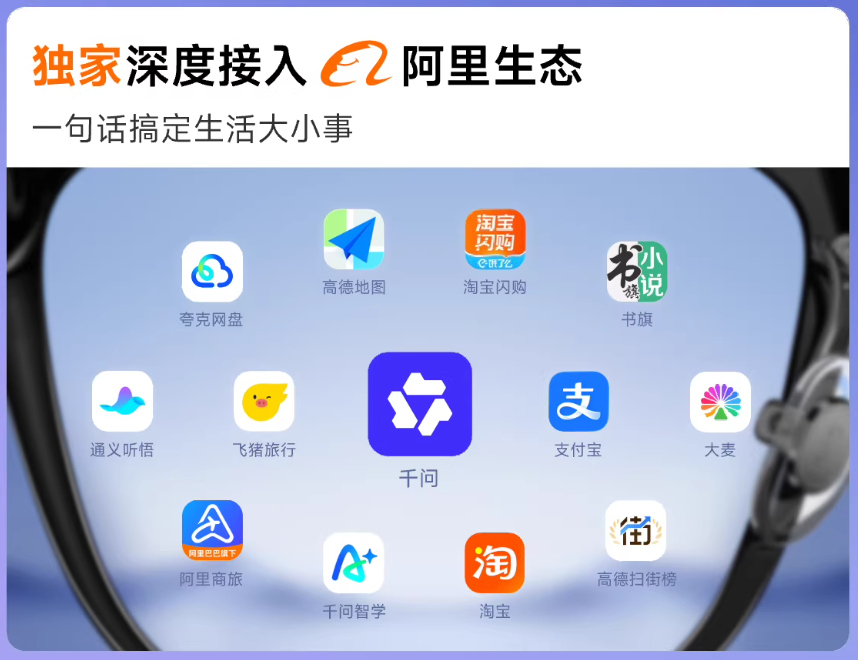
- •Qwen Glasses enable voice/gesture control for ordering, payments; sold out in 3 hours.
- •AI hardware market surges to $41B by 2026; Meta Ray-Ban hits 7M units via ecosystem.
- •Alibaba leverages glasses for first-person data to fuel Qwen model iterations.
🧠 Deep Insight
Background and context from public sources — not the original article. 8 sources cited.
🔑 Enhanced Key Takeaways
- •Alibaba's Qwen achieved 100+ million monthly active users within two months of its $420 million Lunar New Year incentive campaign, demonstrating rapid consumer adoption velocity in the competitive AI market[1].
- •Qwen models have achieved benchmark performance rivaling leading U.S. AI developers, with recent Qwen 3.5 Small Model series (0.8B to 9B parameters) receiving recognition from industry figures like Elon Musk for 'impressive intelligence density'[2].
- •Over 290,000 enterprise customers across robotics, healthcare, finance, and automotive have deployed Qwen via Alibaba's Model Studio as of January 2025, with API calls increasing 15x year-over-year, indicating strong B2B traction beyond consumer hardware[3].
- •Qwen has achieved hardware ecosystem integration across major chipmakers—Apple Silicon, Nvidia, AMD, and Arm have all released optimized Qwen deployments, while MediaTek deployed Qwen3 on Dimensity 9400 smartphone platforms with 20% faster inference through speculative decoding[3].
📊 Competitor Analysis▸ Show
| Aspect | Alibaba Qwen Glasses | Meta Ray-Ban | Apple Vision Pro | Google Glass Enterprise |
|---|---|---|---|---|
| Launch Status | Sold out in 3 hours (2026) | 7M units via ecosystem | Premium AR device | Enterprise-focused |
| AI Integration | Qwen LLM (voice/gesture control) | Meta AI assistant | Siri + on-device ML | Google Assistant |
| Ecosystem Focus | Alibaba services (Taobao, Alipay, Fliggy, Amap) | Meta social ecosystem | Apple ecosystem | Enterprise workflows |
| Market Position | Consumer mass-market | Consumer mainstream | Premium consumer | Enterprise niche |
| Key Differentiator | First-person data for model training | Social integration | Premium hardware | B2B focus |
🛠️ Technical Deep Dive
- Qwen 3.5 Small Model Architecture: Four models spanning 0.8B, 2B, 4B, and 9B parameters; native multimodal models designed for on-device AI deployment and lightweight agents[2]
- Inference Optimization: MediaTek's Dimensity 9400 deployment achieved 20% faster inference through optimized speculative decoding[3]
- Multimodal Capabilities: Qwen-SEA-LION-v4 delivers advanced reasoning, multilingual support, and long-context understanding; ranks first on SEA-HELM leaderboard for Southeast Asian languages among open-source models under 200B parameters[6]
- Hardware Deployment: Qwen models run efficiently on consumer-grade laptops with 32GB RAM; integrated with Nvidia's Drive AGX Orin platform for autonomous vehicles and Qualcomm's Snapdragon 8397 for automotive infotainment[3]
- Open-Source Licensing: Almost all Qwen models released under highly permissive open-source licenses, enabling external providers to offer models without licensing fees to Alibaba[5]
🔮 Future ImplicationsAI analysis grounded in cited sources
⏳ Timeline
📎 Sources (8)
Factual claims are grounded in the sources below. Forward-looking analysis is AI-generated interpretation.
- intellectia.ai — Alibaba Unveils Qwen AI Tools for 2026 Olympics
- TechCrunch — Alibabas Qwen Tech Lead Steps Down After Major AI Push
- asiatimes.com — Alibaba the AI Kingmaker
- vertu.com — Alibaba Qwen Tech Lead Resigns 2026 Chinas AI Future
- brief.bismarckanalysis.com — AI 2026 Alibabas Qwen Seeks to Encourage
- alibabacloud.com — Alibaba Cloud Accelerates Worldwide AI Innovation and Adoption Across Industries 602944
- aibase.com — 25840
- oreateai.com — 4e2403dd647b365a3bee9880393545d5
Weekly AI Recap
Read this week's curated digest of top AI events →
👉Related Updates


AI-curated news aggregator. All content rights belong to original publishers.
Original source: 虎嗅 ↗
This is a summary, not the original. Read the source, or get the weekly briefing.
Weekly AI briefing
One email a week. Unsubscribe anytime.