Alibaba Revives Xiami as an AI Music Model
💡Alibaba’s HappyShrimp enters AI music with strong lyrics but limited professional controls—see where it fits.
⚡ 30-Second TL;DR
What Changed
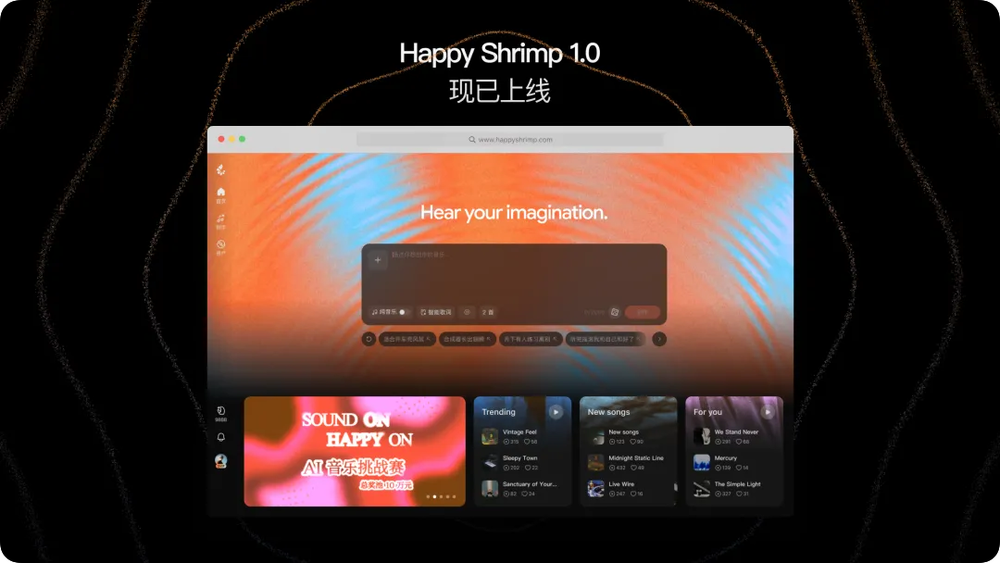
HappyShrimp 1.0 uses a prompt-first interface similar to Suno, with popular songs, new releases, and personalized recommendations alongside the main input box.
Why It Matters
HappyShrimp reflects the industry’s shift from lowering the barrier to music production toward lowering the barrier to expressing musical intent. For AI music builders, the launch suggests that natural-language generation is becoming standard, so differentiation will increasingly depend on controllability, editing workflows, rights, and distribution.
What To Do Next
Run the same structured Chinese-pop prompt through HappyShrimp 1.0, Suno, and Mureka, then compare lyric quality, arrangement consistency, and downstream editing controls before selecting a production workflow.
Key Points
- •HappyShrimp 1.0 uses a prompt-first interface similar to Suno, with popular songs, new releases, and personalized recommendations alongside the main input box.
- •Compared with Mureka and other domestic platforms, it currently offers fewer professional controls such as editing, stem separation, remixing, continuation, and score conversion.
- •In comparative tests, its overall musical quality was less consistent than Mureka and Suno, but its song titles and lyrics showed stronger semantic interpretation and imagery.
- •Alibaba is positioning HappyShrimp within its broader Happy-series AI strategy, alongside products such as HappyHorse and HappyOyster.
- •The launch gives Alibaba an entry into AI music, but the article says its brand, distribution capabilities, and music-industry resources have not yet translated into a clear competitive advantage.
🧠 Deep Insight
Background and context from public sources — not the original article. 14 sources cited.
🔑 Enhanced Key Takeaways
- •HappyShrimp 1.0 was officially released on August 17, 2026, marking a strategic pivot from the defunct Xiami streaming service to a generative AI creative tool.
- •The model employs an end-to-end generation architecture that treats music as a linguistic structure, allowing for holistic planning of lyrics, melody, and arrangement rather than modular assembly.
- •Alibaba integrated the product into the 2026 Aranya Xiami Music Festival (August 28–30) to demonstrate real-time atmospheric music generation capabilities.
- •The brand revival strategy specifically targets the emotional equity of former Xiami Music users, attempting to convert a legacy streaming audience into a modern AI-creator user base.
- •HappyShrimp is part of a unified 'Happy' product ecosystem at Alibaba, sharing underlying infrastructure with the HappyHorse video model and HappyOyster open-world model.
📊 Competitor Analysis▸ Show
| Feature | HappyShrimp 1.0 | Suno / Mureka |
|---|---|---|
| Primary Interface | Prompt-first (Natural Language) | Prompt-first + Advanced Editor |
| Editing Tools | Limited | Extensive (Stem separation, Remix, Continuation) |
| Semantic Depth | High (Imagery/Lyrics) | Moderate |
| Musical Consistency | Variable | High |
| Target User | Casual/Creative | Professional/Prosumer |
🛠️ Technical Deep Dive
- Architecture: End-to-end full-track generation model that treats music as a language with distinct grammar and semantics.
- Processing: Holistic generation approach that plans lyrics, melody, and structure simultaneously to maintain thematic coherence.
- Input Handling: Natural language processing (NLP) engine optimized for interpreting emotional and narrative prompts into musical parameters.
🔮 Future ImplicationsAI analysis grounded in cited sources
⏳ Timeline
📎 Sources (14)
Factual claims are grounded in the sources below. Forward-looking analysis is AI-generated interpretation.
Weekly AI Recap
Read this week's curated digest of top AI events →
👉Related Updates

AI-curated news aggregator. All content rights belong to original publishers.
Original source: 虎嗅 ↗
This is a summary, not the original. Read the source, or get the weekly briefing.
Weekly AI briefing
One email a week. Unsubscribe anytime.