AI Writing Revealed by Story Structure
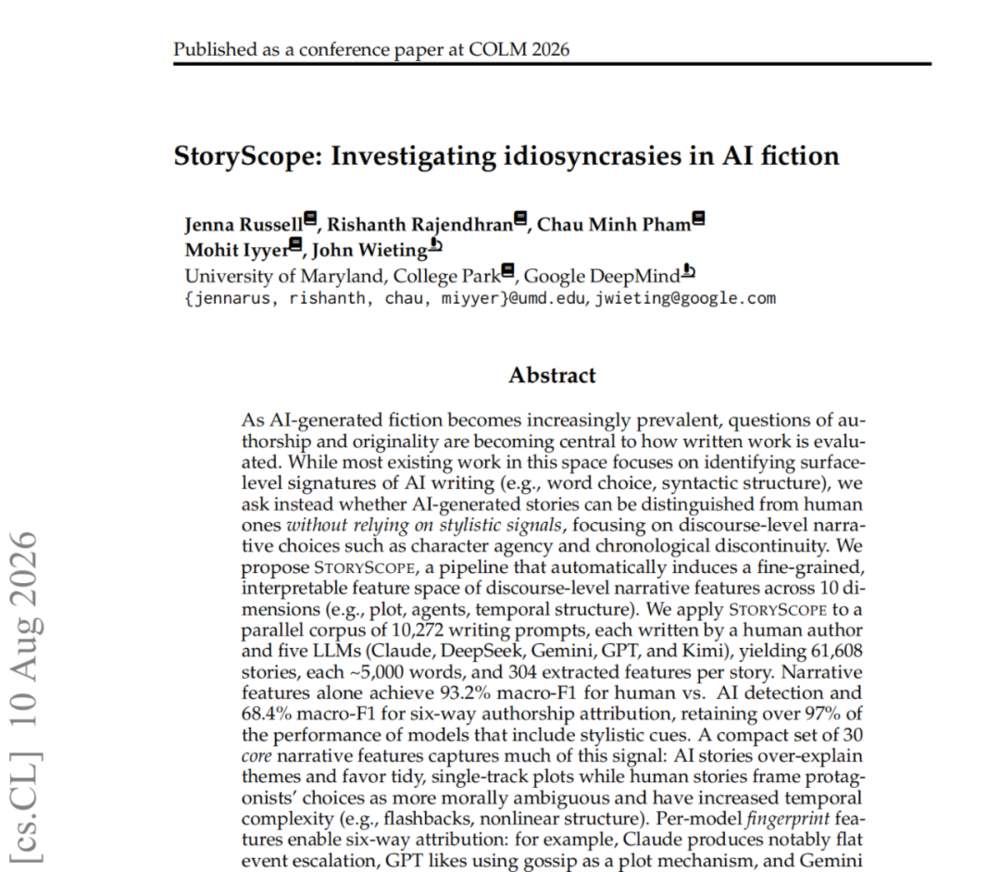
💡AI can change its wording, but StoryScope shows its narrative skeleton may still give it away.
⚡ 30-Second TL;DR
What Changed
The study analyzed 61,608 English short stories, including human originals and outputs from Claude, DeepSeek, Gemini, GPT, and Kimi.
Why It Matters
The findings suggest that AI-content detection should move beyond banned-word lists and examine planning, causality, character agency, and narrative closure. For model builders, reducing detectable AI style may require changing generation and planning behavior rather than merely applying a rewrite pass.
What To Do Next
Evaluate your long-form generation pipeline with structural metrics such as subplot rate, explicit theme statements, temporal transitions, and ending closure instead of relying only on style prompts.
Key Points
- •The study analyzed 61,608 English short stories, including human originals and outputs from Claude, DeepSeek, Gemini, GPT, and Kimi.
- •A classifier based on 304 narrative features across 10 dimensions achieved a 93.2% macro-F1 score without relying on word choice or sentence length.
- •AI stories were more likely to explicitly explain themes, use dialogue to discuss life lessons, avoid subplots, and close narratives with a decisive resolution.
- •Removing clichés and redundant explanations from Gemini stories reduced detection accuracy only from 95.5% to 93.9%, suggesting structural patterns are more persistent than stylistic tics.
🧠 Deep Insight
Background and context from public sources — not the original article. 7 sources cited.
🔑 Enhanced Key Takeaways
- •AI models exhibit a distinct 'emotional formula' where 81% of emotional descriptions rely on physical metaphors, whereas human authors prefer direct expression in only 38% of cases.
- •The 2026 EU AI Act, effective August 2, mandates machine-readable watermarking for AI-generated content, forcing platforms to adopt stricter transparency protocols for narrative outputs.
- •Modern AI writing platforms like 'Lingxie' (灵蟹) have shifted from simple text generation to structural management, allowing independent maintenance of world-building, character arcs, and plot outlines.
- •The industry is transitioning toward 'AI-native' content where narratives are not static but dynamically evolve based on user interaction, moving beyond the static linear plots identified in the StoryScope study.
- •OpenAI's Astra model architecture facilitates multi-agent collaboration, enabling specialized agents to handle distinct narrative layers (e.g., dialogue vs. world-building) to mitigate the 'AI-flavor' identified in the study.
🛠️ Technical Deep Dive
- •
- Classifier architecture: Utilizes a 304-feature vector space focusing on narrative topology rather than lexical frequency.
- •
- Feature dimensions: Includes causal chain density, thematic explicitness, resolution closure, subplot branching factor, and dialogue-to-exposition ratios.
- •
- Robustness testing: Evaluated via adversarial editing (cliché removal and redundancy pruning) to measure the persistence of structural 'fingerprints'.
- •
- Model-specific behavioral profiles: Claude (quiet resolutions), GPT (gossip-driven pacing), Gemini (clean endings), and DeepSeek (early information disclosure).
🔮 Future ImplicationsAI analysis grounded in cited sources
⏳ Timeline
📎 Sources (7)
Factual claims are grounded in the sources below. Forward-looking analysis is AI-generated interpretation.
Weekly AI Recap
Read this week's curated digest of top AI events →
👉Related Updates

AI-curated news aggregator. All content rights belong to original publishers.
Original source: 虎嗅 ↗
This is a summary, not the original. Read the source, or get the weekly briefing.
Weekly AI briefing
One email a week. Unsubscribe anytime.