AI Sonar Tested in RIMPAC 2026
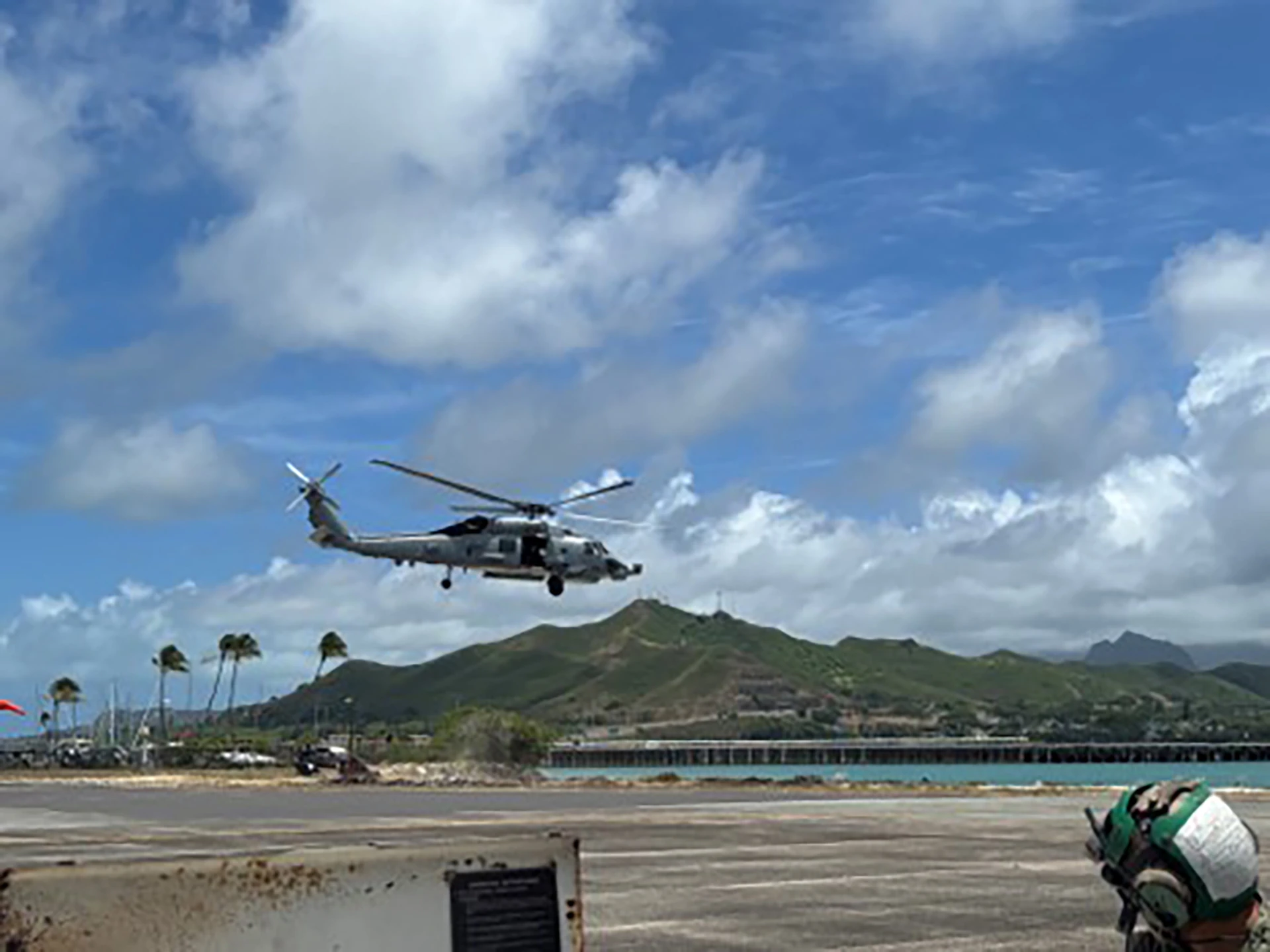
💡A military field test shows how AI is moving from lab demos to noisy, high-stakes sensing missions.
⚡ 30-Second TL;DR
What Changed
The test took place during the 2026 Rim of the Pacific, or RIMPAC, exercise.
Why It Matters
Successful field testing could accelerate the use of AI-assisted sensing in defense and other mission-critical environments. For AI practitioners, it underscores the importance of robust inference, noisy-signal processing, and human oversight in real-world deployments.
What To Do Next
Use PyTorch to benchmark your audio-classification pipeline on noisy, low-signal recordings and add human-review thresholds before production deployment.
Key Points
- •The test took place during the 2026 Rim of the Pacific, or RIMPAC, exercise.
- •The U.S. Navy partnered with Lockheed Martin on the anti-submarine warfare test.
- •Two modified Sikorsky MH-60R Seahawk helicopters carried the AI sonar system.
- •The system was used to support submarine detection and search operations.
🧠 Deep Insight
AI-generated analysis for this event.
🔑 Enhanced Key Takeaways
- •The AI sonar system utilizes a machine learning algorithm known as 'Acoustic Pattern Recognition' (APR) to filter out ambient ocean noise in real-time, significantly reducing false positive detections.
- •Integration with the MH-60R Seahawk's existing AN/AQS-22 Airborne Low-Frequency Sonar (ALFS) allows the AI to process data streams faster than human operators, shortening the OODA loop for submarine tracking.
- •The test specifically focused on detecting 'quiet' diesel-electric submarines, which are notoriously difficult to track due to their low acoustic signatures compared to nuclear-powered vessels.
- •Data collected during RIMPAC 2026 is being fed into a centralized U.S. Navy 'Digital Twin' environment to refine the AI's neural network weights for future deployment across the fleet.
- •This initiative is part of the broader 'Project Overmatch' effort, aimed at connecting distributed naval assets through a unified, AI-enabled tactical network.
📊 Competitor Analysis▸ Show
| Feature | Lockheed Martin AI Sonar | Northrop Grumman (AQS-24) | Thales (FLASH Sonar) |
|---|---|---|---|
| Primary Focus | AI-Driven Pattern Recognition | High-speed Mine Hunting | Long-range ASW Detection |
| Platform | MH-60R / Autonomous Systems | MH-60S / Unmanned Surface Vessels | NH90 / AW101 Helicopters |
| AI Integration | Advanced Neural Network | Limited / Legacy Processing | Modular / Software-Defined |
🛠️ Technical Deep Dive
- Utilizes edge computing modules installed directly on the MH-60R to minimize latency between sensor acquisition and AI inference.
- Employs a multi-modal sensor fusion approach, correlating sonar acoustic data with magnetic anomaly detection (MAD) inputs.
- Architecture is based on a convolutional neural network (CNN) optimized for underwater acoustic signal classification.
- Features an 'Explainable AI' (XAI) interface that provides operators with a confidence score and visual heatmap of potential submarine locations.
🔮 Future ImplicationsAI analysis grounded in cited sources
⏳ Timeline
Weekly AI Recap
Read this week's curated digest of top AI events →
👉Related Updates



AI-curated news aggregator. All content rights belong to original publishers.
Original source: cnBeta (Full RSS) ↗