AI-Powered Lifecycle Management for Feature Flags
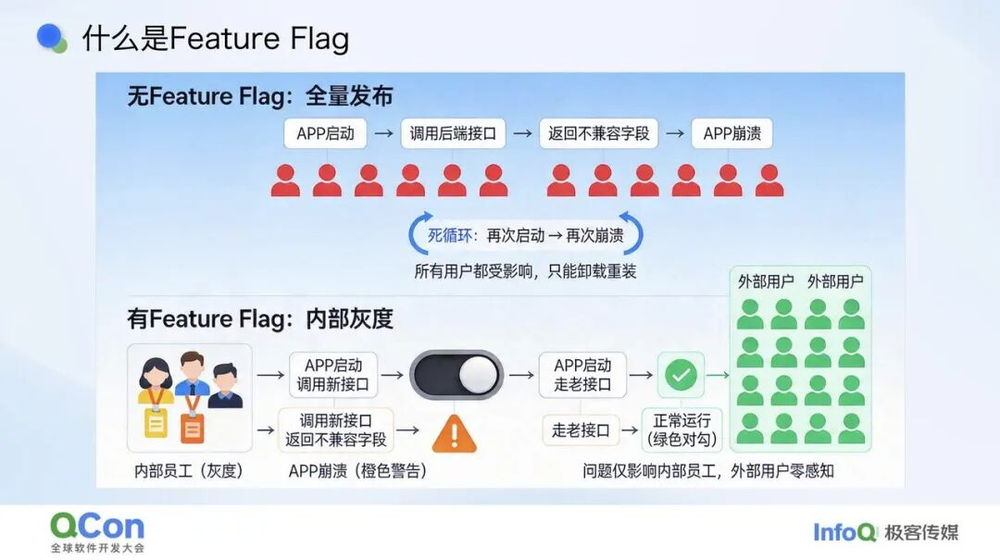
💡Learn how to use AI Agents to automate the cleanup of technical debt and manage feature flag lifecycles at scale.
⚡ 30-Second TL;DR
What Changed
Feature flags create significant technical debt, leading to maintenance costs and stability risks.
Why It Matters
Reduces technical debt and operational overhead in large-scale software systems by automating code cleanup.
What To Do Next
Audit your codebase for stale feature flags and prototype an LLM-based agent to identify and suggest removal for flags with 100% rollout.
Key Points
- •Feature flags create significant technical debt, leading to maintenance costs and stability risks.
- •Traditional manual governance fails due to lack of developer incentive and complexity.
- •Kuaishou implemented AI Agents to automate the identification and removal of obsolete flags.
- •The goal is 'AI Native' governance where the system self-evolves and flags expire automatically.
🧠 Deep Insight
AI-generated analysis for this event — not the original article.
🔑 Enhanced Key Takeaways
- •Kuaishou's implementation utilizes a Large Language Model (LLM) integrated into their CI/CD pipeline to perform static code analysis and identify stale flag references in real-time.
- •The system employs a 'probabilistic expiration' model where flags are automatically tagged for removal based on a combination of last-accessed timestamps and developer-defined TTL (Time-to-Live) policies.
- •By automating flag cleanup, Kuaishou reported a reduction in 'dead code' bloat, which previously accounted for an estimated 15% of their codebase complexity in core modules.
- •The AI agent framework includes a human-in-the-loop verification step where developers receive automated pull requests (PRs) to confirm the removal of identified obsolete flags before final merging.
- •This initiative is part of Kuaishou's broader 'AIGC-driven Engineering Efficiency' strategy, which aims to reduce manual DevOps overhead by 40% across their microservices architecture.
📊 Competitor Analysis▸ Show
| Feature | Kuaishou (Internal AI Agent) | LaunchDarkly (Flag Management) | Split.io (Feature Experimentation) |
|---|---|---|---|
| Flag Cleanup | Automated AI-driven PR generation | Manual/Rule-based cleanup | Manual/Rule-based cleanup |
| Governance | Native AI-Agent lifecycle | Policy-based access control | Experimentation-focused |
| Integration | Custom CI/CD pipeline | Extensive SDK/API support | Extensive SDK/API support |
| Pricing | Internal (N/A) | Tiered Subscription | Tiered Subscription |
🛠️ Technical Deep Dive
- The system architecture leverages a fine-tuned Transformer model trained on internal Kuaishou code repositories to recognize flag patterns and usage context.
- It utilizes Abstract Syntax Tree (AST) parsing to ensure that flag removal does not break dependent logic or introduce syntax errors.
- The agent monitors telemetry data from the production environment to verify that a flag has zero active traffic before triggering the removal workflow.
- Integration is achieved via webhooks in the internal Git platform, allowing the AI to trigger automated testing suites immediately upon suggesting a flag deletion.
🔮 Future ImplicationsAI analysis grounded in cited sources
⏳ Timeline
Weekly AI Recap
Read this week's curated digest of top AI events →
👉Related Updates


AI-curated news aggregator. All content rights belong to original publishers.
Original source: 虎嗅 ↗
This is a summary, not the original. Read the source, or get the weekly briefing.
Weekly AI briefing
One email a week. Unsubscribe anytime.