AI Pavilion Year 4 Emphasizes MPUs Over MCUs
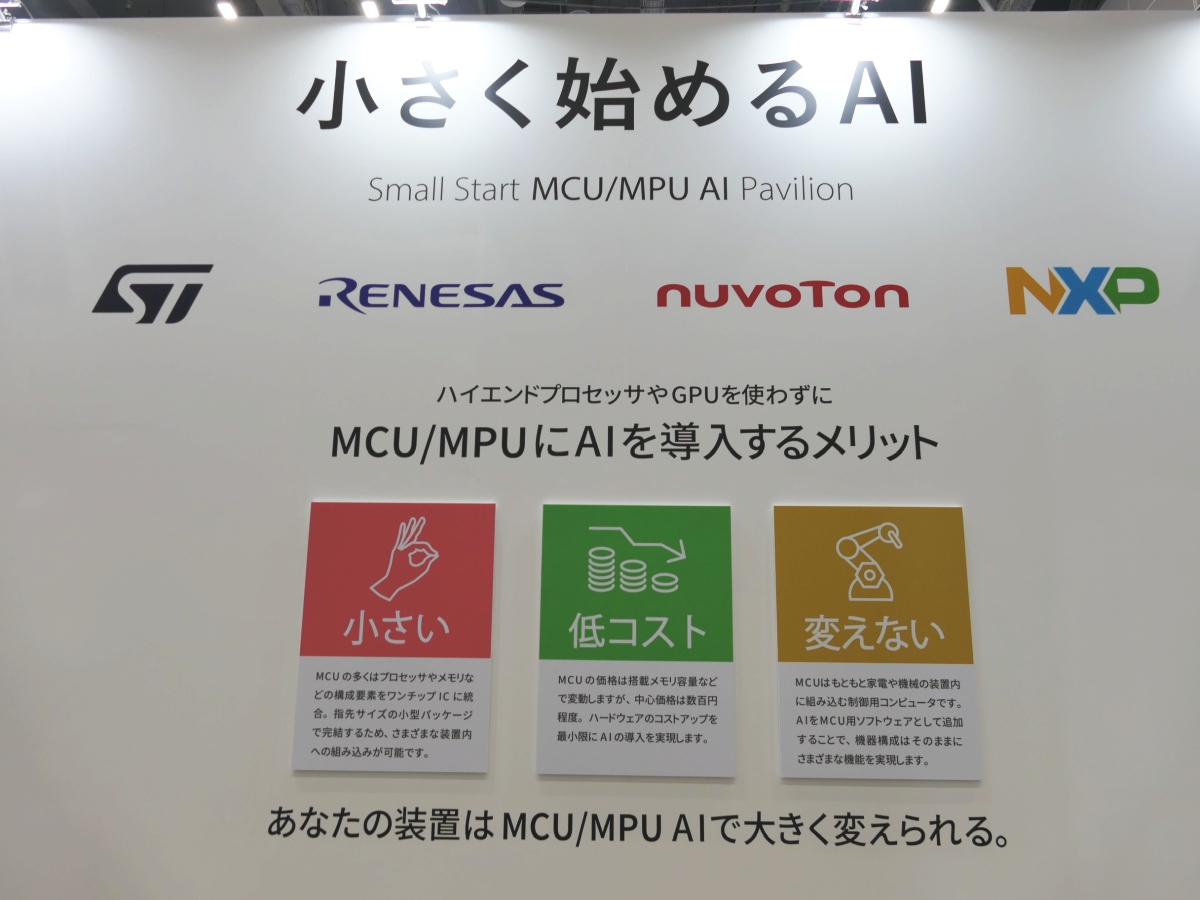
💡Edge AI on MCUs/MPUs gets MPU boost—ideal for low-power prototypes
⚡ 30-Second TL;DR
What Changed
4th year of Small Start AI Pavilion at AI EXPO spring
Why It Matters
Boosts adoption of edge AI in IoT devices via affordable MCUs/MPUs. Helps practitioners prototype power-efficient AI without high-end hardware.
What To Do Next
Visit AI EXPO site to download exhibitor edge AI SDKs from Renesas or NXP.
Key Points
- •4th year of Small Start AI Pavilion at AI EXPO spring
- •Exhibitors: STMicroelectronics, NXP Japan, Nuvoton, Renesas
- •Shift to more MPU-focused low-power AI demos
- •Emphasizes practical edge AI on embedded processors
🧠 Deep Insight
AI-generated analysis for this event — not the original article.
🔑 Enhanced Key Takeaways
- •The shift toward MPUs reflects the growing demand for 'Vision AI' and complex sensor fusion tasks that exceed the memory and clock speed limitations of traditional Cortex-M based MCUs.
- •The 'Small Start AI' initiative is specifically designed to bridge the gap for Japanese manufacturing firms (Monozukuri) that struggle with the high barrier to entry for cloud-based AI integration.
- •Exhibitors are increasingly leveraging standardized software stacks like CMSIS-NN and specialized neural network compilers to ensure portability between their MCU and MPU product lines.
🛠️ Technical Deep Dive
- •Transition from MCU (Cortex-M series) to MPU (Cortex-A series) architectures allows for the integration of dedicated NPU (Neural Processing Unit) accelerators, often exceeding 1-2 TOPS of performance.
- •Implementation of 'TinyML' workflows now frequently utilizes quantization-aware training (QAT) to fit models into the limited SRAM of edge devices while maintaining INT8 precision.
- •Increased adoption of heterogeneous computing architectures, where the MPU handles high-level AI inference while the integrated real-time core (Cortex-M) manages deterministic I/O and sensor data acquisition.
🔮 Future ImplicationsAI analysis grounded in cited sources
⏳ Timeline
Weekly AI Recap
Read this week's curated digest of top AI events →
👉Related Updates
AI-curated news aggregator. All content rights belong to original publishers.
Original source: ITmedia AI+ (日本) ↗
This is a summary, not the original. Read the source, or get the weekly briefing.
The weekly digest
One email a week. Unsubscribe anytime.