AI Memory Crisis Drives 60% DDR2 Price Hike
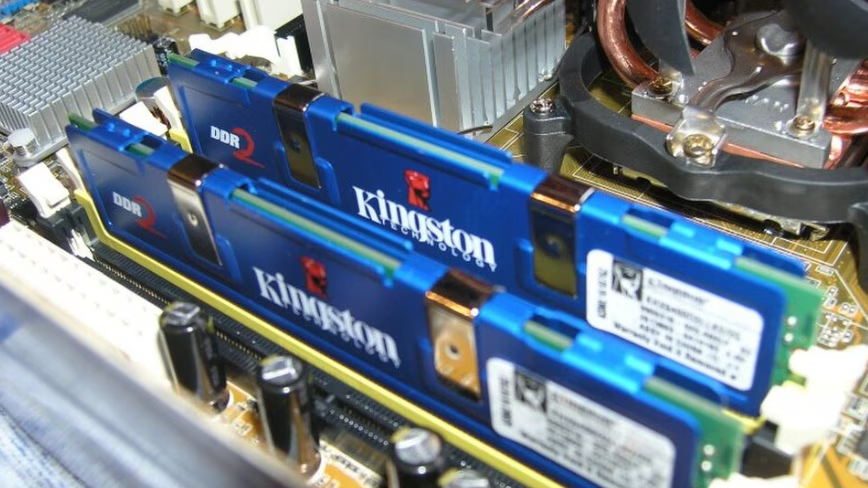
AI memory demand is now impacting legacy hardware prices; check your supply chain for potential cost spikes.
30-Second TL;DR
What Changed
DDR2 contract prices surged 55-60% in Q2 2026
Why It Matters
Supply chain constraints for legacy memory may increase costs for specialized industrial AI hardware that still relies on older architectures.
What To Do Next
Audit your hardware infrastructure and secure long-term supply contracts for legacy components if your AI edge devices rely on older DRAM.
Key Points
- •DDR2 contract prices surged 55-60% in Q2 2026
- •TrendForce forecasts an additional 35-40% price hike in Q3
- •AI demand is creating supply chain pressure even on legacy memory standards
Deep Insight
AI-generated analysis for this event — not the original article.
Enhanced Key Takeaways
- •The surge in DDR2 pricing is primarily driven by industrial and embedded systems manufacturers who cannot easily migrate to modern DDR5 architectures due to long-term hardware support contracts.
- •Major DRAM manufacturers have largely ceased DDR2 production lines, shifting capacity to HBM3e and DDR5 to satisfy the high-margin AI server market.
- •Secondary market brokers are reporting a 'scarcity premium' as stockpiles of refurbished and new-old-stock (NOS) DDR2 modules are depleted by legacy infrastructure maintenance.
- •The price volatility is forcing critical infrastructure sectors, including power grids and telecommunications, to consider expensive 'last-time-buy' procurement strategies to avoid system obsolescence.
- •While DDR2 is the most affected by percentage, the shortage has created a ripple effect causing price instability in DDR3 and DDR4 modules as manufacturers prioritize AI-grade memory silicon.
Technical Deep Dive
- DDR2 memory operates on a 1.8V standard, significantly higher than the 1.1V used in DDR5, leading to higher thermal output in legacy embedded controllers.
- The interface utilizes a parallel bus architecture that lacks the on-die ECC (Error Correction Code) features found in modern DDR5, making legacy systems more susceptible to bit-flip errors in high-radiation or high-heat industrial environments.
- Legacy DDR2 modules typically utilize 80nm to 65nm process nodes, which are no longer supported by modern semiconductor fabrication plants, necessitating the use of expensive, low-yield legacy fab lines.
Future ImplicationsAI analysis grounded in cited sources
Timeline
- 2024-01Major DRAM manufacturers announce final phase-out of legacy DDR2 production lines.
- 2025-06AI server demand begins to consume 70% of global DRAM fabrication capacity.
- 2026-03DDR2 spot market prices begin to decouple from standard commodity DRAM pricing trends.
Weekly AI Recap
Read this week's curated digest of top AI events →
Related Updates


AI-curated news aggregator. All content rights belong to original publishers.
Original source: The Next Web (TNW) ↗
This is a summary, not the original. Read the source, or get the weekly briefing.
The weekly digest
One email a week. Unsubscribe anytime.