AI hardware sector sees surge in startup activity
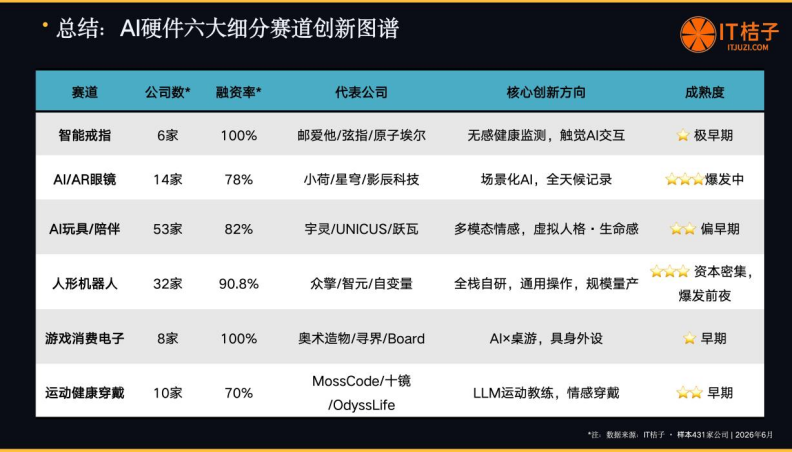
💡Insightful analysis of the AI hardware landscape, funding trends, and the shift toward proactive AI interactions.
⚡ 30-Second TL;DR
What Changed
431 new AI hardware companies identified, with 179 receiving funding in H1 2026.
Why It Matters
The shift toward scenario-specific AI hardware suggests a fragmented but highly specialized market where software-hardware synergy is the primary competitive moat.
What To Do Next
Evaluate your hardware roadmap for 'proactive interaction' capabilities; focus on specific user scenarios rather than general AI features.
Key Points
- •431 new AI hardware companies identified, with 179 receiving funding in H1 2026.
- •Embodied AI robots lead in funding, while wearables like AI glasses and rings show high growth potential.
- •Industry faces a 'hammer looking for a nail' problem; success requires balancing tech with market needs.
- •Active interaction (proactive sensing) is the next frontier, requiring better edge computing and privacy.
🧠 Deep Insight
AI-generated analysis for this event — not the original article.
🔑 Enhanced Key Takeaways
- •The surge in AI hardware is heavily driven by the maturation of RISC-V architecture, which allows startups to customize instruction sets for specific AI inference tasks at lower costs than traditional ARM or x86 designs.
- •Supply chain data indicates a significant shift in semiconductor procurement, with AI hardware startups increasingly utilizing 3nm and 4nm process nodes to optimize the power-to-performance ratio required for battery-constrained wearable devices.
- •Venture capital investment patterns in 2026 show a pivot away from 'foundation model' startups toward 'verticalized hardware' companies that integrate proprietary sensor fusion algorithms directly into the silicon.
- •Regulatory bodies in major markets have begun drafting specific privacy-by-design mandates for AI-enabled wearables, forcing startups to implement on-device data processing (Local AI) to ensure compliance with data sovereignty laws.
- •The 'active interaction' trend is being accelerated by the integration of multimodal Large Action Models (LAMs) that allow hardware to execute multi-step tasks rather than just responding to voice or visual queries.
🛠️ Technical Deep Dive
- Shift toward heterogeneous computing architectures combining NPU (Neural Processing Unit) cores with low-power DSPs for always-on sensing.
- Implementation of Transformer-based hardware acceleration blocks designed to handle KV-cache compression directly at the edge.
- Adoption of advanced packaging technologies like Chiplets to integrate memory and logic dies, reducing latency in real-time embodied AI applications.
- Utilization of neuromorphic sensing inputs to reduce power consumption in proactive sensing hardware by processing only event-based data changes.
🔮 Future ImplicationsAI analysis grounded in cited sources
Weekly AI Recap
Read this week's curated digest of top AI events →
👉Related Updates


AI-curated news aggregator. All content rights belong to original publishers.
Original source: 虎嗅 ↗
This is a summary, not the original. Read the source, or get the weekly briefing.
Weekly AI briefing
One email a week. Unsubscribe anytime.