🟢NVIDIA Blog•Stalecollected in 30m
NVIDIA and Hugging Face Expand LeRobot Open Robotics Ecosystem
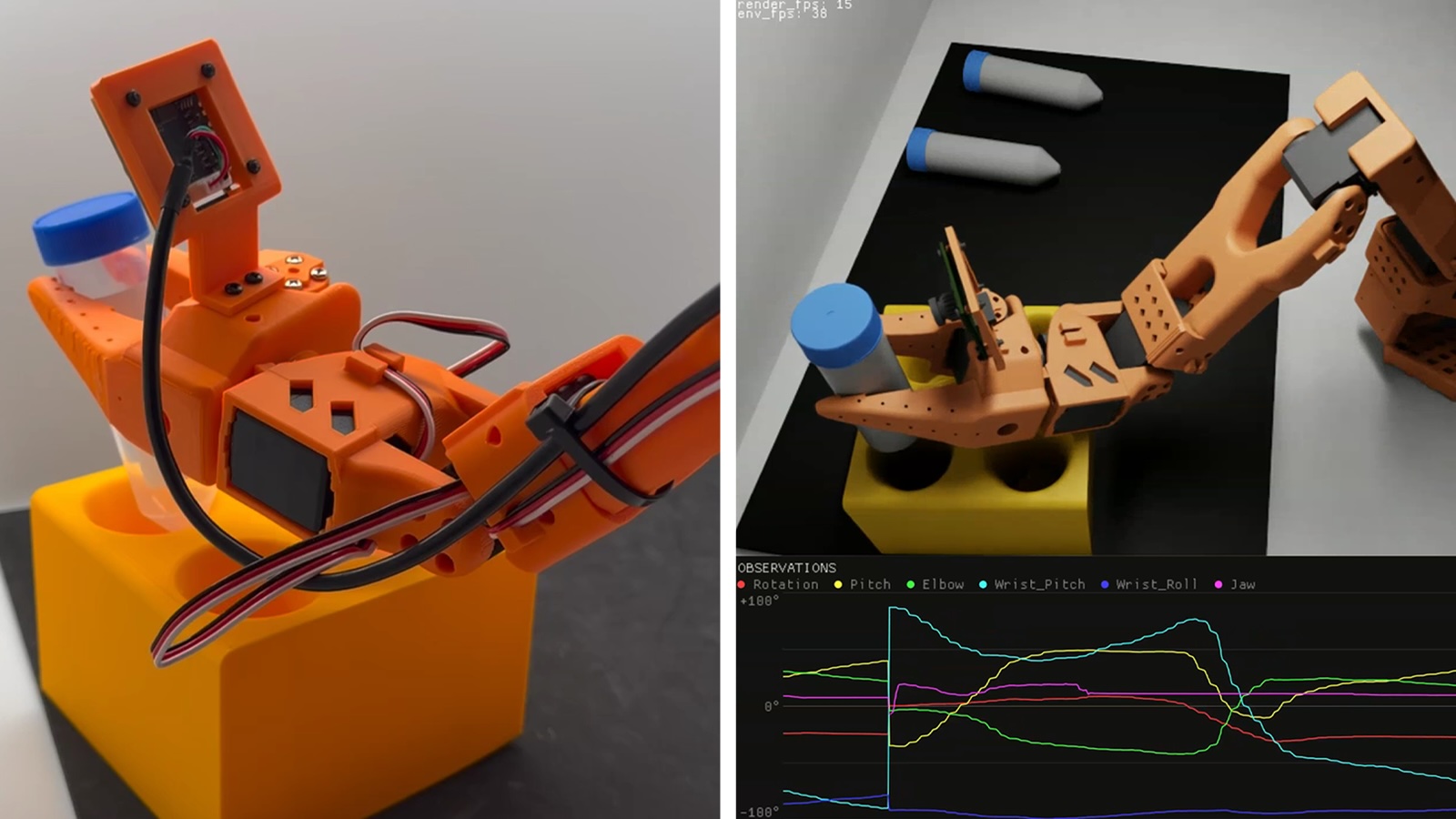
💡NVIDIA 與 Hugging Face 聯手降低機器人 AI 開發門檻,獲取最新的開源模型與模擬工具。
⚡ 30-Second TL;DR
What Changed
整合 NVIDIA 的模擬與運算工具至 Hugging Face 的 LeRobot 平台
Why It Matters
這項合作顯著降低了機器人學習的入門門檻,讓開發者能更輕易地存取工業級的模擬與訓練資源。預計將加速開源機器人社群在具身智慧(Embodied AI)領域的研發速度。
What To Do Next
前往 Hugging Face 的 LeRobot 儲存庫,下載最新的模型與模擬工具,開始測試你的機器人控制策略。
Who should care:Developers & AI Engineers
Key Points
- •整合 NVIDIA 的模擬與運算工具至 Hugging Face 的 LeRobot 平台
- •提供開源的機器人基礎模型與大型數據集
- •解決物理 AI 開發中資源碎片化與成本高昂的問題
🧠 Deep Insight
AI-generated analysis for this event — not the original article.
🔑 Enhanced Key Takeaways
- •The collaboration leverages NVIDIA Isaac Sim and Isaac Lab to provide high-fidelity synthetic data generation, which is critical for training LeRobot models where real-world data is scarce.
- •NVIDIA's Jetson platform is now natively optimized for deploying LeRobot-trained policies, enabling edge-AI execution with low latency on physical robotic hardware.
- •The initiative includes the integration of NVIDIA's cuRobo library, which provides accelerated motion planning and collision avoidance capabilities for the LeRobot ecosystem.
- •This partnership aims to standardize the 'Robot-as-a-Service' (RaaS) development pipeline by aligning Hugging Face's model hub workflows with NVIDIA's Omniverse-based simulation environments.
- •The ecosystem expansion introduces support for multi-modal transformer architectures specifically tuned for robotic manipulation tasks, moving beyond simple imitation learning.
📊 Competitor Analysis▸ Show
| Feature | NVIDIA/Hugging Face (LeRobot) | Google DeepMind (RT-2/AutoRT) | Tesla (Optimus/FSD) |
|---|---|---|---|
| Open Source | High (Open Weights/Code) | Low (Research-focused) | None (Proprietary) |
| Simulation | Isaac Sim (Omniverse) | MuJoCo / Custom | Proprietary Internal Sim |
| Hardware Focus | Agnostic (Jetson-optimized) | Agnostic | Vertical Integration |
| Primary Goal | Democratization of Robotics | General Purpose Embodied AI | Commercial Product Scaling |
🛠️ Technical Deep Dive
- Integration of NVIDIA Isaac Lab allows for reinforcement learning (RL) training loops that are significantly faster than traditional CPU-based simulation.
- LeRobot models utilize transformer-based policy architectures that ingest multi-modal inputs including RGB-D camera streams and proprioceptive robot state data.
- Support for the Open-X Embodiment dataset format ensures interoperability between LeRobot and other research-grade robotic datasets.
- Deployment utilizes TensorRT optimization to convert PyTorch-based LeRobot models into high-performance inference engines for Jetson Orin and Thor modules.
- Implementation of the 'Sim-to-Real' transfer pipeline uses domain randomization techniques within Isaac Sim to bridge the reality gap for vision-based policies.
🔮 Future ImplicationsAI analysis grounded in cited sources
Standardization of robotic foundation models will accelerate the commercial viability of general-purpose humanoid robots.
By lowering the barrier to entry for data collection and model training, the ecosystem creates a flywheel effect that reduces the cost of developing specialized robotic skills.
NVIDIA will capture a dominant share of the physical AI infrastructure market.
By embedding their simulation and edge-computing stack into the most popular open-source robotics framework, NVIDIA ensures that developers are locked into their hardware-software ecosystem.
⏳ Timeline
2024-05
Hugging Face launches the LeRobot library to democratize robotics research.
2024-06
NVIDIA announces Isaac Lab, a modular framework for robot learning in simulation.
2025-03
Hugging Face and NVIDIA announce initial collaboration to integrate Isaac Sim with LeRobot.
2026-07
Expansion of the LeRobot ecosystem with new NVIDIA-optimized models and development tools.
📰
Weekly AI Recap
Read this week's curated digest of top AI events →
👉Related Updates

AI-curated news aggregator. All content rights belong to original publishers.
Original source: NVIDIA Blog ↗
This is a summary, not the original. Read the source, or get the weekly briefing.
Weekly AI briefing
One email a week. Unsubscribe anytime.