AI faces legal challenges similar to Big Tobacco lawsuits
💡Understand the looming legal risks that could reshape the AI industry's regulatory landscape.
⚡ 30-Second TL;DR
What Changed
Senator Ed Markey suggests the 'Big Tobacco moment' for AI is already here.
Why It Matters
AI developers must prepare for increased scrutiny regarding data usage, copyright, and the societal impact of their models.
What To Do Next
Audit your training data sources and implement robust provenance tracking to mitigate future copyright litigation risks.
Key Points
- •Senator Ed Markey suggests the 'Big Tobacco moment' for AI is already here.
- •Legal machinery used against tobacco is being adapted for AI and social media.
- •Potential for massive settlements could fundamentally transform AI marketing and regulation.
🧠 Deep Insight
Background and context from public sources — not the original article. 18 sources cited.
🔑 Enhanced Key Takeaways
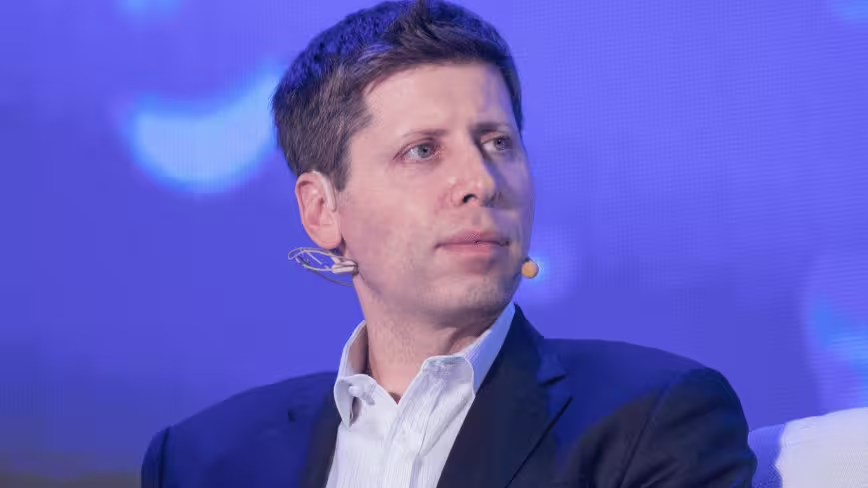
- •Florida has initiated a 10-count lawsuit against OpenAI and its CEO, Sam Altman, alleging deceptive trade practices, negligence, product liability violations, fraudulent misrepresentation, and public nuisance, specifically treating ChatGPT as a defective product, marking the first state to sue an AI company over product design and safety using legal theories akin to those against tobacco and opioid manufacturers.
- •The European Union is developing a comprehensive legal framework, including the AI Act (Regulation (EU) 2024/1689) and a proposed AI Liability Directive, which aims to adapt non-contractual civil liability rules for AI systems by introducing a rebuttable 'presumption of causality' to simplify the burden of proof for victims and granting national courts the authority to mandate disclosure of evidence for high-risk AI systems.
- •Senator Ed Markey has introduced significant legislation, including the "Artificial Intelligence (AI) Civil Rights Act" (S. 5152) to prohibit discriminatory algorithms, mandate independent audits, and grant individuals the right to appeal AI-based decisions, and the "Youth AI Privacy Act" to implement privacy safeguards in AI chatbots for minors, such as an advertising ban and restrictions on using minors' personal data for training.
- •A primary legal challenge for AI companies, especially those developing generative AI, revolves around copyright infringement and data scraping, with lawsuits like The New York Times against OpenAI and Microsoft alleging that large language models are trained on copyrighted material without proper authorization, potentially enabling AI to reproduce content and bypass paywalls.
- •The White House Office of Science and Technology Policy (OSTP) published the "Blueprint for an AI Bill of Rights" in October 2022, a non-binding framework outlining five core principles—safe and effective systems, algorithmic discrimination protections, data privacy, notice and explanation, and human alternatives—to guide the ethical design and deployment of AI systems, despite lacking direct legal enforceability.
🛠️ Technical Deep Dive
- Generative AI models, particularly large language models (LLMs) like ChatGPT, are central to copyright infringement lawsuits due to their reliance on extensive web scraping for training data.
- Recommendation algorithms and other complex AI algorithms are under scrutiny for potential bias and discrimination in critical sectors such as housing, healthcare, employment, and financial services.
- AI chatbots are specifically implicated in legal concerns regarding privacy and safety for minors, including issues related to data collection, manipulative design, and the use of personal data for training or profiling.
- Web scraping, the automated collection of data from online sources, is a key technical process facing legal challenges, including claims of copyright infringement, breach of website terms of service, and potential violations of the Computer Fraud and Abuse Act (CFAA) when used to gather data for AI model training.
🔮 Future ImplicationsAI analysis grounded in cited sources
⏳ Timeline
📎 Sources (18)
Factual claims are grounded in the sources below. Forward-looking analysis is AI-generated interpretation.
Weekly AI Recap
Read this week's curated digest of top AI events →
👉Related Updates


AI-curated news aggregator. All content rights belong to original publishers.
Original source: The Next Web (TNW) ↗
This is a summary, not the original. Read the source, or get the weekly briefing.
The weekly digest
One email a week. Unsubscribe anytime.