AI Excels at Massive SWE Tasks, Timelines Shorten
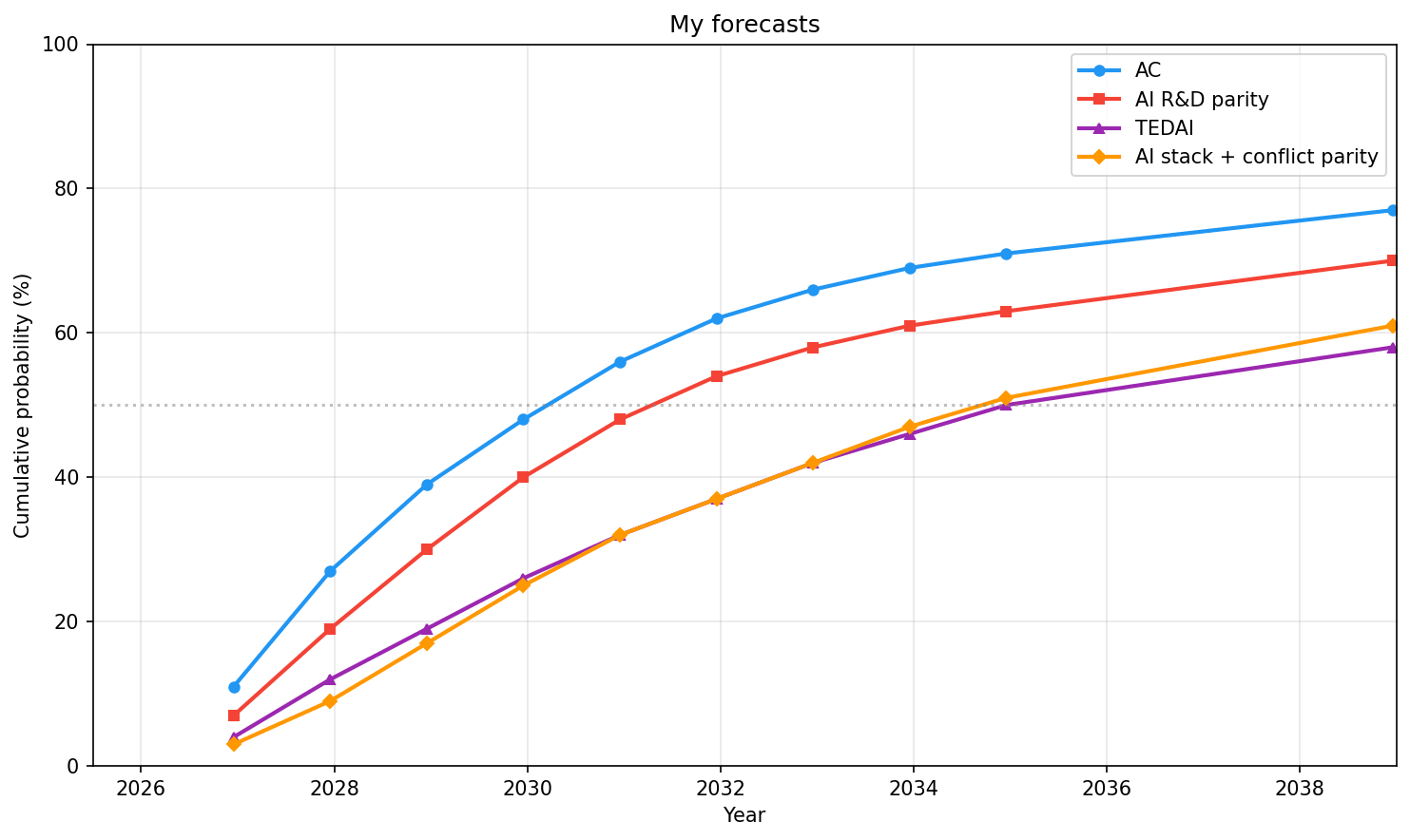
AI now autonomously does months-long SWE—recalibrate your timelines now!
30-Second TL;DR
What Changed
Updated AI R&D automation probability to ~30% by EOY 2028 (from 15%)
Why It Matters
Signals accelerating AI capabilities in coding, potentially enabling faster iteration on AI systems themselves. Could shift strategies towards AI-assisted development sooner than expected.
What To Do Next
Test Claude Opus on your large easy-to-verify SWE tasks with basic scaffolding today.
Key Points
- •Updated AI R&D automation probability to ~30% by EOY 2028 (from 15%)
- •AIs handle massive ESNI tasks with 50% reliability horizon of months-years using public models
- •Impressed by Opus 4.5/4.6, Codex 5.2 demos like autonomous C compiler and METR results
Deep Insight
AI-generated analysis for this event — not the original article.
Enhanced Key Takeaways
- •The acceleration in software engineering automation is largely attributed to the integration of 'long-context reasoning loops' that allow models to maintain state across millions of lines of code, surpassing previous limitations of window-size constraints.
- •METR (Monitoring and Evaluation of Threats and Risks) benchmarks have shifted focus from static code completion to 'agentic autonomy,' where models are evaluated on their ability to navigate complex, multi-step build environments without human intervention.
- •The shift in timelines is driven by the emergence of 'recursive self-improvement' in coding agents, where models are now capable of debugging their own generated build scripts, significantly reducing the human-in-the-loop requirement for large-scale refactoring.
Technical Deep Dive
- •Opus 4.5/4.6 architecture utilizes a Mixture-of-Experts (MoE) configuration optimized for high-throughput token generation during long-context retrieval tasks.
- •Codex 5.2 incorporates a specialized 'System-Call-Aware' training objective, enabling the model to interact directly with Linux kernel interfaces and compiler toolchains.
- •The autonomous C compiler demo relies on a multi-agent orchestration framework that separates the 'Planner' agent (high-level logic) from the 'Executor' agent (low-level syntax and build validation).
Future ImplicationsAI analysis grounded in cited sources
Timeline
- 2025-03Release of initial METR agentic evaluation framework for software engineering.
- 2025-09Deployment of Codex 5.0, introducing improved reasoning for multi-file codebases.
- 2026-01Public demonstration of autonomous C compiler agent using Codex 5.2.
- 2026-03Opus 4.6 update achieves parity with human-level performance on specific ESNI (Engineering Software Non-Interactive) benchmarks.
Weekly AI Recap
Read this week's curated digest of top AI events →
AI-curated news aggregator. All content rights belong to original publishers.
Original source: AI Alignment Forum ↗
This is a summary, not the original. Read the source, or get the weekly briefing.
The weekly digest
One email a week. Unsubscribe anytime.