AI Demand Reshapes the Server CPU Market
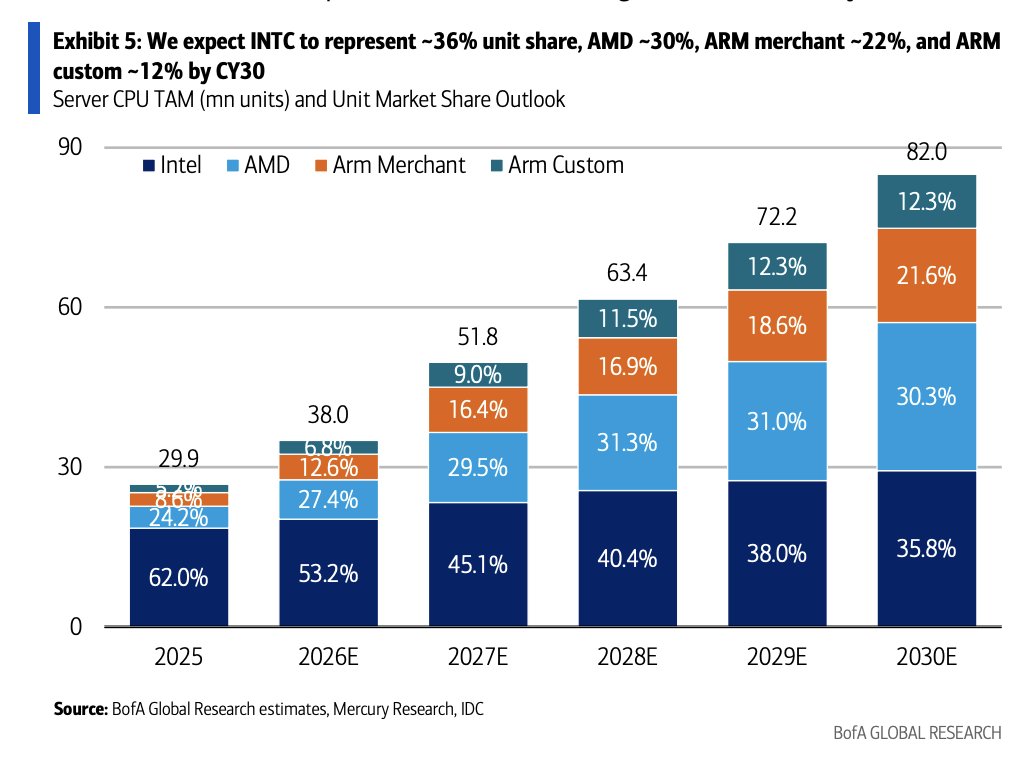
💡AI agents may push server CPU demand above $200 billion while x86 remains the safe default.
⚡ 30-Second TL;DR
What Changed
AI workloads, especially CPU-intensive agent workflows, are driving server CPU demand.
Why It Matters
AI infrastructure planners may need to reassess CPU capacity as agent-based workloads increase orchestration, retrieval, and tool-use demands. The continued dominance of x86 reduces near-term migration risk, but AMD and Arm create more opportunities for cost and performance optimization.
What To Do Next
Benchmark your CPU-bound agent workloads on current AMD EPYC, Intel Xeon, and Arm server instances before committing to new capacity.
Key Points
- •AI workloads, especially CPU-intensive agent workflows, are driving server CPU demand.
- •The server CPU total addressable market could surpass $200 billion by 2030.
- •AMD and Arm are eroding Intel's server market share.
- •x86 is still expected to remain the dominant server architecture.
🧠 Deep Insight
AI-generated analysis for this event.
🔑 Enhanced Key Takeaways
- •The rise of 'AI Agents' is shifting server requirements toward higher per-core memory bandwidth and increased L3 cache capacity to handle complex, multi-step reasoning tasks.
- •Hyperscalers are increasingly adopting custom silicon (ASICs) alongside general-purpose CPUs, creating a hybrid compute environment that forces traditional CPU vendors to integrate more AI-specific acceleration blocks directly onto the die.
- •Power Delivery Units (PDUs) and thermal management systems in data centers are becoming a bottleneck, leading to a shift in CPU design focus toward 'performance-per-watt' rather than raw clock speed.
- •The integration of CXL (Compute Express Link) 3.0 is becoming a critical differentiator for server CPUs, allowing for memory pooling that optimizes resource utilization for large-scale AI agent workflows.
- •Supply chain diversification is accelerating, with major cloud providers moving toward multi-vendor strategies to mitigate risks associated with geopolitical tensions and manufacturing concentration.
📊 Competitor Analysis▸ Show
| Feature | Intel (Xeon 6) | AMD (EPYC 9005) | Arm (Neoverse V3) |
|---|---|---|---|
| Architecture | x86 (P-core/E-core) | x86 (Zen 5) | ARMv9 |
| Target Workload | General Purpose/AI | High-Perf Computing | Cloud Native/AI |
| Memory Support | DDR5/HBM3 | DDR5 | DDR5/HBM |
| Power Efficiency | Moderate | High | Very High |
🛠️ Technical Deep Dive
- Modern server CPUs are incorporating dedicated matrix multiplication units (like Intel AMX) to handle AI inference tasks without offloading to a GPU.
- Implementation of chiplet-based architectures allows for mixing process nodes, such as using 3nm for compute dies and 6nm for I/O dies to optimize cost and yield.
- Increased reliance on CXL 3.0 protocols enables cache-coherent memory expansion, which is essential for AI agents that require massive context windows.
- Thermal Design Power (TDP) for top-tier server CPUs has climbed to 500W+, necessitating liquid cooling solutions in high-density rack configurations.
🔮 Future ImplicationsAI analysis grounded in cited sources
⏳ Timeline
Weekly AI Recap
Read this week's curated digest of top AI events →
👉Related Updates


AI-curated news aggregator. All content rights belong to original publishers.
Original source: cnBeta (Full RSS) ↗