NVIDIA Takes a Stake in SpaceX
💡NVIDIA is using capital and hardware partnerships to reshape who controls the next AI compute layer.
⚡ 30-Second TL;DR
What Changed
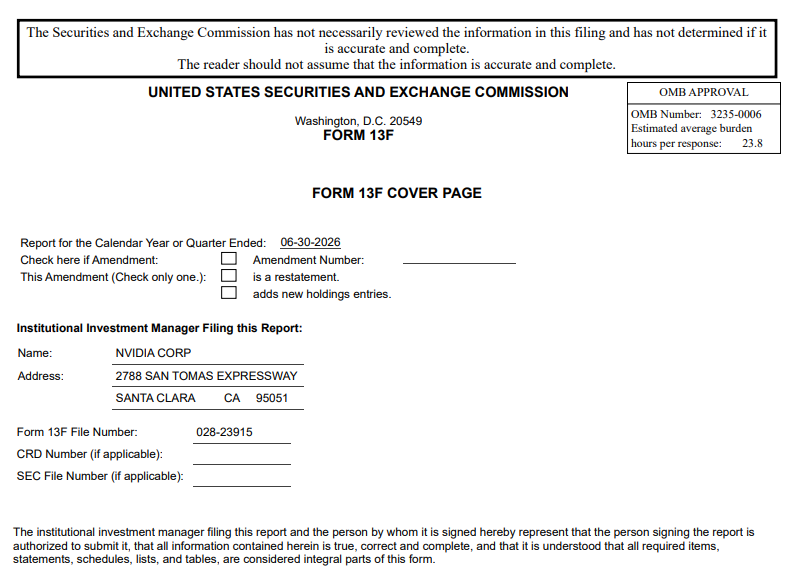
NVIDIA held 122.8 million SpaceX shares valued at nearly $21 billion as of June 30.
Why It Matters
NVIDIA is moving beyond selling GPUs toward shaping the ownership, financing, and deployment ecosystem around AI compute. For AI infrastructure builders, this could deepen vendor lock-in while improving access to future-generation hardware for strategic partners such as SpaceX.
What To Do Next
Evaluate your inference and training stack for Vera Rubin compatibility, while modeling the cost and operational risks of deeper NVIDIA hardware dependence.
Key Points
- •NVIDIA held 122.8 million SpaceX shares valued at nearly $21 billion as of June 30.
- •SpaceX CEO Elon Musk said the company will work exclusively with NVIDIA for AI systems and expects a large allocation of Vera Rubin GPUs next year.
- •SpaceX and NVIDIA have started joint R&D on the Starmind AI1 satellite computing payload.
- •NVIDIA also held approximately 214.8 million Intel shares, worth about $30 billion at the end of Q2.
- •NVIDIA has invested more than $100 billion in AI companies over the past two years.
🧠 Deep Insight
AI-generated analysis for this event.
🔑 Enhanced Key Takeaways
- •The investment in SpaceX is part of a broader NVIDIA strategy to secure vertical integration within the space-based AI infrastructure market, moving beyond traditional data center hardware.
- •NVIDIA's massive stake in Intel, while significant, is viewed by analysts as a strategic hedge or potential precursor to supply chain consolidation rather than a purely passive investment.
- •The Starmind AI1 payload utilizes a specialized radiation-hardened architecture designed to maintain high-performance inference capabilities in low Earth orbit (LEO) environments.
- •Regulatory filings indicate that NVIDIA's investment portfolio has shifted significantly toward 'AI-native' infrastructure providers, reducing exposure to traditional consumer electronics firms.
- •SpaceX's commitment to NVIDIA hardware is expected to accelerate the deployment of the Starlink 'Direct-to-Cell' AI processing capabilities, which require real-time edge computing.
📊 Competitor Analysis▸ Show
| Feature | NVIDIA/SpaceX (Starmind) | AMD/AST SpaceMobile | Intel/Various |
|---|---|---|---|
| Primary Focus | High-compute LEO AI | Connectivity-focused LEO | General Purpose/Legacy |
| Hardware | Vera Rubin GPUs | Instinct Accelerators | Gaudi/Xeon |
| Integration | Deep vertical stack | Partnership-based | Component supplier |
🛠️ Technical Deep Dive
- Starmind AI1 Payload: Employs a heterogeneous computing architecture combining NVIDIA's Vera Rubin GPU cores with custom radiation-hardened FPGA fabric for signal processing.
- Thermal Management: Utilizes advanced micro-fluidic cooling loops integrated into the satellite bus to handle the high TDP of AI-focused silicon in a vacuum.
- Interconnect: Leverages a proprietary space-grade NVLink variant to facilitate high-bandwidth, low-latency communication between the AI payload and Starlink's laser inter-satellite links.
- Inference Optimization: The system is optimized for real-time geospatial data processing, allowing for on-orbit object detection and classification without needing to downlink raw telemetry.
🔮 Future ImplicationsAI analysis grounded in cited sources
⏳ Timeline
Weekly AI Recap
Read this week's curated digest of top AI events →
👉Related Updates


AI-curated news aggregator. All content rights belong to original publishers.
Original source: 虎嗅 ↗