AI Agents for Emergency Evacuation Simulation
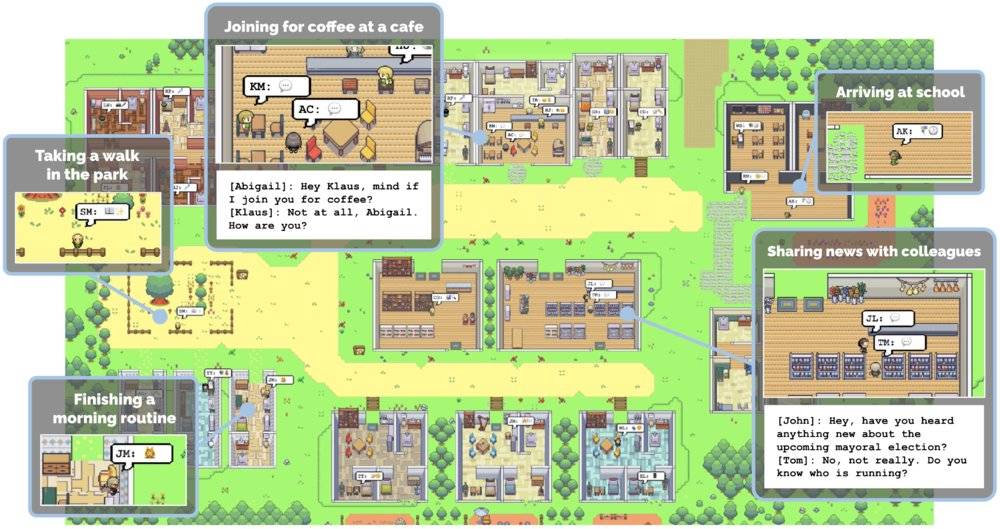
💡See how LLM-driven agents are moving from virtual parties to life-saving emergency evacuation simulations.
⚡ 30-Second TL;DR
What Changed
Transition from physical-only models to 'physical-cognitive' architectures that simulate human hesitation and panic.
Why It Matters
This research bridges the gap between theoretical AI agents and practical safety engineering, potentially replacing traditional, less accurate crowd simulation models.
What To Do Next
Explore the RESCUE project's open-source code to understand how to integrate 3D physical constraints with LLM-based agent decision logic.
Key Points
- •Transition from physical-only models to 'physical-cognitive' architectures that simulate human hesitation and panic.
- •CMU successfully integrated LLM-based evacuation simulations into real-world school safety SOPs.
- •RESCUE project introduces 3D-adaptive physical collision modeling for crowd dynamics.
- •AgentSociety enables city-scale social simulation, processing millions of interactions for policy impact analysis.
🧠 Deep Insight
AI-generated analysis for this event — not the original article.
🔑 Enhanced Key Takeaways
- •Integration of 'Theory of Mind' (ToM) modules allows agents to predict the intentions of nearby individuals, significantly reducing unrealistic 'clumping' behaviors seen in traditional social force models.
- •Researchers are utilizing multi-modal LLMs to process visual inputs from CCTV feeds, enabling agents to react to real-time environmental changes like smoke density or blocked exits.
- •The use of Reinforcement Learning from Human Feedback (RLHF) specifically tuned for high-stress scenarios allows agents to exhibit 'altruistic' or 'selfish' personality traits based on psychological profiling.
- •Privacy-preserving federated learning is being deployed to train these evacuation models on sensitive building floor plans without exposing proprietary architectural data.
- •Current simulations have moved beyond simple pathfinding to include 'social contagion' algorithms that model how panic spreads through verbal and non-verbal cues in a crowd.
📊 Competitor Analysis▸ Show
| Feature | LLM-Driven Agent Simulation | Traditional Social Force Models (SFM) | Cellular Automata (CA) |
|---|---|---|---|
| Decision Making | Cognitive/LLM-based | Rule-based/Heuristic | Grid-based probability |
| Computational Cost | High (GPU intensive) | Low | Very Low |
| Human Behavior | High (Panic/Hesitation) | Low (Fluid-like) | Minimal |
| Scalability | Medium | High | Very High |
🛠️ Technical Deep Dive
- Architecture: Employs a hierarchical agent framework where the LLM acts as the 'Cognitive Engine' (high-level decision making) while a physics engine (e.g., Unity or NVIDIA Isaac Sim) handles 'Kinematic Execution' (collision avoidance).
- Memory Module: Agents utilize a Vector Database (e.g., Pinecone or Milvus) to store long-term spatial memory of the building layout and short-term working memory of immediate threats.
- Latency Optimization: Implementation of 'Model Distillation' where large LLMs train smaller, faster 'Student' models to run real-time simulations at 30+ FPS.
- Collision Modeling: Integration of RVO2 (Reciprocal Velocity Obstacles) libraries to ensure physical constraints are respected even when agents are making complex cognitive decisions.
🔮 Future ImplicationsAI analysis grounded in cited sources
⏳ Timeline
Weekly AI Recap
Read this week's curated digest of top AI events →
👉Related Updates



AI-curated news aggregator. All content rights belong to original publishers.
Original source: 虎嗅 ↗
This is a summary, not the original. Read the source, or get the weekly briefing.
Weekly AI briefing
One email a week. Unsubscribe anytime.