Agentic AI Brings CPUs Back
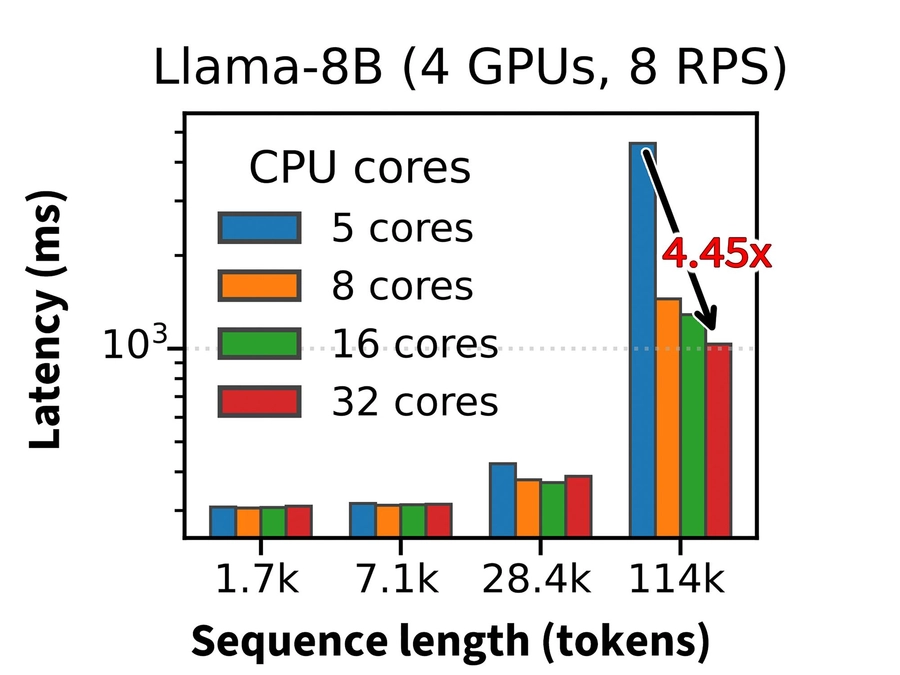
💡Tool calls and long contexts may make CPU capacity the hidden limit on agentic AI scale.
⚡ 30-Second TL;DR
What Changed
Agentic workloads use CPUs for output parsing, tool selection, API calls, code execution, and result handling.
Why It Matters
The article indicates that scaling agentic AI is not only a GPU problem: orchestration, tokenization, guardrails, and tool execution may determine real-world throughput. Teams deploying large numbers of agents may need to budget for CPU capacity and optimize CPU-GPU co-scheduling.
What To Do Next
Profile CPU utilization, tokenization time, and GPU idle intervals in your agent runtime before scaling GPUs, then test higher-core instances and asynchronous tool-call scheduling.
Key Points
- •Agentic workloads use CPUs for output parsing, tool selection, API calls, code execution, and result handling.
- •CPU and GPU can remain idle at alternating stages; scheduling optimization reduced end-to-end latency to as low as 5/9 of the baseline.
- •Repeated tokenization of long tool-call contexts can substantially increase time to first token.
- •Adding CPU cores reduced long-sequence TTFT to roughly two-thirds to one-seventh in reported tests.
- •AWS tightened CPU usage, while Intel, AMD, Arm, Qualcomm, and Nvidia expanded agent-focused CPU efforts.
🧠 Deep Insight
Background and context from public sources — not the original article. 14 sources cited.
🔑 Enhanced Key Takeaways
- •The industry is shifting from a 1:4–8 CPU-to-GPU ratio to a 1:1 ratio to accommodate the high orchestration demands of autonomous agents.
- •NVIDIA has introduced the Vera CPU as part of its Rubin platform, specifically designed to function as a standalone processor for non-parallelizable agentic reasoning tasks.
- •Arm has entered the high-performance server market with an AGI-focused CPU featuring dual 70-core N3P chiplets and a 2 TB/s UCIe fabric link.
- •Agentic AI creates a multiplier effect where a single user intent triggers 10 to 100+ LLM invocations, necessitating massive CPU overhead for state management and task decomposition.
- •SpaceXAI announced a large-scale deployment of NVIDIA Vera CPUs in August 2026 to specifically accelerate its next-generation agentic AI infrastructure.
📊 Competitor Analysis▸ Show
| Feature | NVIDIA (Vera) | Arm (AGI CPU) | AMD (EPYC) |
|---|---|---|---|
| Primary Focus | Standalone agentic reasoning | High-perf orchestration | Balanced data center compute |
| Architecture | Rubin Platform | Dual 70-core N3P chiplets | x86 EPYC architecture |
| Interconnect | Proprietary | 2 TB/s UCIe fabric | Infinity Fabric |
| Market Position | Specialized AI-Agent focus | High-efficiency/Custom | General-purpose/Scaling |
🛠️ Technical Deep Dive
- CPU-GPU Ratio: Shifted from 1:8 to 1:1 to handle orchestration overhead.
- Interconnect: Adoption of 2 TB/s UCIe fabric links to reduce latency in multi-chiplet agentic workloads.
- Compute Architecture: Transition to high-core-count chiplet designs (e.g., 140-core configurations) to manage parallel API calls and tokenization.
- Memory Management: Increased reliance on high-bandwidth CPU-side memory to cache long-context agent states during tool-use cycles.
🔮 Future ImplicationsAI analysis grounded in cited sources
⏳ Timeline
📎 Sources (14)
Factual claims are grounded in the sources below. Forward-looking analysis is AI-generated interpretation.
Weekly AI Recap
Read this week's curated digest of top AI events →
👉Related Updates



AI-curated news aggregator. All content rights belong to original publishers.
Original source: 虎嗅 ↗
This is a summary, not the original. Read the source, or get the weekly briefing.
Weekly AI briefing
One email a week. Unsubscribe anytime.