Advantech Launches WEDA for Unified Edge AI Management
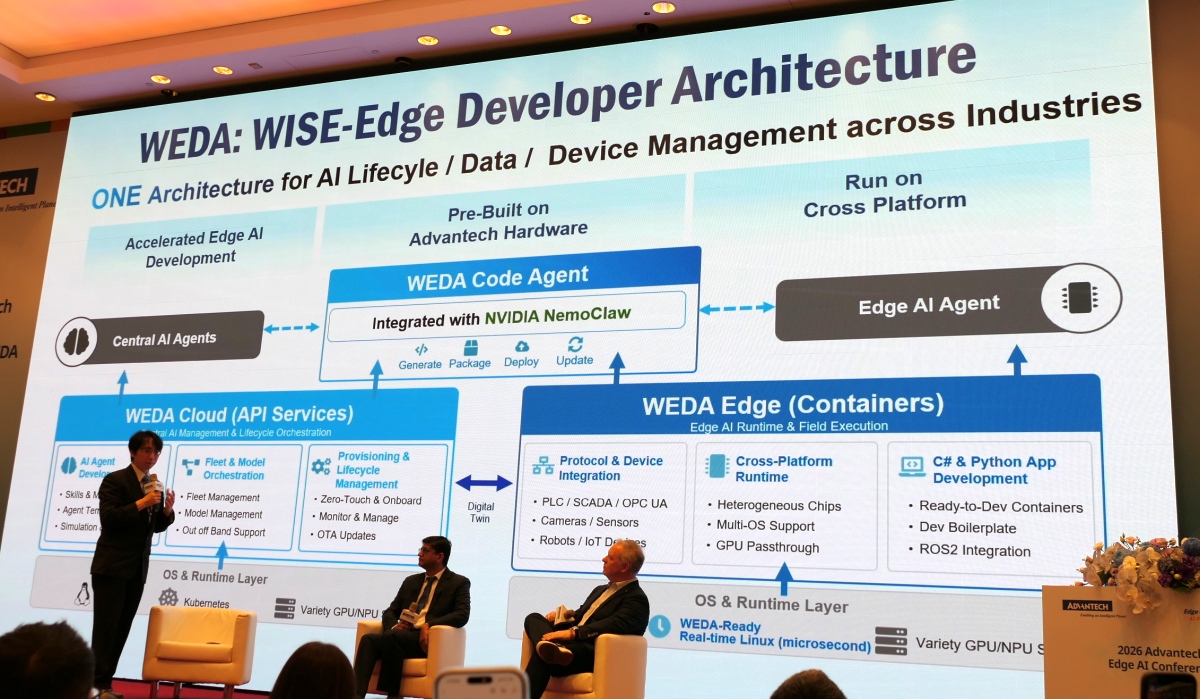
💡Streamline your edge AI lifecycle with Advantech's new WEDA platform powered by NVIDIA NemoClaw.
⚡ 30-Second TL;DR
What Changed
Integrates NVIDIA's NemoClaw for edge AI orchestration
Why It Matters
WEDA simplifies the complex lifecycle of edge AI, potentially reducing the operational overhead for companies deploying AI at the network edge.
What To Do Next
Evaluate WEDA's integration capabilities if you are managing distributed NVIDIA-based edge AI deployments.
Key Points
- •Integrates NVIDIA's NemoClaw for edge AI orchestration
- •Covers the full lifecycle from development to deployment
- •Designed for enterprise-scale edge AI operations
🧠 Deep Insight
Background and context from public sources — not the original article. 8 sources cited.
🔑 Enhanced Key Takeaways
- •Advantech's WEDA (WISE-Edge Developer Architecture) provides a "Ready-to-develop" environment featuring Container Passthrough technology, enabling developers to directly utilize NPU and GPU power within containers without complex driver configurations.
- •WEDA includes a Device Library that simplifies operational technology (OT) hardware control and data integration by transforming intricate OT hardware commands into intuitive Python and C# SDKs.
- •The platform supports cross-chip AI deployment, delivering hardware acceleration-enabled containers with direct GPU/NPU/DSP passthrough, and is compatible with a wide range of chipsets including AMD, Intel, NVIDIA, NXP, Qualcomm, and Rockchip platforms.
- •WEDA operates on a dual-layer architecture, consisting of WEDA Cloud, a high-performance backend for large-scale orchestration using Digital Twin protocols, and WEDA Edge, optimized for low-to-medium power embedded systems with components like WEDA Node and WEDA SubNode.
🛠️ Technical Deep Dive
- Architecture: WEDA utilizes a dual-layer architecture comprising WEDA Cloud (a centralized management engine, WEDA Core) and WEDA Edge (a runtime agent, WEDA Node, and an open-source framework, WEDA SubNode).
- Containerization: Employs "Container Passthrough technology" to allow direct NPU and GPU access within containers and supports one-click stack and node deployment using Docker Compose and Helm Charts.
- Device Management: WEDA Core provides robust APIs for organizational governance and large-scale fleet operations, including lifecycle management, device capabilities monitoring, entity linking, batch tasks, and notifications. WEDA Node is a Go-based agent responsible for monitoring edge hardware, managing container lifecycles, and relaying Digital Twin messages.
- Development Environment: Offers Python and C# SDKs through a Device Library to simplify OT hardware control and provides "Ready-to-dev Containers" pre-built with Computer Vision and Large Language Model (LLM) capabilities.
- Data Handling: Features a comprehensive DTDL (Digital Twin Definition Language) Edge–Cloud Collaboration Framework for auto provisioning, device shadow, telemetry, and command protocols. It also includes a high-throughput IoT Core, optimized time-series processing, and Digital Twin Integration using Open Device (DTDL) and OpenUSD standards.
- NVIDIA NemoClaw Integration: NemoClaw is NVIDIA's enterprise AI agent framework, built upon the open-source OpenClaw orchestration layer, and enhances it with enterprise-grade security controls, privacy routing, and local Nemotron model deployment. It provides a secure runtime environment, NVIDIA OpenShell Runtime, which includes policy enforcement, privacy controls, and system-level governance for autonomous agents. NemoClaw uses a versioned blueprint to orchestrate sandbox creation, network and filesystem policy, and inference setup, integrating with the NVIDIA NeMo framework, Nemotron models, and NIM (NVIDIA Inference Microservices).
🔮 Future ImplicationsAI analysis grounded in cited sources
⏳ Timeline
📎 Sources (8)
Factual claims are grounded in the sources below. Forward-looking analysis is AI-generated interpretation.
Weekly AI Recap
Read this week's curated digest of top AI events →
👉Related Updates
AI-curated news aggregator. All content rights belong to original publishers.
Original source: ITmedia AI+ (日本) ↗
This is a summary, not the original. Read the source, or get the weekly briefing.
The weekly digest
One email a week. Unsubscribe anytime.