🐯虎嗅•Freshcollected in 6m
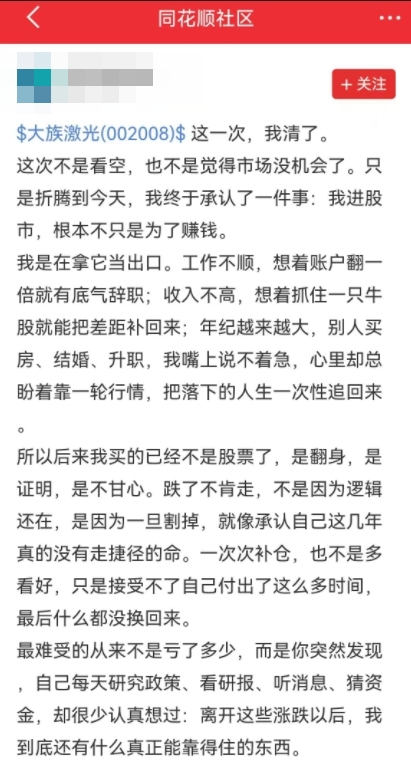
A-share market: The middle-aged man's 'puberty'
💡Understand how AI-driven institutional trading is reshaping the retail investment landscape and investor psychology.
⚡ 30-Second TL;DR
What Changed
A-share investors are aging, with the 40+ demographic becoming the primary force.
Why It Matters
Reflects the social and psychological landscape of retail investors in China, which is increasingly influenced by institutional AI-driven strategies.
What To Do Next
Analyze retail investor sentiment data to understand how human behavioral biases interact with AI-driven market volatility.
Who should care:Founders & Product Leaders
Key Points
- •A-share investors are aging, with the 40+ demographic becoming the primary force.
- •Middle-aged men use the stock market as a psychological outlet for lost career and life control.
- •The 'control illusion' leads investors to believe they can beat the market through professional analysis.
- •Institutional investors increasingly use AI and algorithmic trading, putting individual retail investors at a disadvantage.
🧠 Deep Insight
AI-generated analysis for this event.
🔑 Enhanced Key Takeaways
- •The 'A-share middle-aged male' phenomenon is increasingly linked to the '35-year-old crisis' in the Chinese tech and corporate sectors, where involuntary career exits drive individuals toward speculative financial activities [1].
- •Data from major Chinese brokerage firms indicates a significant shift in asset allocation, with middle-aged retail investors increasingly pivoting from real estate—historically the primary wealth vehicle—to high-volatility equity trading [1].
- •Behavioral finance studies on the Chinese retail market highlight the 'disposition effect,' where middle-aged male investors are statistically more likely to hold losing positions for extended periods to avoid realizing losses, exacerbating portfolio stagnation [1].
- •The rise of 'fin-fluencers' on platforms like Douyin and Xiaohongshu has created echo chambers that reinforce the 'control illusion' by promoting technical analysis strategies that often fail against institutional high-frequency trading (HFT) [1].
- •Regulatory bodies in China have intensified warnings regarding retail investor protection, specifically targeting the gamification of trading apps that exploit the psychological vulnerabilities of the aging investor demographic [1].
🔮 Future ImplicationsAI analysis grounded in cited sources
Increased regulatory intervention in retail trading interfaces
Regulators are likely to mandate 'cooling-off' periods and stricter risk disclosure requirements to curb the compulsive trading behaviors observed in the aging retail demographic.
Shift toward passive investment products
Persistent underperformance of retail stock picking will likely force a market-wide migration toward ETFs and institutional-managed funds as middle-aged investors exhaust their capital.
⏳ Timeline
2015-06
A-share market bubble burst leads to significant losses for retail investors, marking the beginning of increased market skepticism.
2019-07
Launch of the STAR Market (Science and Technology Innovation Board) introduces stricter investor suitability requirements.
2023-02
Full implementation of the registration-based IPO system across all A-share boards, shifting market dynamics toward institutional dominance.
📰
Weekly AI Recap
Read this week's curated digest of top AI events →
👉Related Updates

AI-curated news aggregator. All content rights belong to original publishers.
Original source: 虎嗅 ↗