Japan-India high-speed rail project faces major friction
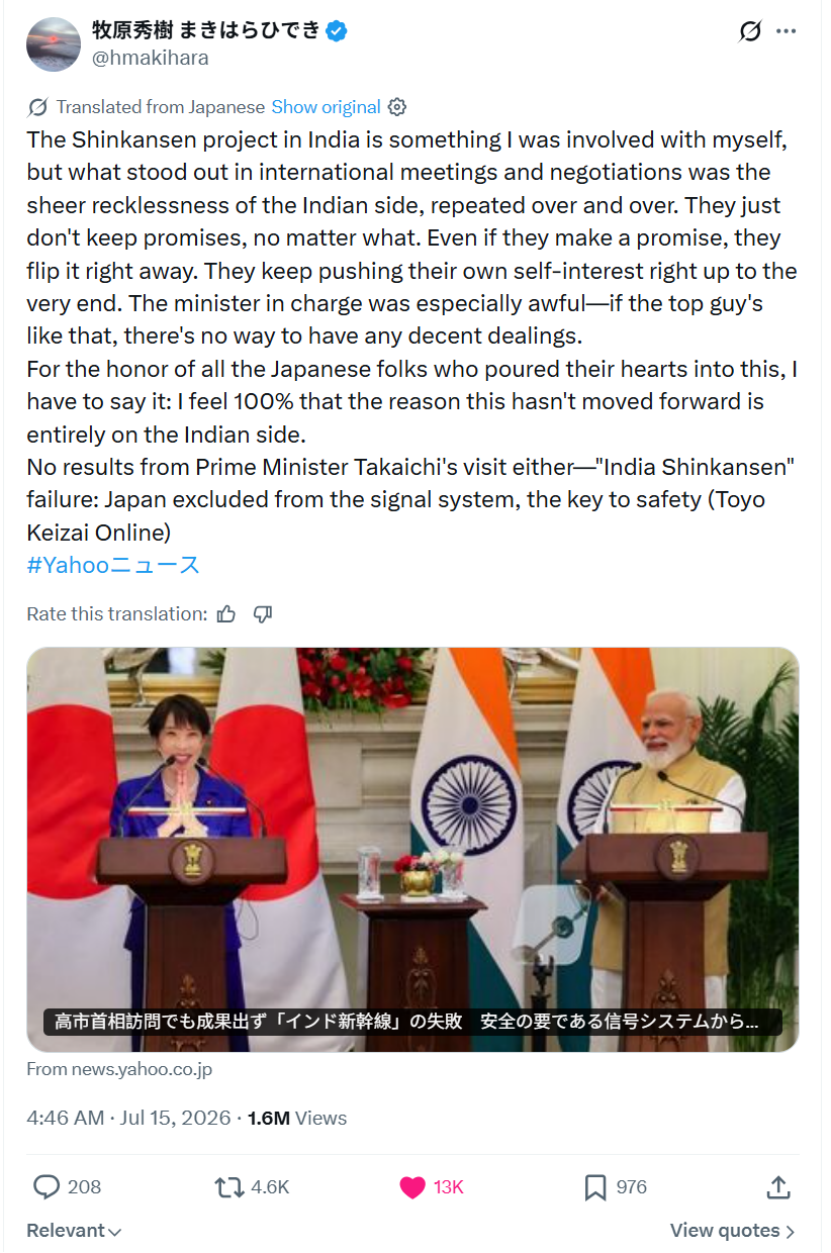
💡A case study on how technology standards and industrial sovereignty can derail multi-billion dollar international projec
⚡ 30-Second TL;DR
What Changed
Japan provided massive low-interest loans but is now excluded from critical signaling and vehicle system contracts.
Why It Matters
This geopolitical and technical dispute highlights the complexities of international infrastructure cooperation when national industrial interests conflict with technology transfers.
What To Do Next
Monitor international infrastructure procurement policies as they increasingly prioritize local technology sovereignty over imported turnkey solutions.
Key Points
- •Japan provided massive low-interest loans but is now excluded from critical signaling and vehicle system contracts.
- •India is prioritizing local manufacturing and European signaling standards to reduce long-term dependency on Japanese technology.
- •The project timeline for Japanese E10 series trains has been pushed to the 2030s, while India pursues domestic train development for 2027.
🧠 Deep Insight
AI-generated analysis for this event.
🔑 Enhanced Key Takeaways
- •The Mumbai-Ahmedabad High-Speed Rail (MAHSR) project is the first application of Japan's Shinkansen technology in India, originally designed as a turnkey 'package deal' under the JICA loan framework.
- •India's 'Make in India' initiative has increasingly pressured the project to localize rolling stock production, leading to the development of the Vande Bharat series as a potential domestic high-speed alternative.
- •The shift toward European Train Control System (ETCS) Level 2 is driven by the Indian Railways' broader strategy to standardize signaling across its national network to ensure interoperability.
- •Japan's involvement is governed by a 2015 Memorandum of Cooperation, which initially stipulated the use of Japanese Shinkansen technology, creating legal and diplomatic friction regarding the recent contract shifts.
- •Cost escalations have plagued the project, with estimates rising significantly from the initial 2017 projection of approximately 1.08 trillion rupees due to land acquisition delays and currency fluctuations.
🛠️ Technical Deep Dive
- Shinkansen E5 Series: The original Japanese platform specified for the MAHSR, featuring a maximum operating speed of 320 km/h and advanced seismic detection systems.
- ETCS Level 2: A digital signaling and control system that uses GSM-R or LTE-R for continuous communication between the trackside and the train, replacing traditional fixed block signaling.
- Vande Bharat Platform: An indigenously developed electric multiple unit (EMU) trainset by India, currently operating at lower speeds but being upgraded for higher-speed corridors to compete with imported technology.
🔮 Future ImplicationsAI analysis grounded in cited sources
⏳ Timeline
Weekly AI Recap
Read this week's curated digest of top AI events →
👉Related Updates


AI-curated news aggregator. All content rights belong to original publishers.
Original source: 虎嗅 ↗