86% Non-Coders Deploy Apps via Claude Code
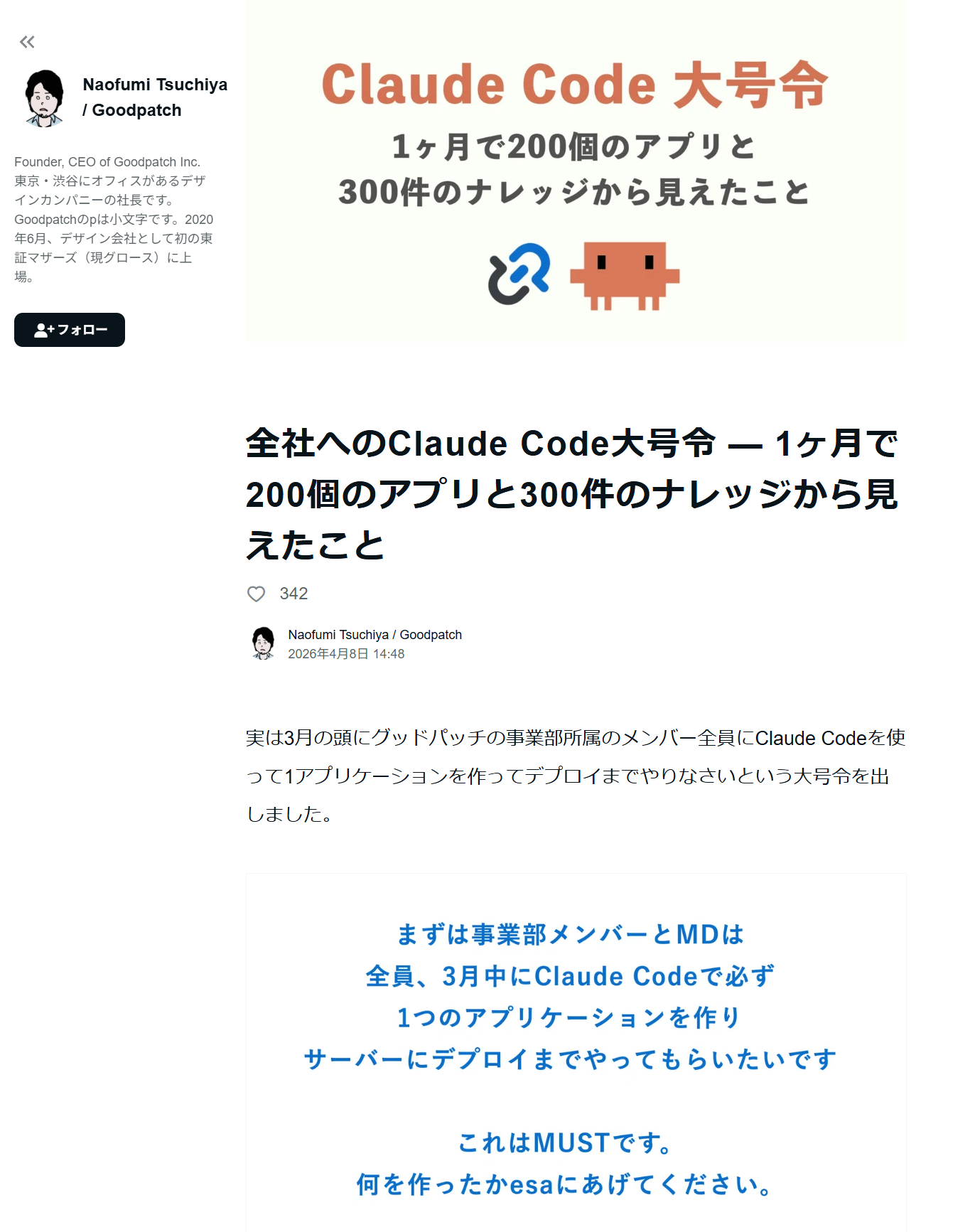
💡86% non-coders deployed apps with Claude Code—proof AI unlocks dev for everyone.
⚡ 30-Second TL;DR
What Changed
Goodpatch mandated Claude Code for every employee
Why It Matters
This demonstrates AI's potential to democratize coding, enabling non-technical teams to build deployable software rapidly. It could inspire companies to integrate AI coding tools firm-wide for productivity gains.
What To Do Next
Mandate a 1-week Claude Code trial for your non-technical team to build/deploy a simple app.
Key Points
- •Goodpatch mandated Claude Code for every employee
- •86% of zero-coding-experience staff achieved app deployment
- •Apps solved minor daily/work issues
- •Results publicly disclosed by Goodpatch
🧠 Deep Insight
AI-generated analysis for this event — not the original article.
🔑 Enhanced Key Takeaways
- •Goodpatch utilized Claude Code's agentic capabilities to integrate directly with their internal GitHub repositories and cloud infrastructure, allowing non-technical staff to bypass traditional IDE setup and environment configuration.
- •The initiative was part of a broader 'AI-First' operational shift at Goodpatch, aimed at reducing the dependency on specialized engineering resources for internal tooling and micro-utility development.
- •Post-deployment analysis revealed that the majority of these apps were built using a standardized, secure sandbox environment provided by Claude Code, which mitigated security risks associated with non-coder code generation.
📊 Competitor Analysis▸ Show
| Feature | Claude Code (Anthropic) | Cursor (Composer) | GitHub Copilot Workspace |
|---|---|---|---|
| Primary Target | Agentic CLI-based dev | IDE-integrated dev | Project-wide planning/coding |
| Non-Coder Focus | High (CLI abstraction) | Medium (IDE required) | Low (Technical workflow) |
| Deployment | Direct CLI deployment | Requires manual push | Requires PR/CI workflow |
🛠️ Technical Deep Dive
- •Claude Code operates as a CLI-based agent that leverages Anthropic's Claude 3.5/3.7 Sonnet models to perform file system operations, run terminal commands, and manage git workflows.
- •The tool utilizes a 'Plan-Execute-Verify' loop, where the agent writes code, attempts to run it in a local containerized environment, and automatically iterates based on error logs.
- •It implements a 'Human-in-the-loop' security layer, requiring explicit user approval for destructive commands or network-facing configuration changes.
- •The system relies on a pre-configured 'context window' that includes project documentation and coding standards to ensure generated code adheres to company-specific architecture.
🔮 Future ImplicationsAI analysis grounded in cited sources
⏳ Timeline
Weekly AI Recap
Read this week's curated digest of top AI events →
👉Related Updates

AI-curated news aggregator. All content rights belong to original publishers.
Original source: ITmedia AI+ (日本) ↗
This is a summary, not the original. Read the source, or get the weekly briefing.
The weekly digest
One email a week. Unsubscribe anytime.