Search

Tag: #inference-scaling6 results

Adaptive Parallel Reasoning Scales Efficient Inference

Adaptive Parallel Reasoning Scales Efficient Inference

This Berkeley AI Research article introduces Adaptive Parallel Reasoning, where LLMs dynamically decompose tasks, spawn parallel threads, and coordinate based on problem needs. It analyzes progress in parallel reasoning to overcome sequential reasoning's linear scaling issues like context-rot and high latency. Motivation stems from inference-time scaling dominating benchmarks in math, coding, and agents.

Berkeley AI ResearchResearchMay 8#parallel-reasoning#inference-scaling#context-rot
Tokens Enable Emergent Resource Rationality

Tokens Enable Emergent Resource Rationality

Inference-time scaling in language models leads to adaptive resource rationality without explicit cost rewards. Models shift from brute-force to analytic strategies as task complexity rises. LRMs show robustness on challenging functions like XOR/XNOR unlike IT models.

ArXiv AIResearchFeb 12#research#language-models#v1
Inference Scaling vs Larger Tasks

Inference Scaling vs Larger Tasks

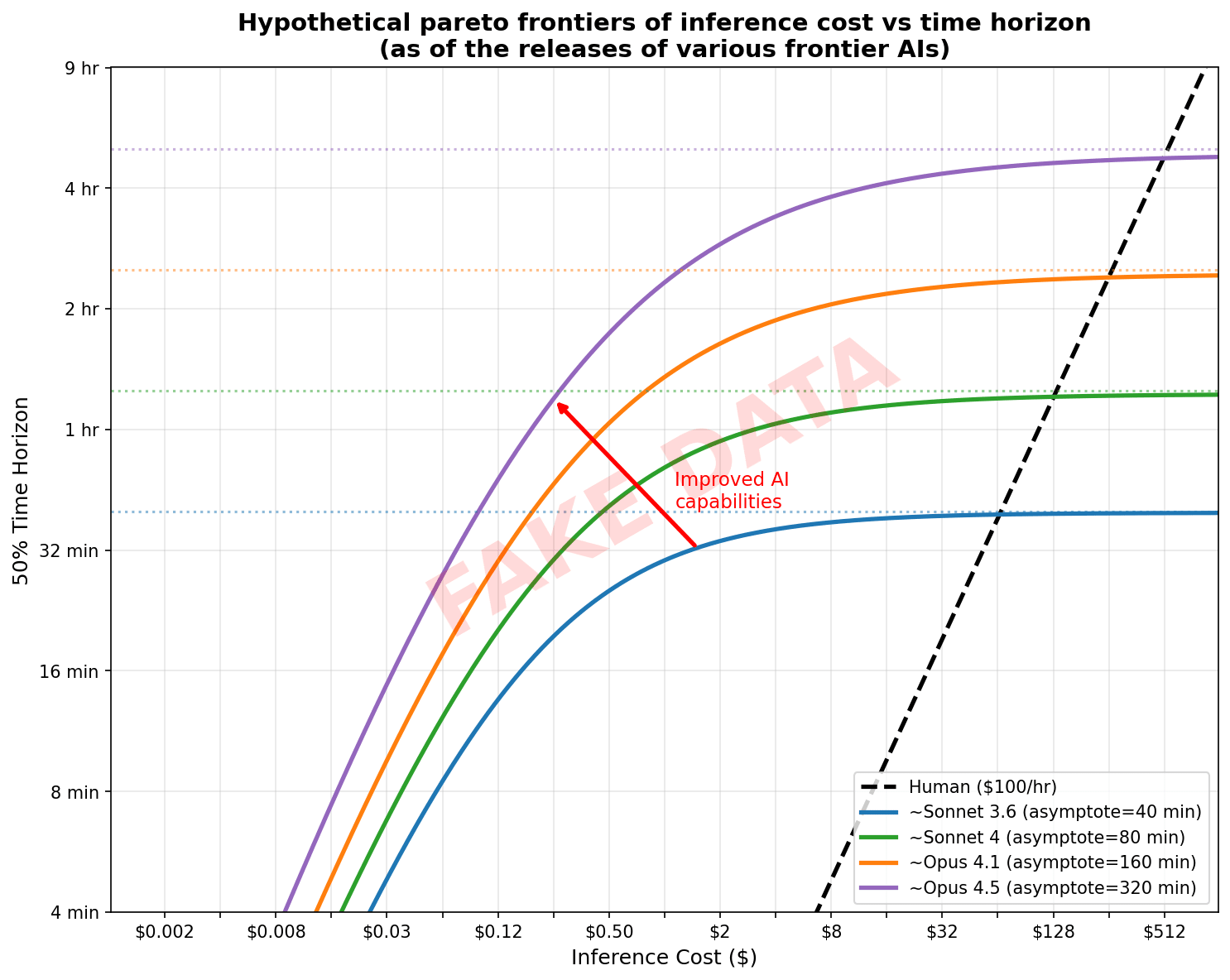
Distinguishes inference scaling from natural compute increases for bigger tasks in LLMs. Uses Pareto frontiers of compute budget vs. task time-horizon to analyze efficiency. Argues true scaling concerns arise only when exceeding human-equivalent costs inefficiently.

AI Alignment ForumCommunityFeb 11#research#llms#ai