
Ramp Launches Router for Multi-Model AI Access
Ramp has launched Router, an AI model routing service that allows users and companies to access and switch between multiple large language models. The service is available through an API.
10 results on this page
Ramp has launched Router, an AI model routing service that allows users and companies to access and switch between multiple large language models. The service is available through an API.

Amazon Bedrock AgentCore now supports Policy Authoring, which converts natural-language policy documents into Dogwood policies. The update helps teams enforce agent controls, including new time-based constraints, with worked examples and best practices.

Serval has made Catalyst generally available as an administrative super agent that discovers repetitive work and builds governed enterprise automations. It can also create background agents that monitor connected systems, identify emerging issues, and suggest fixes before employees submit tickets.

GitLab Dedicated customers can now deploy the AI Gateway for GitLab Duo Agent Platform within their single-tenant SaaS environment. This keeps AI processing aligned with the customer's selected AWS region and enables connections to Amazon Bedrock or preferred model providers.

GitLab 19.3 adds bulk SAST False Positive Detection and Agentic SAST Vulnerability Resolution for existing vulnerability backlogs. Teams can automatically assess findings, dismiss likely false positives, and generate ready-to-merge fixes, including for SARIF-imported third-party scanner results.
Cloudflare is previewing a feature that automatically adds WebMCP support to webpages. The update could simplify how developers make web experiences accessible to AI agents.
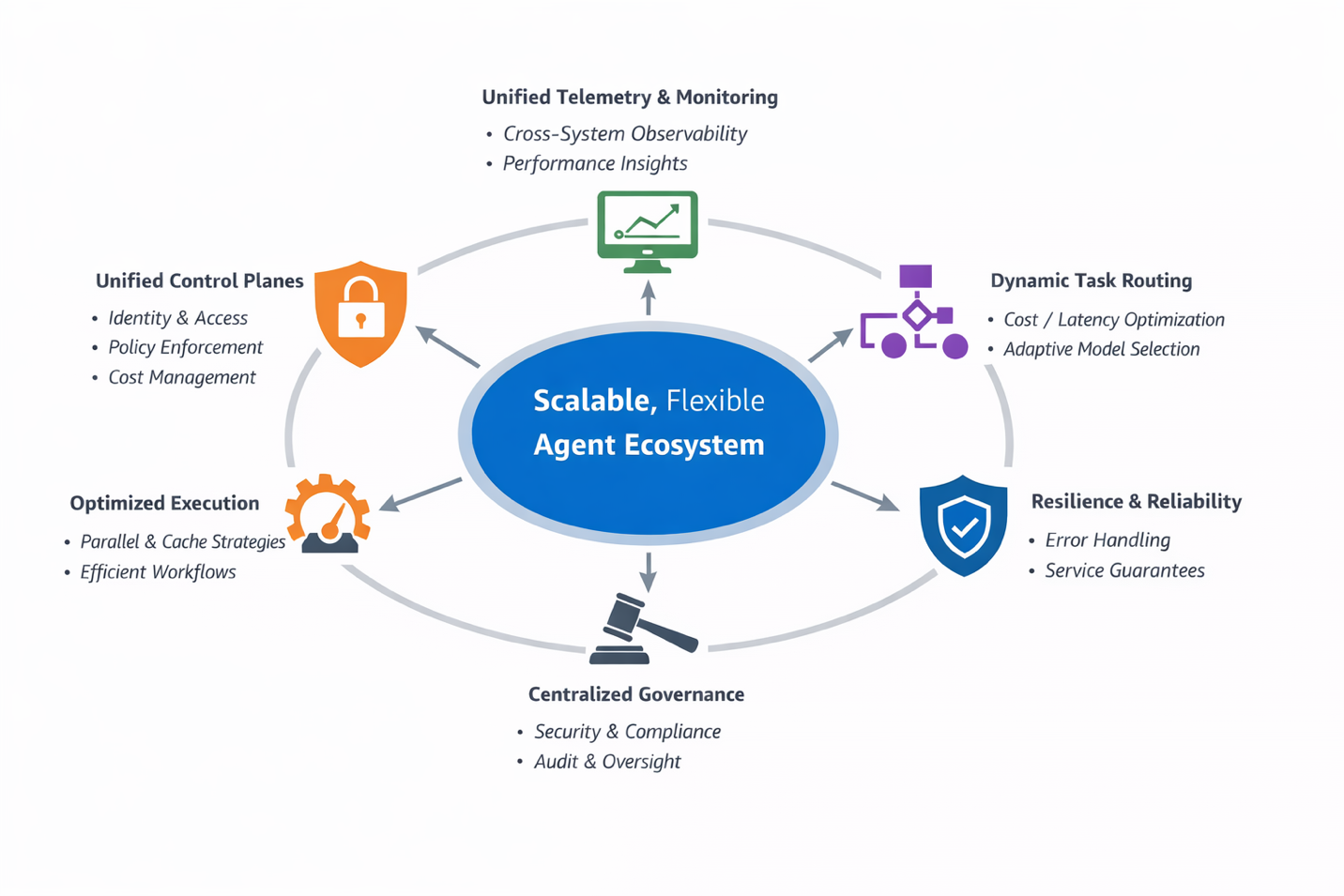
AWS outlines enterprise patterns for operating many agentic AI systems across diverse frameworks, models, and providers. The guidance focuses on preserving flexibility and enabling multi-agent systems to scale together without vendor lock-in.

This systematic review examines Agentic AI’s historical evolution, architectures, working principles, real-world applications, adoption factors, and current challenges. It also identifies research gaps and proposes future directions, including a stakeholder adoption framework based on system-quality dimensions.
This survey frames self-evolving LLM agents as dynamic graphs whose memories, tools, skills, workflows, and relationships change over time. It presents four evolution taxonomies, connects nine dynamic-graph-learning fields to agent capabilities, and proposes graph-aware evaluation and governance protocols.

Apple Machine Learning studies how to mix scarce target-domain data with abundant generic data during language-model pretraining. Across more than 2,000 training runs, the research examines the trade-off between insufficient target exposure, repeated examples, diminishing returns, and overfitting.