
Ornith-1.5 Launches Three Open Model Sizes
Ornith-1.5 launches open models in 397B, 35B, and 9B parameter sizes. The models feature self-improving task and scaffold generation and report strong performance on coding and reasoning benchmarks.
10 results on this page
Ornith-1.5 launches open models in 397B, 35B, and 9B parameter sizes. The models feature self-improving task and scaffold generation and report strong performance on coding and reasoning benchmarks.
Google DeepMind announced that the Gemma model family has surpassed one billion global downloads. Developers have released more than 100,000 Gemma variants over the past two years, contributing to an expanding ecosystem called the “Gemmaverse.”
Qwen Code v0.21.15 improves Web Shell performance, file attachments, sidebar synchronization, and Goal v3 controls. It also adds reasoning toggles for hybrid Qwen models, resume support for reviews, and authenticated HTTPS Git extension installs.
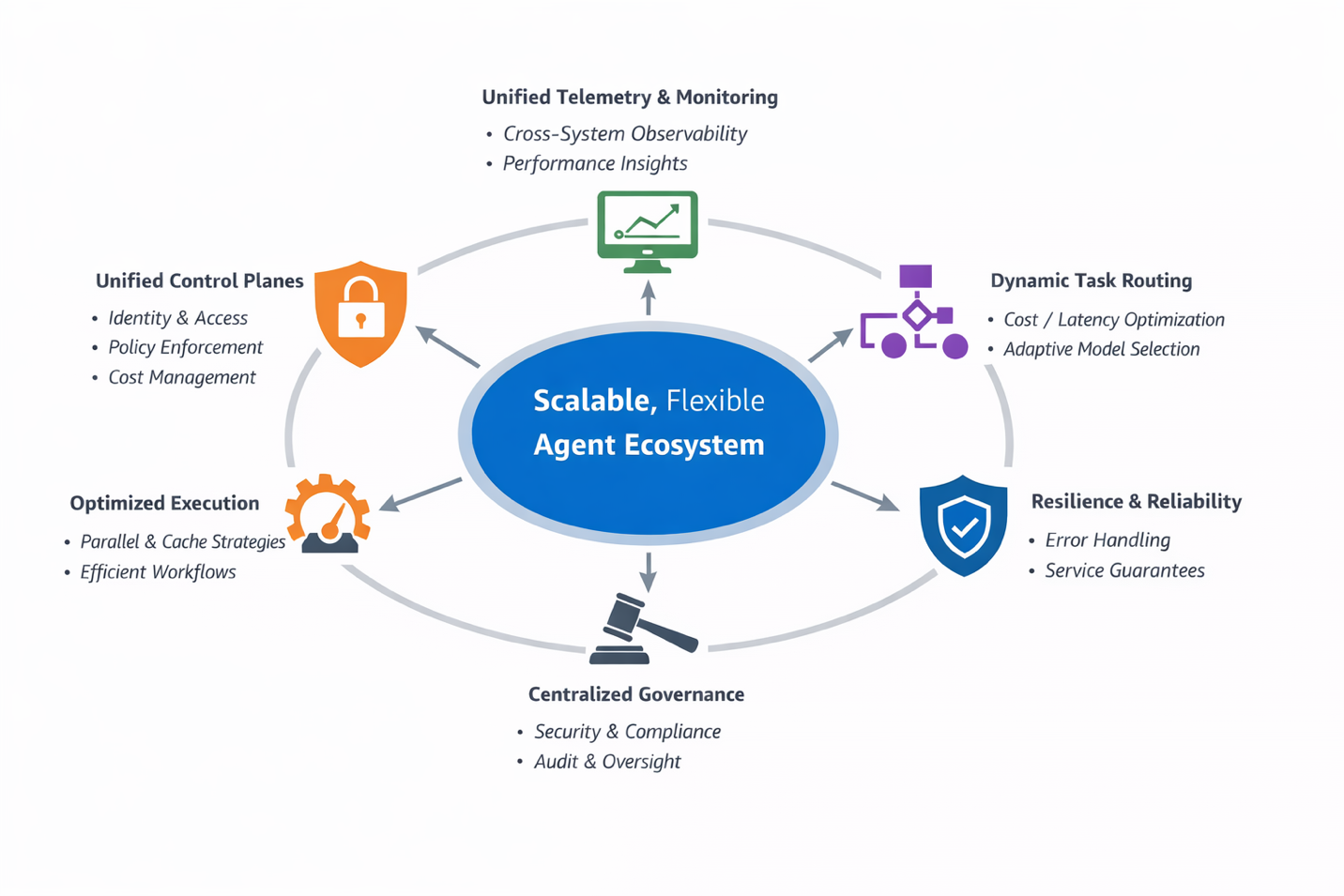
AWS outlines enterprise patterns for operating many agentic AI systems across diverse frameworks, models, and providers. The guidance focuses on preserving flexibility and enabling multi-agent systems to scale together without vendor lock-in.
Moonshot and ZAI are reportedly approaching the performance of models from OpenAI and Anthropic. The models can reportedly build passable websites at a cost 75% lower than Claude, highlighting potential advantages in cost-sensitive coding workflows.
The Spectral Neuron is a proposed ML primitive based on the largest eigenvalue of an input-conditioned matrix. The preprint develops its mathematical properties, initialization and training methods, and evaluates scalability on synthetic and real-world datasets.
Ant Group’s quarterly profit barely grew after the company increased spending on artificial intelligence. The investments target healthcare, large language models, and payment services, while expansion costs also pressured results.

ByteDance’s Seed foundation-model division has reportedly completed another internal restructuring. Its foundation-model organization now includes four first-level departments focused on pretraining data, reinforcement learning, product post-training for work, and product post-training for chat.

A position paper analyzing 500 Hugging Face model cards argues that model cards alone do not provide enough information for governing open-weight foundation models. It proposes combining model cards with acceptable use policies and licenses to address safety, provenance, behavior, and enforcement gaps.
This systematic review examines how large language models support mental-health applications, including social-media analysis, clinical conversational agents, therapy support, and psychoeducation. It also covers multimodal diagnosis, prompt engineering, interpretability, and the ethical and regulatory safeguards needed for responsible deployment.