Search

Tag: #multi-modal27 results

Qwen Code SDK TypeScript v0.1.8-preview.0 Released

Qwen Code SDK TypeScript v0.1.8-preview.0 Released

The latest Qwen Code SDK update introduces multi-modal input support, improved error handling for OpenAI-compatible providers, and enhanced CLI batch execution capabilities. This release also includes significant security fixes and architectural improvements for subagent tracking and LSP integration.

Qwen (GitHub Releases: qwen-code)MediaMay 26#sdk#multi-modal#cli
BAAI Launches Cardiac MRI AI Diagnostic Agent

BAAI Launches Cardiac MRI AI Diagnostic Agent

BAAI partnered with Beijing Anzhen Hospital and Henan Medical University First Affiliated Hospital to release the first cardiac MRI multimodal agent. It enables a full closed-loop diagnostic workflow from segmentation and analysis to diagnosis and reporting. The Agent-Expert system automates end-to-end MRI analysis with clinical-standard reports.

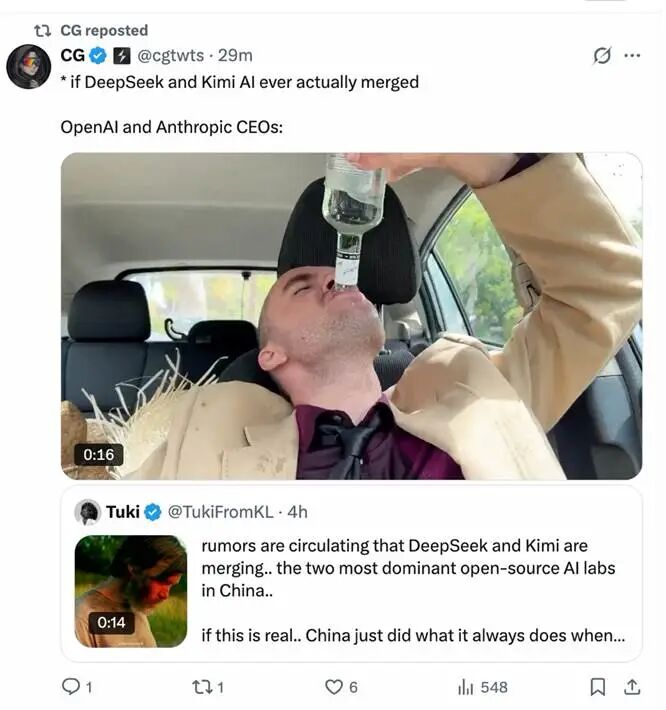
DeepSeek-Kimi Merge: Rivaling OpenAI?

DeepSeek-Kimi Merge: Rivaling OpenAI?

Hypothetical merger of DeepSeek and Kimi could create a full-stack open-source platform matching OpenAI via tech complementarity in MLA attention, Muon optimizer, and agent capabilities. Business synergies address compute shortages, pricing wars, and global expansion. Founders' first-principles align for faster evolution.

Qwen Code TypeScript SDK v0.1.7 Release

Qwen Code TypeScript SDK v0.1.7 Release

Qwen Code releases TypeScript SDK v0.1.7, bundling CLI v0.15.3 and backfilling for v0.1.5. Highlights include a security fix for command injection, multi-modal input support for images, PDFs, and audio, plus concurrent CLI batch execution and experimental LSP for code intelligence. Other improvements cover retry logic, Claude plugin fixes, and VSCode companion enhancements.

Qwen (GitHub Releases: qwen-code)MediaApr 28#security-fix#multi-modal#lsp-support
CognitiveTwin Predicts Alzheimer's Cognitive Decline

CognitiveTwin Predicts Alzheimer's Cognitive Decline

CognitiveTwin is a digital twin framework predicting patient-specific cognitive trajectories in Alzheimer's disease using multi-modal data like cognitive scores, MRI, PET, CSF biomarkers, and genetics. It fuses modalities with a Transformer architecture and models temporal dynamics via Deep Markov Model. Trained on 1,666 TADPOLE patients, it excels in accuracy, demographic fairness, and robustness to missing data.

ArXiv AIResearchApr 27#digital-twins#multi-modal#alzheimers
InVitroVision AI Describes Embryo Development

InVitroVision AI Describes Embryo Development

Researchers fine-tuned PaliGemma-2 into InVitroVision using 1,000 embryo time-lapse images and captions to predict natural language descriptions of morphology, cell cycle, and developmental stages. The model outperformed ChatGPT 5.2 and base models across metrics, with performance scaling with more data. This highlights vision-language models' potential for few-shot IVF applications.

ArXiv AIResearchApr 24#multi-modal#ivf#vision-language
Deep Agents v0.5 Adds Async Subagents

Deep Agents v0.5 Adds Async Subagents

LangChain released v0.5 of Deep Agents and DeepAgentsJS, featuring async non-blocking subagents, expanded multi-modal filesystem support, and more improvements. Async subagents enable delegation to remote agents running in the background, unlike prior inline versions. Full details are in the changelog.

LangChain BlogMediaApr 7#agent#multi-modal#async
Page 2 of 3