🐯虎嗅•較早收集於 15m
AI Agent Skill 的技術本質解析
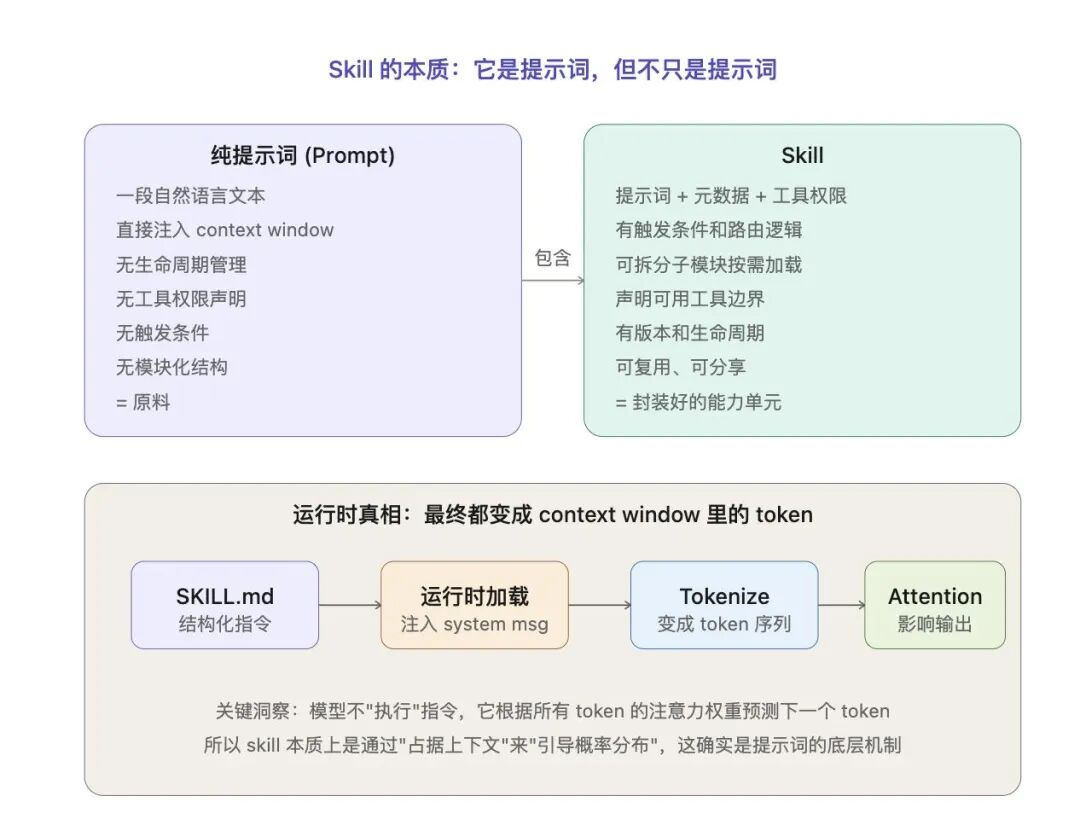
💡了解為何大多數 AI「Skill」只是包裝過的提示詞,以及如何構建真正的 Agent 基礎設施。
⚡ 30-Second TL;DR
有什麼變化
Skill 在注意力機制中扮演「引力場」角色,影響 Token 的機率分佈。
為什麼重要
理解 Skill 本質上是受管理的提示詞,有助於開發者構建更穩健的 Agent 工作流。這將重點從「撰寫長提示詞」轉向「架構高效、模組化且具備權限意識的 Agent 系統」。
下一步行動
審查您現有的 Agent 提示詞;將模糊的定性指令替換為具體、可驗證的資料結構,以提高資訊密度。
誰應關注:Developers & AI Engineers
關鍵要點
- •Skill 在注意力機制中扮演「引力場」角色,影響 Token 的機率分佈。
- •Skill 中過長的提示詞會佔用 Context Window 空間並稀釋模型的注意力。
- •Skill 的真正價值在於外部元數據,如觸發路由、工具權限與模組化載入。
- •高效的 Skill 應優先考慮資訊密度而非冗長的指令,以優化模型表現。
🧠 深度解析
Web-grounded analysis with 31 cited sources.
🔑 增強重點摘要
- •AI agent skills are fundamentally implemented through 'function calling' or 'tool use,' where the Large Language Model (LLM) generates a structured output (e.g., JSON) that an external application then executes, rather than the LLM performing the action itself.
- •Effective skill management employs 'dynamic context management' and 'progressive loading,' meaning that only essential metadata is loaded initially, while detailed instructions and resources are pulled into the context window on-demand when a skill is triggered, optimizing token usage and focus.
- •The portability and reusability of AI agent skills are enhanced by standardized formats, such as the SKILL.md file, which defines trigger conditions, workflows, and supporting resources, allowing skills to be shared and utilized across various AI platforms and tools.
- •The evolution of AI agents increasingly involves multi-agent systems, where specialized agents collaborate and coordinate using these skills, often orchestrated by frameworks that manage state, communication, and task delegation.
- •Beyond prompt engineering, developing production-ready AI agents with robust skills necessitates a broader 'agent engineering' discipline, encompassing expertise in system design, retrieval engineering (RAG), reliability, security, and observability to ensure real-world viability.
📊 競品分析▸ Show
AI Agent Orchestration Frameworks and Platforms
| Feature/Platform | LangChain/LangGraph | Microsoft AutoGen | CrewAI | Semantic Kernel | OpenAI Agents SDK | Google ADK |
|---|---|---|---|---|---|---|
| Orchestration Pattern | Graph-based, stateful workflows | Conversational, multi-agent collaboration | Role-based team automation | Enterprise integration, plugin-based | OpenAI-centric, custom GPTs, function calling | Hierarchical, multi-agent orchestration |
| Language Support | Python, JS | Python, C# | Python | C#, Python, Java | Python, JS (via OpenAI API) | Python, TS |
| Multi-Agent Support | Strong | Strong | Strong | Adequate | Strong (via Swarm) | Strong |
| Memory/State Management | Explicit state management, checkpointing | Dynamic conversation state | Built-in memory (ChromaDB + SQLite), external backends | Integrates with external memory | Context management | Session management |
| Tool Integration | Modular, reusable tools, API chaining | Supports various tools | Role-specific tools | Plugins for external services | Function calling, code interpreter | Action groups, knowledge bases |
| Best For | Highly customized, complex agent systems with precise control | Complex workflows requiring multiple specialized agents to collaborate | Teams needing multi-agent capabilities with intuitive role-based structure | Enterprise organizations integrating AI agents into existing software ecosystems | Users already in the OpenAI stack, rapid development | Gemini-powered apps, native interoperability |
| Open Source | Yes | Yes | Yes | Yes | No (SDK is, underlying models/features are proprietary) | No (ADK is, underlying models/features are proprietary) |
| Key Differentiator | Graph-based control for stateful, cyclic workflows | Dynamic conversational orchestration | Intuitive role-based approach for team-based systems | Strong enterprise integration, plugin model | Tight integration with OpenAI models and ecosystem | Multi-agent orchestration for Gemini-powered applications |
🛠️ 技術深入
- Function Calling Mechanism: When an LLM utilizes a 'skill' or 'tool,' it typically involves a process where the LLM analyzes user input, identifies the need for an external action, and then generates a structured output (often JSON) containing the function name and its required arguments. The LLM itself does not execute this function; instead, an external application or runtime environment receives this structured output, deserializes it, and then executes the actual function or API call.
- Model Training for Tool Use: LLMs are fine-tuned on datasets that include extensive code examples and modified text corpuses to effectively detect when a function needs to be called and to accurately format the necessary arguments. This training enables them to understand function definitions and the expected outputs of tools.
- Context Management and Progressive Loading: To optimize the limited context window, advanced skill systems employ progressive loading. This means that only minimal metadata about available skills is initially presented to the LLM. When a specific task requires a skill, its full instructions and supporting resources are dynamically loaded into the context, reducing token waste and maintaining focus.
- Orchestration Patterns: AI agent frameworks utilize various architectural patterns for managing skills and agent interactions:
- Graph-based: Frameworks like LangGraph define agents and their interactions as nodes and edges in a graph, allowing for explicit state management and cyclic workflows.
- Conversational: AutoGen models agent collaboration as dynamic message exchanges, where agents delegate tasks and reach consensus through structured dialogue.
- Role-based: CrewAI assigns specific roles, goals, and expertise to agents, enabling predictable and maintainable behavior in team-based systems.
- Interoperability Protocols: Emerging standards like the Model Context Protocol (MCP) and Agent Communication Protocol (ACP) aim to standardize how AI applications connect to external tools and how agents communicate with each other, facilitating dynamic capability discovery and reducing vendor lock-in.
- Skill Definition Format: Skills are often defined in human-readable, structured formats, such as markdown files (e.g., SKILL.md), which include trigger conditions, step-by-step workflows, supporting resources (scripts, templates), and constraints.
🔮 前景展望AI analysis grounded in cited sources
Standardized protocols will become critical for enterprise AI agent adoption.
As enterprises deploy more AI agents across diverse systems, open standards like MCP and ACP will be essential for ensuring interoperability, dynamic tool discovery, and reducing vendor lock-in, enabling scalable and governed AI ecosystems.
'Agent Engineering' will emerge as a distinct and highly specialized role.
The complexity of building production-ready AI agents, which involves not just prompt crafting but also system design, reliability, security, and integration of external tools and data, will necessitate a specialized engineering discipline beyond traditional software development.
AI Agent Management Platforms (AMPs) will become indispensable for enterprise governance.
The rapid proliferation of AI agents across various departments and frameworks will lead to 'AI sprawl,' making centralized platforms for unified governance, security, observability, and operational oversight crucial for managing costs and risks.
⏳ 時間線
2018
BERT and GPT mark the rise of Large Language Models (LLMs) as general-purpose cognitive cores.
2021-Late
Retrieval-Augmented Generation (RAG) goes mainstream, enabling LLMs to query external data sources.
2023
Meta AI introduces Toolformer, the first LLM capable of autonomously choosing and calling external tools; OpenAI introduces function calling for structured tool interaction.
2023-01
LangChain is introduced, providing a framework for LLMs to connect with tools, APIs, and chains.
2023-Mid
LangGraph, a graph-based orchestration framework, builds upon LangChain to manage stateful, multi-agent applications.
2024-Late
Anthropic introduces the Model Context Protocol (MCP), an open standard for AI applications to connect to external tools and data sources.
📎 來源 (31)
Factual claims are grounded in the sources below. Forward-looking analysis is AI-generated interpretation.
- martinfowler.com
- apideck.com
- promptingguide.ai
- anthropic.com
- manus.im
- dev.to
- skill-desktop.com
- kdnuggets.com
- medium.com
- kdnuggets.com
- monday.com
- intuz.com
- medium.com
- medium.com
- gleecus.com
- youtube.com
- olostep.com
- langchain.com
- redis.io
- ninjalabo.ai
- langfuse.com
- medium.com
- amazon.com
- medium.com
- gostoa.dev
- zilliz.com
- substack.com
- coderabbit.ai
- kore.ai
- ibm.com
- galileo.ai
📰
AI 週報
閱讀本週精選 AI 大事摘要 →
👉相關動態

AI 策展新聞聚合。所有內容版權歸原始發布者所有。
原始來源: 虎嗅 ↗