來源虎嗅•較早收集於 50m
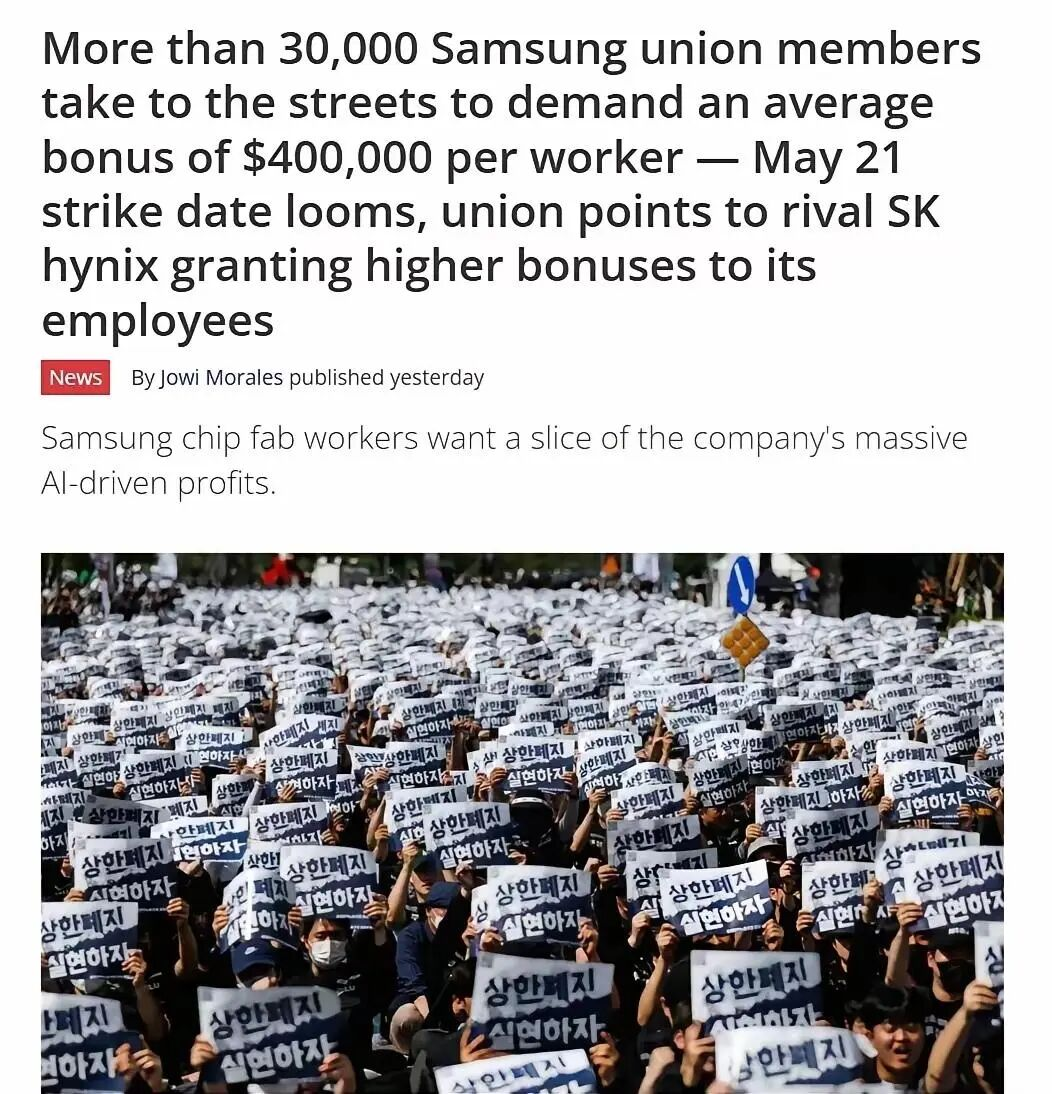
三星罷工危機威脅全球 AI 供應鏈
#supply-chain#semiconductor#memory-chips#ai-hardwaresamsung-semiconductorsamsungnvidiask-hynixhbmdram
💡了解主要記憶體供應商的勞資糾紛如何為您的 AI 基礎設施專案造成瓶頸。
⚡ 30 秒速覽
有什麼變化
三星生產全球 40% 的 DRAM 與 30% 的 NAND,其穩定性對 AI 硬體至關重要。
為什麼重要
此事件凸顯了 AI 產業對少數記憶體製造商的極度依賴。未來的供應鏈策略必須將半導體產業的地緣政治與勞工風險納入考量。
下一步行動
分散您的硬體採購策略,並監控 HBM 供應的前置時間,以降低對單一供應商的依賴風險。
誰應關注:Enterprise & Security Teams
關鍵要點
- •三星生產全球 40% 的 DRAM 與 30% 的 NAND,其穩定性對 AI 硬體至關重要。
- •罷工威脅到 HBM 的生產,這是 NVIDIA GPU 等 AI 加速器的關鍵組件。
- •記憶體產業的高度集中意味著供應鏈衝擊將對 AI 資料中心產生放大效應。
- •法律介入將三星半導體廠列為「安全保護設施」,以防止生產中斷。
🧠 深度解析
背景與延伸:來自公開資料,非原文內容。引用 23 個來源。
🔑 增強重點摘要
- •The recent labor agreement, approved on May 27, 2026, resolved the immediate strike threat but caused significant internal conflict within Samsung due to a large disparity in performance bonuses between the profitable semiconductor (DS) division and other divisions like finished products (DX).
- •A court injunction issued on May 18, 2026, legally restricted the strike's impact by mandating the continuation of essential semiconductor production and maintenance, preventing a complete shutdown of facilities.
- •Samsung's first-ever majority union, the Trans-Company Union, lost its majority status on June 4, 2026, after approximately 18,000 members defected, largely due to dissatisfaction with the wage agreement's bonus structure favoring the semiconductor division.
- •Despite recent challenges in HBM market share, Samsung plans to significantly boost its HBM production capacity by about 50% in 2026, aiming for 250,000 wafers per month by year-end, with a strong focus on HBM4.
- •The broader HBM market is characterized by an oligopoly of SK Hynix, Micron, and Samsung, with SK Hynix currently holding the largest share (62% as of Q2 2025), and all three suppliers having their 2026 HBM capacity largely sold out to hyperscalers.
📊 競品分析▸ Show
| Feature/Metric | Samsung Electronics | SK Hynix | Micron Technology |
|---|---|---|---|
| HBM Market Share (Q2 2025) | 17% | 62% | 21% |
| HBM3E Status | Completed validation in 2025, mass production ramping | Dominant position, early and exclusive supply agreements with NVIDIA | Shipping 12-stack HBM3E |
| HBM4 Status | Began sampling in 2025, mass production ramping in 2026, first supplier of HBM4 to NVIDIA | Began sampling in 2025, mass production ramping in 2026, preparing for HBM4 market emergence | Began sampling in 2025, mass production ramping in 2026 |
| 2026 HBM Capacity | Plans 50% surge to ~250,000 wafers/month by end of 2026 | Capacity reportedly fully booked for next three years | Entire 2026 production reportedly sold out |
| DRAM Market Share (Q1 2026) | 38% (led market) | 29% | Not specified in Q1 2026, but a major player |
🛠️ 技術深入
- HBM Fundamentals: High Bandwidth Memory (HBM) is a 3D-stacked DRAM architecture that maximizes data throughput while minimizing power consumption and footprint. It achieves this through Through-Silicon Vias (TSVs) for vertical interconnects and wide I/O interfaces.
- HBM3E (Fifth Generation): This is the current production-grade HBM, delivering over 1.2 TB/s per stack through a 1024-bit wide interface and 16 independent channels. It pushes per-pin data rates beyond 9 Gbps, with capacities up to 36GB per stack.
- HBM4 (Sixth Generation): Defined by JEDEC JESD270-4 (published December 2024, official spec April 2025), HBM4 doubles the interface width to 2048 bits and 32 independent channels. It targets over 2.0 TB/s (up to 3.3 TB/s in advanced configurations) per stack and up to 64GB capacity per stack (via 16-high configurations with 32Gb layers).
- Power Efficiency: HBM4 reduces the core DRAM voltage to 1.05V (from 1.1V in HBM3/3E), contributing to improved power efficiency.
- Architectural Shift: HBM4 is not an incremental speed bump but a redesign of the memory interface and a shift in memory architecture, integrating a logic die and requiring significant redesign of silicon interposers due to the doubled bus width.
🔮 前景展望基於引用來源的 AI 分析
The HBM market will continue to experience extreme supply tightness and price premiums through 2026 and beyond.
All major HBM suppliers (SK Hynix, Samsung, Micron) have already sold out their 2026 production, driven by insatiable demand from AI accelerators and hyperscalers, indicating a structural supercycle rather than a cyclical boom.
Samsung will likely regain significant HBM market share, especially in the HBM4 generation.
Samsung is aggressively increasing its HBM production capacity by 50% in 2026, focusing on HBM4, and has reportedly become the first supplier of HBM4 samples to NVIDIA, positioning it to challenge SK Hynix's current dominance.
Labor disputes and internal compensation disparities will remain a significant challenge for Samsung, potentially impacting long-term stability and employee morale.
The recent wage agreement led to the collapse of Samsung's first majority union due to bonus gaps between divisions, indicating deep-seated issues that could continue to fuel labor-labor and labor-management conflicts.
⏳ 時間線
2019
Samsung chairman convicted and imprisoned for union sabotage, signaling a shift from the company's long-standing 'union-free workplace' policy.
2020-05
Samsung Vice Chairman Lee Jae-yong apologizes for the company's union-busting activities.
2021-08
Samsung Electronics signs a collective agreement with four different trade unions, marking a formal recognition of unions.
2024-06-07
National Samsung Electronics Union (NSEU) stages a one-day strike, the first employee-led strike in Samsung Group's history.
2025-04
JEDEC releases the official HBM4 specification.
2026-04
The Trans-Company Union becomes the first organization to achieve majority status at Samsung Electronics.
2026-05-18
A South Korean court issues an injunction restricting the scope of a planned Samsung Electronics strike, mandating the maintenance of essential workforce at semiconductor plants.
2026-05-27
Samsung Electronics' tentative wage agreement is approved by union members, resolving the immediate strike risk.
2026-06-04
The Trans-Company Union loses its majority status at Samsung Electronics due to member defections over the wage agreement.
📎 來源 (23)
Factual claims are grounded in the sources below. Forward-looking analysis is AI-generated interpretation.
📰
AI 週報
閱讀本週精選 AI 大事摘要 →
👉相關動態


AI 策展新聞聚合。所有內容版權歸原始發布者所有。
原始來源: 虎嗅 ↗
每週電子報
每週一封,可隨時退訂。