來源Bloomberg Technology•較早收集於 13m
RLRWLD 與 Nvidia 合作開發 DexBench 機器人標準
💡標準化基準測試對於衡量具身智慧 (Embodied AI) 與人形機器人靈巧度的進展至關重要。
⚡ 30 秒速覽
有什麼變化
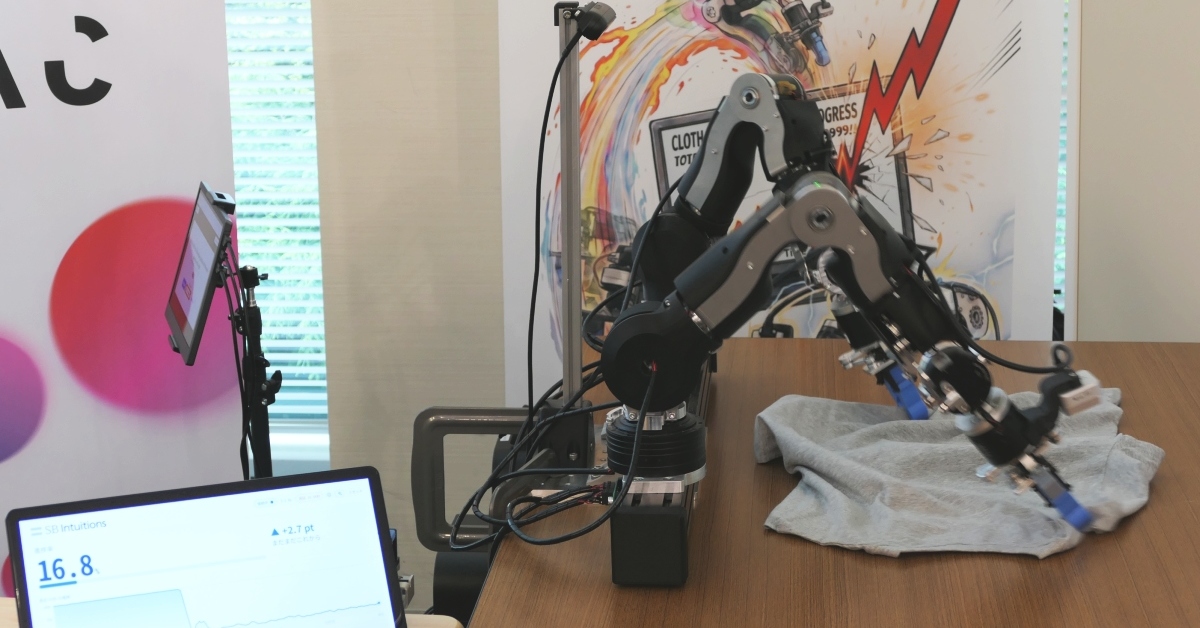
RLRWLD 與 Nvidia 正在建立機器人手部操作的通用基準測試。
為什麼重要
像 DexBench 這樣的標準化基準測試將為研究人員和開發者提供共同指標,從而加速靈巧人形機器人的開發。
下一步行動
密切關注 DexBench 的發布,以便將其評估指標整合到您自己的機器人操作訓練流程中。
誰應關注:Researchers & Academics
關鍵要點
- •RLRWLD 與 Nvidia 正在建立機器人手部操作的通用基準測試。
- •該專案專注於量化機器人如何與物體互動以完成任務。
- •目標是為人形機器人定義下一代產業標準。
🧠 深度解析
背景與延伸:來自公開資料,非原文內容。引用 18 個來源。
🔑 增強重點摘要
- •DexBench will establish a universal benchmark for evaluating dexterity performance, define a data standard for dexterous manipulation training, and deeply integrate with NVIDIA's open Isaac Lab and Isaac Lab-Arena frameworks.
- •The benchmark defines five core evaluation domains—Grasp Diversity, Spatial Precision, Temporal Precision, Contact Precision, and Context Awareness—across 18 Key Atomic Tasks derived from real-world industrial applications like assembly, sorting, and packaging.
- •DexBench will utilize a dual-validation framework, integrating with NVIDIA's Isaac Lab-Arena environment to ensure performance validation in both simulation and real-world conditions.
- •RLRWLD's RLDX-1 foundation model for humanoid dexterous manipulation has previously demonstrated state-of-the-art performance, surpassing NVIDIA GR00T N1.6 and Physical Intelligence π₀.₅ on eight established simulation benchmarks.
- •The initiative aims to overcome the current industry challenges of lacking a common framework for objectively measuring humanoid dexterity and a shared data standard for training manipulation models at scale, which currently impedes technological advancement and commercial deployment.
📊 競品分析▸ Show
| Benchmark/Initiative | Focus | Key Features | Integration/Platform |
|---|---|---|---|
| DexBench (RLRWLD & Nvidia) | Universal benchmark for robotic hand manipulation and dexterity. | 5 core evaluation domains, 18 Key Atomic Tasks from industrial settings, dual-validation (sim & real-world), data standard for training. | Deep integration with NVIDIA Isaac Lab and Isaac Lab-Arena. |
| NIST's Proposed Baseline Performance Benchmark | Comprehensive method to evaluate minimum expected physical capabilities for humanoid robots. | Low-footprint set of locomotion and manipulation tasks, uses previously standardized test methods, aims for baseline capabilities in industrial, household, healthcare. | Standardized test methods from ASTM and NIST. |
| ManipulationNet | Measuring real-world robot manipulation performance. | Shared testing platform for standardized real-world tasks, combines distributed testing with centralized verification, aims for realism, accessibility, and authenticity. | Client software for data upload and central server for verification. |
| POMDAR (ETH Zurich) | Taxonomy-grounded dexterity benchmark for anthropomorphic hands. | Formalizes dexterity as task throughput (correctness and speed) across vertical, horizontal, continuous-rotation, and pure-grasping configurations, implemented in real-world and simulation. | Reproducible hardware (3D printing), observable motions via scaffolding. |
| Elliott and Connolly Benchmark (Carnegie Mellon) | Evaluating in-hand dexterity of robot hands. | Based on classification of human manipulations, 13 distinct in-hand manipulation patterns, qualitative and quantitative metrics. | Focuses on hardware design evaluation. |
🛠️ 技術深入
- DexBench defines dexterity through five core evaluation domains: Grasp Diversity, Spatial Precision, Temporal Precision, Contact Precision, and Context Awareness.
- It comprises 18 Key Atomic Tasks that are directly derived from dexterous manipulation tasks observed in industrial environments, such as precision assembly, sorting, and packaging.
- The benchmark will be integrated into NVIDIA's Isaac Lab-Arena, an open-source framework for efficient and scalable robotic policy evaluation in simulation, enabling a dual-validation approach across both simulated and real-world conditions.
- A shared data standard for dexterous manipulation training will be developed to ensure native compatibility with NVIDIA Isaac Lab pipelines, aiming to serve as a common data interface for global robot manufacturers and research organizations.
- DexBench tasks are defined by specifying initial and goal states, allowing the system under test to determine the method, with success measured by verifiable end-state conditions rather than trajectory similarity.
- The benchmark utilizes commercially available objects with published specifications (dimensions, weights, materials) for its test cases.
- Dexterity is conceptualized as the ability to achieve a required state transition under the object's complexity constraints, rather than an inherent property of the robotic hand itself.
- NVIDIA Isaac Lab-Arena, co-developed with Lightwheel, features a modular architecture for task curation, automated diversification, and large-scale parallel evaluation, using an Affordance system for standardized interactions across diverse objects.
🔮 前景展望基於引用來源的 AI 分析
DexBench will significantly accelerate the commercial deployment and adoption of humanoid robots in industrial environments.
By providing a universal, standardized benchmark and a common data standard, DexBench will enable objective comparison and validation of robot dexterity, thereby reducing development friction, mitigating deployment risks, and fostering trust among manufacturers and enterprises.
RLRWLD will gain substantial market influence by becoming a key architect of industry standards for humanoid robotics.
If DexBench achieves widespread adoption, its specifications could become a de facto baseline, shaping procurement criteria and integration practices across the humanoid robotics market and potentially favoring RLRWLD's technology stack and training tools.
The collaboration will foster a more unified and efficient global ecosystem for humanoid AI development.
Establishing a shared language for measuring and reproducing robot hand movements and a common data interface will reduce fragmentation, accelerate research and development, and facilitate collaboration among global robot manufacturers and research organizations.
⏳ 時間線
2026-01
NVIDIA announced the pre-alpha release of Isaac Lab-Arena, an open-source framework for scalable robotic policy evaluation in simulation.
2026-04
NVIDIA introduced RoboLab, a high-fidelity simulation benchmark for generalist robot policies, built on Isaac and Omniverse, focusing on post-training transfer performance.
2026-06
RLRWLD's RLDX-1 foundation model for humanoid dexterous manipulation demonstrated state-of-the-art performance, outperforming NVIDIA GR00T N1.6 and Physical Intelligence π₀.₅ on 8 established simulation benchmarks.
2026-06-09
RLRWLD and NVIDIA officially announced their collaboration to develop DexBench, a universal benchmark for robotic hand manipulation, a data standard, and deep integration with Isaac Lab and Isaac Lab-Arena.
📎 來源 (18)
Factual claims are grounded in the sources below. Forward-looking analysis is AI-generated interpretation.
📰
AI 週報
閱讀本週精選 AI 大事摘要 →
👉相關動態

AI 策展新聞聚合。所有內容版權歸原始發布者所有。
原始來源: Bloomberg Technology ↗
每週電子報
每週一封,可隨時退訂。