來源虎嗅•較早收集於 24m
Keller揭RISC-V CPU與AI融合趨勢
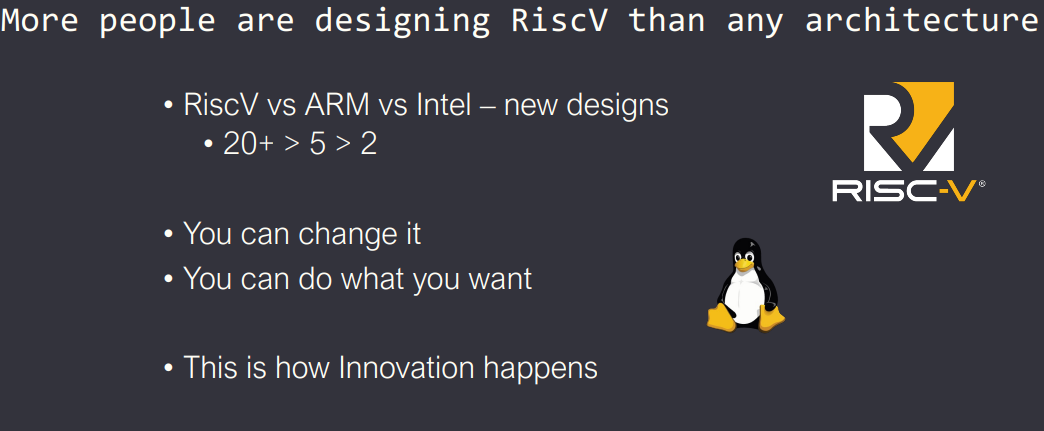
💡RISC-V新設計4倍ARM;Tenstorrent CPU-AI路線降低成本 (24字)
⚡ 30 秒速覽
有什麼變化
RISC-V新設計20+,ARM 5、Intel 2
為什麼重要
RISC-V動搖ARM/Intel壟斷,以開放高效晶片降低AI算力成本。
下一步行動
測試Tenstorrent BUDA工具鏈,用於RISC-V AI模型部署。
誰應關注:Developers & AI Engineers
關鍵要點
- •RISC-V新設計20+,ARM 5、Intel 2
- •Ascalon:8路解碼、6 ALU、2x256-bit向量、230GB/s
- •路線圖:Grendel CPU+ML chiplets融合
- •BUDA自動化AI程式,Android官方支援RISC-V
🧠 深度解析
本篇為 AI 生成分析,非原文內容。
🔑 增強重點摘要
- •Tenstorrent's strategy leverages the 'chiplet' ecosystem to decouple CPU core development from AI accelerator silicon, allowing for rapid iteration of heterogeneous compute tiles.
- •The BUDA software stack is designed to abstract hardware complexity by compiling high-level AI models (PyTorch/TensorFlow) directly into a graph-based intermediate representation that maps across both RISC-V cores and Tenstorrent's proprietary Tensix cores.
- •RISC-V's momentum is bolstered by the 'RISE' (RISC-V Software Ecosystem) project, which coordinates industry-wide efforts to upstream RISC-V support into major Linux distributions and toolchains, reducing the fragmentation risk historically associated with open-source architectures.
📊 競品分析▸ Show
| Feature | Tenstorrent (Ascalon/Grendel) | ARM (Neoverse V3) | Intel (Xeon 6 / Gaudi 3) |
|---|---|---|---|
| ISA | RISC-V (Open) | ARMv9 (Proprietary) | x86-64 (Proprietary) |
| AI Integration | Native Chiplet Fusion | External/PCIe Accelerator | Integrated AMX / Gaudi PCIe |
| Customization | High (Instruction Set Extensions) | Low (Licensing constraints) | Low (Fixed architecture) |
| Software Stack | BUDA (Graph-based) | Standard Linux/Compute Libs | OneAPI / OpenVINO |
🛠️ 技術深入
- Ascalon Core Architecture: Features an out-of-order execution engine with an 8-wide decode width, designed to maximize IPC (Instructions Per Cycle) for high-performance server workloads.
- Vector Processing: Utilizes dual 256-bit vector units per core, optimized for AI inference and mathematical acceleration, bridging the gap between general-purpose CPU tasks and specialized NPU tasks.
- Interconnect: Employs a high-bandwidth chiplet-to-chiplet interconnect (likely based on UCIe or proprietary low-latency fabric) to achieve the 230GB/s bandwidth, minimizing data movement bottlenecks between the CPU and AI compute tiles.
- BUDA Compiler: Implements a 'graph-to-hardware' mapping approach that treats the entire chiplet array as a unified compute fabric, automatically partitioning tensors across available RISC-V and Tensix cores.
🔮 前景展望基於引用來源的 AI 分析
RISC-V will capture >20% of the hyperscaler server CPU market by 2030.
The combination of open-source ISA flexibility and the ability to integrate custom AI accelerators provides a cost-to-performance advantage that proprietary architectures struggle to match.
Tenstorrent will transition to a pure-play IP and chiplet provider model.
The company's focus on licensing Ascalon cores and BUDA software suggests a shift away from selling finished silicon toward enabling other vendors to build custom AI-CPU fusion chips.
⏳ 時間線
2016-05
Tenstorrent founded by Ljubisa Bajic, Ivan Hamer, and Milos Trajkovic.
2023-01
Jim Keller appointed as CEO of Tenstorrent.
2023-08
Tenstorrent announces the Ascalon RISC-V high-performance CPU core.
2024-02
Tenstorrent and LG Electronics announce partnership to integrate RISC-V and AI into smart TVs and automotive products.
2025-06
Tenstorrent demonstrates Grendel chiplet-based architecture for AI-CPU fusion.
📰
AI 週報
閱讀本週精選 AI 大事摘要 →
👉相關動態



AI 策展新聞聚合。所有內容版權歸原始發布者所有。
原始來源: 虎嗅 ↗
每週電子報
每週一封,可隨時退訂。