🌍The Next Web (TNW)•較早收集於 44m
Dunia Innovations 投入 2.8 億歐元建設自動化 AI 材料實驗室
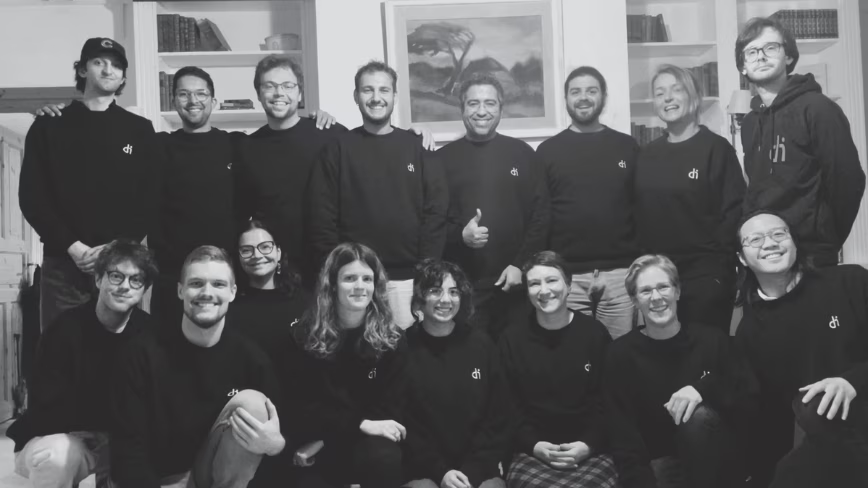
💡了解自動化實驗室如何整合 NVIDIA 與 AWS 技術,以加速材料科學的研發進程。
⚡ 30-Second TL;DR
有什麼變化
投入 2.8 億歐元建設 6,000 平方公尺的自動化研發中心。
為什麼重要
該設施代表了物理與數位融合的重大飛躍,透過自動化 AI 實驗加速新材料的發現。
下一步行動
若您正在從事 AI 驅動的物理設計,請探索 NVIDIA 的 cuLitho 或類似的材料科學 API。
誰應關注:Researchers & Academics
關鍵要點
- •投入 2.8 億歐元建設 6,000 平方公尺的自動化研發中心。
- •設施旨在解決 AI 設計中材料驗證的瓶頸問題。
- •合作夥伴包括 NVIDIA、Siemens、ABB Robotics 與 AWS。
🧠 深度解析
Web-grounded analysis with 7 cited sources.
🔑 增強重點摘要
- •Dunia Innovations' GigaLab aims to achieve an industrial scale of materials discovery, capable of 500 to 1,000 material iterations per day and generating one million high-quality data points annually, significantly surpassing current industry capabilities.
- •The GigaLab will focus on accelerating breakthroughs in strategically important sectors, including energy storage, catalysis, semiconductors, clean manufacturing, and critical raw material substitution.
- •Dunia's core platform, IRIS, is a third-generation system that integrates AI, lab automation, and simulation into a closed-loop Design-Make-Test-Analyze (DMTA) cycle, designed to bridge the simulation-to-reality (Sim2Real) gap.
- •The facility addresses the critical bottleneck of experimental verification, which has emerged as AI models generate millions of novel material candidates that traditional methods and fragmented scientific records struggle to validate under real-world conditions.
- •Key technology partners include Siemens for digital twin and process simulation, ABB Robotics for lab automation, AWS for cloud infrastructure and analytics, NVIDIA for high-performance computing and AI model training, and ILS for advanced high-throughput parallel testing equipment.
🛠️ 技術深入
- Dunia Innovations' platform integrates AI, lab automation, and simulation into a closed-loop system for materials discovery.
- The AI component is described as "physics-informed AI," which integrates principles of physics and empirical verification into its algorithms for robust and insightful problem-solving.
- Robotic automation is utilized for precision execution of electrochemical experiments, ensuring meticulous data capture for traceable and reproducible results.
- The system is designed to capture terabytes of rich, multi-modal experimental data at scale, transforming fragmented outputs into validated datasets.
- Siemens contributes digital twin and process simulation technology to the GigaLab.
- ABB Robotics provides advanced lab automation solutions for fully autonomous experimentation within the facility.
- AWS supplies the cloud data infrastructure and capabilities for large-scale analytics.
- NVIDIA supports the project with high-performance computing resources for AI model training, leveraging its Inception programme.
- ILS provides advanced high-throughput parallel testing equipment to enhance experimental capacity.
- Dunia's second-generation platform, IRIS, is capable of running 56 complete make-test iterations per day end-to-end, operating autonomously without human intervention.
- The GigaLab aims to integrate autonomous experimentation, AI-guided design, digital simulation, and industrial-grade characterization into a single, unified closed-loop platform.
- The AI models are developed to optimize for desired material characteristics and incorporate manufacturability considerations from the initial design phase, including tracking material abundance, processing requirements, and supply chain feasibility.
🔮 前景展望AI analysis grounded in cited sources
GigaLab will significantly accelerate the discovery and deployment of advanced materials for critical industries.
By industrializing the materials discovery process and generating high-quality, large-scale datasets, it will overcome current bottlenecks in experimental verification and enable faster innovation in sectors like energy storage and semiconductors.
The GigaLab initiative will strengthen Europe's position as a global hub for deeptech materials innovation.
The substantial €280M investment and the consortium of major industrial partners aim to create a world-leading facility, attracting talent and potentially leading to further public co-investment.
The 'physics-informed AI' approach will lead to more robust and reliable material predictions and designs.
By integrating fundamental physics principles with empirical verification, Dunia's AI aims to overcome limitations of purely data-driven models and simulations that often fail under real-world conditions.
⏳ 時間線
2022
Dunia Innovations founded
2023
Dunia's first-generation platform launched
2024-10
Dunia Innovation raised $12.0M Seed funding
2025-05
Dunia's second-generation IRIS platform went live
2025-12
Dr. Dirk Demuth joined Dunia Innovations as Senior Advisor and Head of Corporate Development
2026-05-20
Dunia Innovations announced plans for the Berlin GigaLab
📎 來源 (7)
Factual claims are grounded in the sources below. Forward-looking analysis is AI-generated interpretation.
📰
AI 週報
閱讀本週精選 AI 大事摘要 →
👉相關動態

AI 策展新聞聚合。所有內容版權歸原始發布者所有。
原始來源: The Next Web (TNW) ↗