ZML launches cross-chip tool to break Nvidia dominance
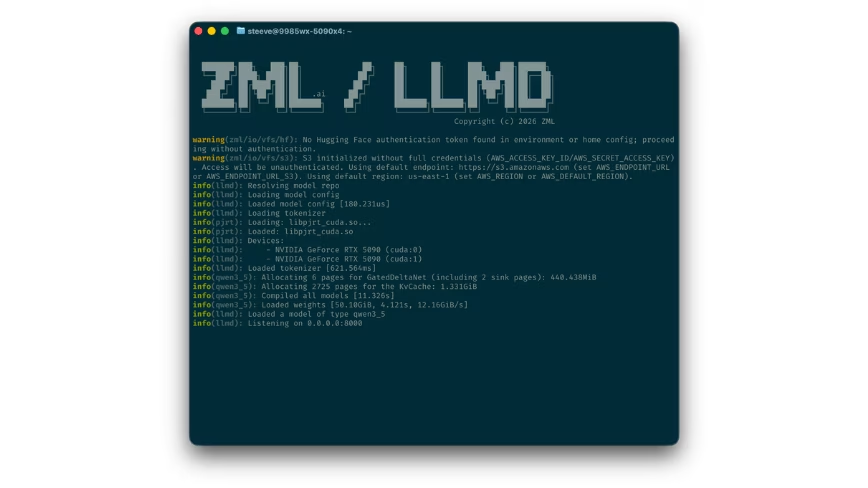
💡Reduce infrastructure costs by running AI models on non-Nvidia hardware using ZML's new cross-chip tool.
⚡ 30-Second TL;DR
What Changed
ZML software enables cross-platform AI model execution
Why It Matters
If successful, this could lower infrastructure costs for startups by allowing them to utilize non-Nvidia hardware for AI workloads.
What To Do Next
Evaluate ZML's tool against your current inference stack to see if you can leverage cheaper or existing non-Nvidia hardware.
Key Points
- •ZML software enables cross-platform AI model execution
- •Supports silicon from Nvidia, AMD, Google, Apple, and Intel
- •Focuses on breaking Nvidia's hardware lock-in for AI developers
🧠 Deep Insight
AI-generated analysis for this event — not the original article.
🔑 Enhanced Key Takeaways
- •ZML's software stack is built upon the MLIR (Multi-Level Intermediate Representation) compiler infrastructure, allowing it to target various hardware backends without rewriting model code.
- •The startup recently secured a seed funding round led by European venture capital firms to accelerate the development of its hardware-agnostic compiler technology.
- •ZML's architecture specifically addresses the 'CUDA tax' by providing a unified abstraction layer that translates high-level AI operations into optimized machine code for non-Nvidia chips.
- •The tool integrates with popular frameworks like PyTorch and JAX, enabling developers to switch hardware targets with minimal configuration changes.
- •ZML is positioning its offering as an open-core model, providing a free community version while planning enterprise-grade support and optimization services.
📊 Competitor Analysis▸ Show
| Feature | ZML | Triton (OpenAI) | Apache TVM | Mojo (Modular) |
|---|---|---|---|---|
| Primary Focus | Cross-chip portability | GPU kernel optimization | Deep learning compilation | High-performance programming |
| Hardware Support | Broad (Nvidia, AMD, Intel, Apple, Google) | Primarily Nvidia | Broad | Primarily Nvidia/CPU |
| Pricing | Free (Open-core) | Open Source | Open Source | Proprietary/Freemium |
| Ease of Use | High (Abstraction layer) | Low (Requires kernel writing) | Medium (Complex setup) | High (Python-like) |
🛠️ Technical Deep Dive
- Utilizes MLIR-based compilation pipeline to lower high-level AI graphs into hardware-specific kernels.
- Implements a custom runtime environment that manages memory allocation and kernel scheduling across heterogeneous devices.
- Supports dynamic shape inference, allowing models to run on varying input sizes without recompilation.
- Leverages vendor-specific libraries (e.g., ROCm for AMD, OneAPI for Intel) under the hood to ensure performance parity with native implementations.
🔮 Future ImplicationsAI analysis grounded in cited sources
⏳ Timeline
Weekly AI Recap
Read this week's curated digest of top AI events →
👉Related Updates


AI-curated news aggregator. All content rights belong to original publishers.
Original source: The Next Web (TNW) ↗
This is a summary, not the original. Read the source, or get the weekly briefing.
The weekly digest
One email a week. Unsubscribe anytime.