ElevenLabs CEO discusses revenue and AI competition
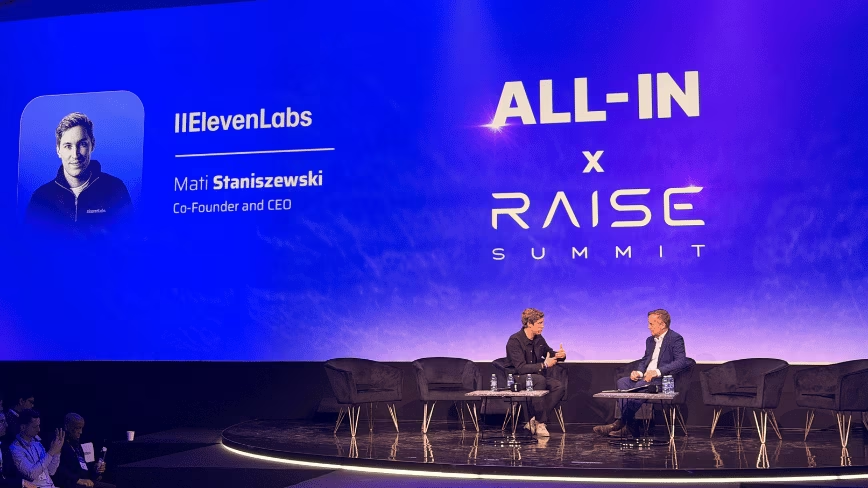
💡Learn how a specialized voice startup sustains growth while competing with industry giants like OpenAI.
⚡ 30-Second TL;DR
What Changed
ElevenLabs has reached approximately $600 million in revenue.
Why It Matters
This highlights the viability of specialized AI startups to achieve massive scale despite competition from foundation model providers.
What To Do Next
Analyze ElevenLabs' product-market fit in the voice synthesis space to identify potential niches for your own AI ventures.
Key Points
- •ElevenLabs has reached approximately $600 million in revenue.
- •CEO remains confident in competing against big tech labs.
- •The current market is identified as an optimal time for AI development.
🧠 Deep Insight
AI-generated analysis for this event — not the original article.
🔑 Enhanced Key Takeaways
- •ElevenLabs has successfully transitioned from a specialized voice synthesis tool to a broader multimodal AI platform, incorporating text-to-sound effects and music generation capabilities.
- •The company has secured significant strategic partnerships with major media and gaming conglomerates to integrate its proprietary voice-cloning technology into professional production workflows.
- •ElevenLabs has expanded its infrastructure to support enterprise-grade API deployments, focusing on low-latency inference for real-time conversational AI applications.
- •The firm has implemented advanced safety and watermarking protocols, such as the AI Speech Classifier, to address regulatory concerns regarding deepfakes and synthetic media misuse.
- •ElevenLabs has shifted its business model to emphasize high-volume B2B licensing, moving beyond its initial consumer-facing subscription model to capture larger market share in the entertainment industry.
📊 Competitor Analysis▸ Show
| Feature | ElevenLabs | OpenAI (Voice Engine) | Anthropic (Claude) |
|---|---|---|---|
| Core Focus | Audio/Speech Synthesis | Multimodal/LLM | Text/Reasoning |
| Voice Quality | Industry-leading emotional range | High fidelity/Natural | N/A (Text-focused) |
| Pricing Model | Tiered Subscription/API | Usage-based | Usage-based |
| Benchmarks | Superior MOS (Mean Opinion Score) | Competitive | N/A |
🛠️ Technical Deep Dive
- Utilizes proprietary transformer-based architectures optimized for high-fidelity audio synthesis and prosody control.
- Employs latent diffusion models for text-to-sound and music generation tasks.
- Implements custom inference engines designed to minimize latency for real-time voice interaction.
- Features a robust fine-tuning pipeline that allows users to clone voices with minimal training data while maintaining speaker identity.
- Integrates multi-language support through cross-lingual voice cloning, enabling speech synthesis in various languages while preserving the original speaker's characteristics.
🔮 Future ImplicationsAI analysis grounded in cited sources
⏳ Timeline
Weekly AI Recap
Read this week's curated digest of top AI events →
👉Related Updates


AI-curated news aggregator. All content rights belong to original publishers.
Original source: The Next Web (TNW) ↗
This is a summary, not the original. Read the source, or get the weekly briefing.
The weekly digest
One email a week. Unsubscribe anytime.