🌍The Next Web (TNW)•Freshcollected in 14m
Zipline partners with Cleveland Clinic for drone delivery
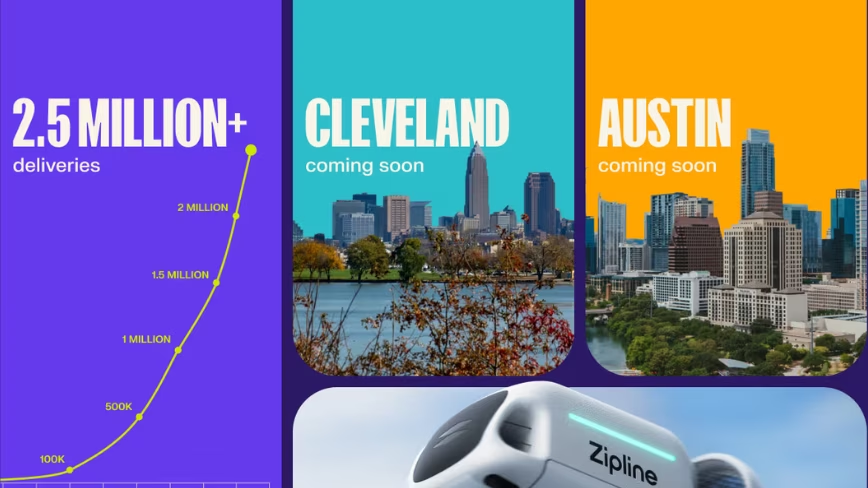
💡See how autonomous drone fleets are scaling to handle millions of commercial deliveries.
⚡ 30-Second TL;DR
What Changed
Partnership with Cleveland Clinic for healthcare logistics
Why It Matters
Zipline's ability to scale autonomous logistics demonstrates the growing maturity of AI-driven robotics in real-world healthcare applications.
What To Do Next
Monitor Zipline's API or integration documentation if you are building logistics or supply chain AI solutions.
Who should care:Developers & AI Engineers
Key Points
- •Partnership with Cleveland Clinic for healthcare logistics
- •Surge in delivery volume with 13x growth in business adoption
- •Strategic hiring of autonomous vehicle experts from Tesla and Waymo
🧠 Deep Insight
AI-generated analysis for this event.
🔑 Enhanced Key Takeaways
- •The partnership utilizes Zipline's 'Platform 2' (P2) autonomous delivery system, which features a tethered delivery droid designed for precise, quiet drop-offs at residential and clinical locations.
- •Cleveland Clinic is integrating Zipline's service to facilitate 'hub-and-spoke' distribution, aiming to reduce patient wait times for specialty medications and lab samples by bypassing traditional ground traffic.
- •Zipline's recent hiring surge is specifically focused on scaling its 'autonomy stack,' leveraging Waymo and Tesla veterans to refine sensor fusion and real-time obstacle avoidance in dense urban environments.
- •The 13x growth in business adoption is largely attributed to Zipline's expansion into the U.S. domestic market, moving beyond its historical focus on blood and vaccine delivery in Rwanda and Ghana.
- •Regulatory approval for this deployment was accelerated under FAA Part 135 certification, allowing Zipline to conduct beyond-visual-line-of-sight (BVLOS) operations in the Ohio region.
📊 Competitor Analysis▸ Show
| Feature | Zipline (P2) | Wing (Alphabet) | Amazon Prime Air |
|---|---|---|---|
| Delivery Mechanism | Tethered Droid | Winch/Drop | Direct Drop |
| Primary Focus | Healthcare/Retail | Retail/Food | E-commerce |
| Operational Range | ~10 miles (radius) | ~6 miles (radius) | ~5-10 miles (radius) |
| Autonomy Level | High (BVLOS) | High (BVLOS) | High (BVLOS) |
🛠️ Technical Deep Dive
- Platform 2 (P2) Architecture: Utilizes a dual-vehicle system consisting of a long-range fixed-wing aircraft and a smaller, battery-powered delivery droid.
- Navigation: Employs a combination of GPS, computer vision, and LiDAR for precision landing within a 3-meter target zone.
- Noise Mitigation: The P2 droid utilizes active noise cancellation and optimized propeller geometry to maintain sound levels below 50 decibels at 20 feet.
- Safety Systems: Features redundant flight computers, emergency parachutes, and real-time telemetry monitoring via a proprietary cloud-based command center.
🔮 Future ImplicationsAI analysis grounded in cited sources
Zipline will achieve profitability in its U.S. healthcare division by Q4 2027.
The high volume of recurring medical deliveries provides a stable revenue stream that offsets the initial capital expenditure of drone infrastructure.
Cleveland Clinic will expand drone delivery to include home-based diagnostic testing.
The current infrastructure allows for the rapid transport of biological samples, which is a critical bottleneck in remote patient monitoring.
⏳ Timeline
2016-10
Zipline launches its first commercial drone delivery service in Rwanda.
2022-11
Zipline officially unveils the Platform 2 (P2) autonomous delivery system.
2023-06
Zipline receives FAA Part 135 certification for commercial drone delivery in the U.S.
2024-03
Zipline begins commercial P2 operations with healthcare partners in the U.S.
📰
Weekly AI Recap
Read this week's curated digest of top AI events →
👉Related Updates


AI-curated news aggregator. All content rights belong to original publishers.
Original source: The Next Web (TNW) ↗