Zhipu AI Open-Sources GLM-5.2 With 1M Token Context
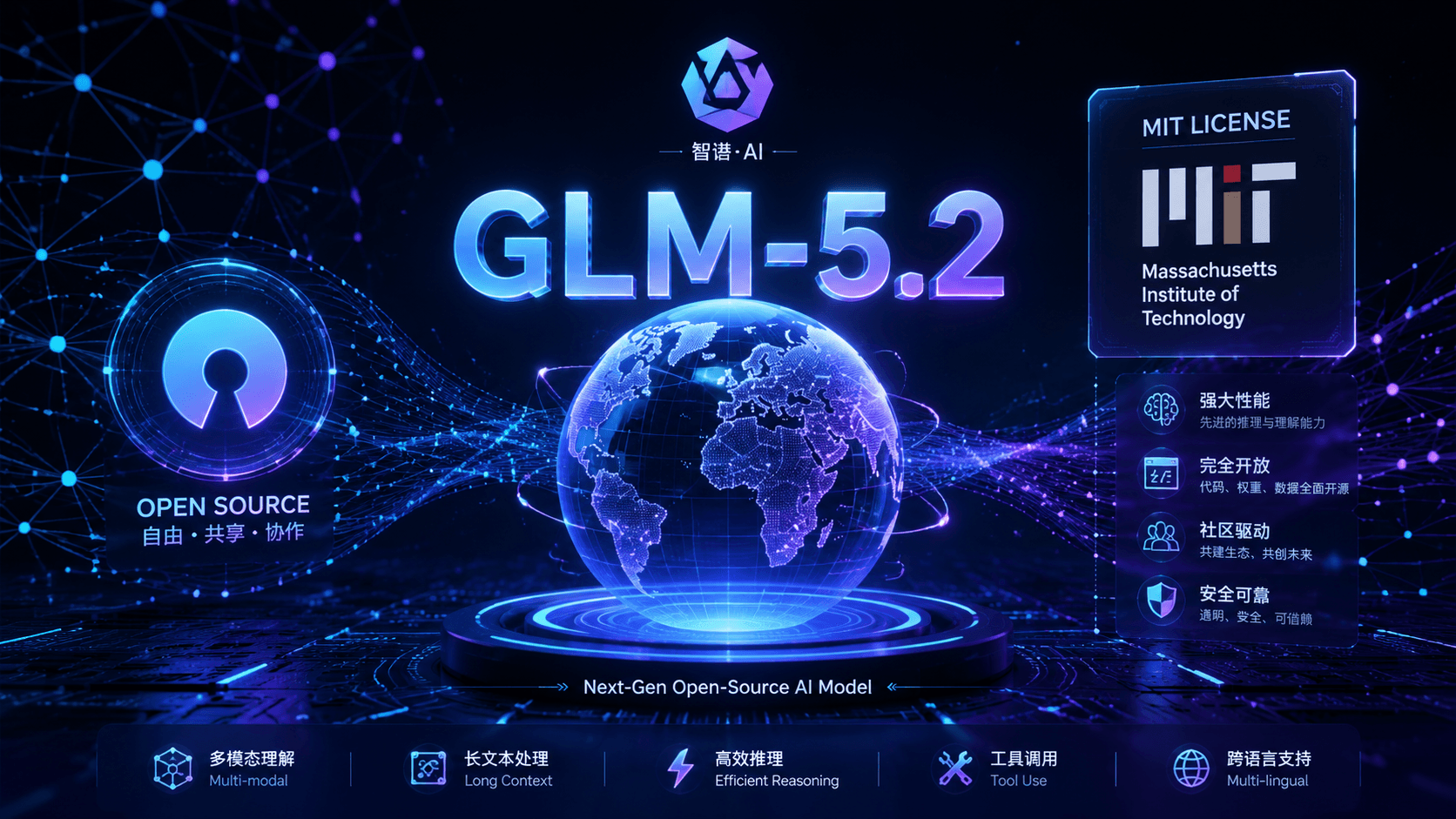
💡New 1M context open-source model available under MIT license; a major alternative to restricted US models.
⚡ 30-Second TL;DR
What Changed
GLM-5.2 is now available under the permissive MIT license.
Why It Matters
This release provides a powerful alternative for developers needing long-context capabilities without relying on US-restricted APIs. It significantly lowers the barrier for building RAG-heavy applications in regions affected by export controls.
What To Do Next
Download the GLM-5.2 weights and benchmark its retrieval accuracy on your long-document datasets compared to existing proprietary models.
Key Points
- •GLM-5.2 is now available under the permissive MIT license.
- •The model supports an extensive 1 million token context window.
- •The release serves as a strategic alternative to restricted US-based AI models.
- •Zhipu AI aims to provide high-capacity open-source infrastructure for developers.
🧠 Deep Insight
Background and context from public sources — not the original article. 15 sources cited.
🔑 Enhanced Key Takeaways
- •GLM-5.2 is the third major iteration in Zhipu AI's GLM-5 family, specifically engineered for agentic coding and long-horizon software development tasks.
- •The model was made available to users of Zhipu AI's GLM Coding Plan on June 13, 2026, with the public API and open-source weights under the MIT license slated for release the following week.
- •Zhipu AI's decision to open-source GLM-5.2 is a direct strategic counter to the US Commerce Department's recent directive, issued just two days prior, which mandated Anthropic to block foreign access to its Fable 5 and Mythos 5 models due to national security concerns.
- •The underlying architecture of GLM-5.2 is a 744-billion-parameter Mixture-of-Experts (MoE) model, utilizing 40 billion active parameters per token, and was trained on an extensive dataset of 28.5 trillion tokens.
- •The entire GLM-5 model family, including GLM-5.2, was developed and trained exclusively on Huawei Ascend chips using the MindSpore framework, showcasing Zhipu AI's capability to achieve frontier-class performance independent of NVIDIA hardware.
📊 Competitor Analysis▸ Show
| Feature/Model | Zhipu AI GLM-5.2 | Anthropic Claude Opus 4.6 | OpenAI GPT-5.2 | Google AI Gemini | xAI Grok | Moonshot AI Kimi K2.5 |
|---|---|---|---|---|---|---|
| Context Window | 1,000,000 tokens | 200,000 tokens (output capped at 64,000) | N/A (GPT-5.2 has 400K context window) | Up to 1,000,000 tokens | Up to 2,000,000 tokens | 262,000 tokens |
| Input Pricing (per 1M tokens) | ~$1.40 (GLM-5.1), $1.00 (GLM-5) | $5.00 | $1.75 | Competitive pricing | N/A | ~$1.09 (per 1,000 tokens, Kimi K2.5) |
| Output Pricing (per 1M tokens) | ~$4.40 (GLM-5.1) | $25.00 | $14.00 | Competitive pricing | N/A | N/A |
| License | MIT License | Proprietary | Proprietary | Proprietary (Gemma open-source) | Proprietary | Open-source for commercial use (DeepSeek-V2) |
| Key Focus | Agentic coding, long-horizon tasks, open-source alternative | Reasoning, AI safety, long-document understanding | General-purpose, commercial LLM API | Multimodal, Google ecosystem integration | N/A | Ultra-long context, multimodal |
🛠️ Technical Deep Dive
- GLM-5.2 is built upon a 744-billion-parameter Mixture-of-Experts (MoE) architecture.
- During inference, the model activates approximately 40 billion parameters per token, balancing performance and speed.
- It was trained on an extensive dataset comprising 28.5 trillion tokens, an increase from the 23 trillion tokens used for GLM-4.5.
- The model incorporates DeepSeek Sparse Attention (DSA) and heavily optimized kernels to ensure affordable inference even with its large context window.
- Training was conducted using Zhipu AI's proprietary Slime asynchronous reinforcement-learning infrastructure.
- GLM-5.2 features a specialized post-training layer designed for native understanding and generation of structured document layouts.
- It includes a verifiable, built-in chain-of-thought mechanism, similar to modern reasoning models.
- The model offers two distinct thinking-effort levels, 'High' and 'Max,' allowing developers to choose between cost and depth of reasoning.
- The entire GLM-5 family, including GLM-5.2, was trained exclusively on Huawei Ascend chips using the MindSpore framework, demonstrating a fully independent hardware-software ecosystem.
- It supports a broad domestic inference stack, including hardware from Moore Threads, Cambricon, and Kunlunxin.
- The maximum output token limit for GLM-5.2 is 131,072 tokens.
🔮 Future ImplicationsAI analysis grounded in cited sources
⏳ Timeline
📎 Sources (15)
Factual claims are grounded in the sources below. Forward-looking analysis is AI-generated interpretation.
Weekly AI Recap
Read this week's curated digest of top AI events →
👉Related Updates

AI-curated news aggregator. All content rights belong to original publishers.
Original source: Pandaily ↗
This is a summary, not the original. Read the source, or get the weekly briefing.
The weekly digest
One email a week. Unsubscribe anytime.