Zhang 2016 Shatters DL Generalization Theory
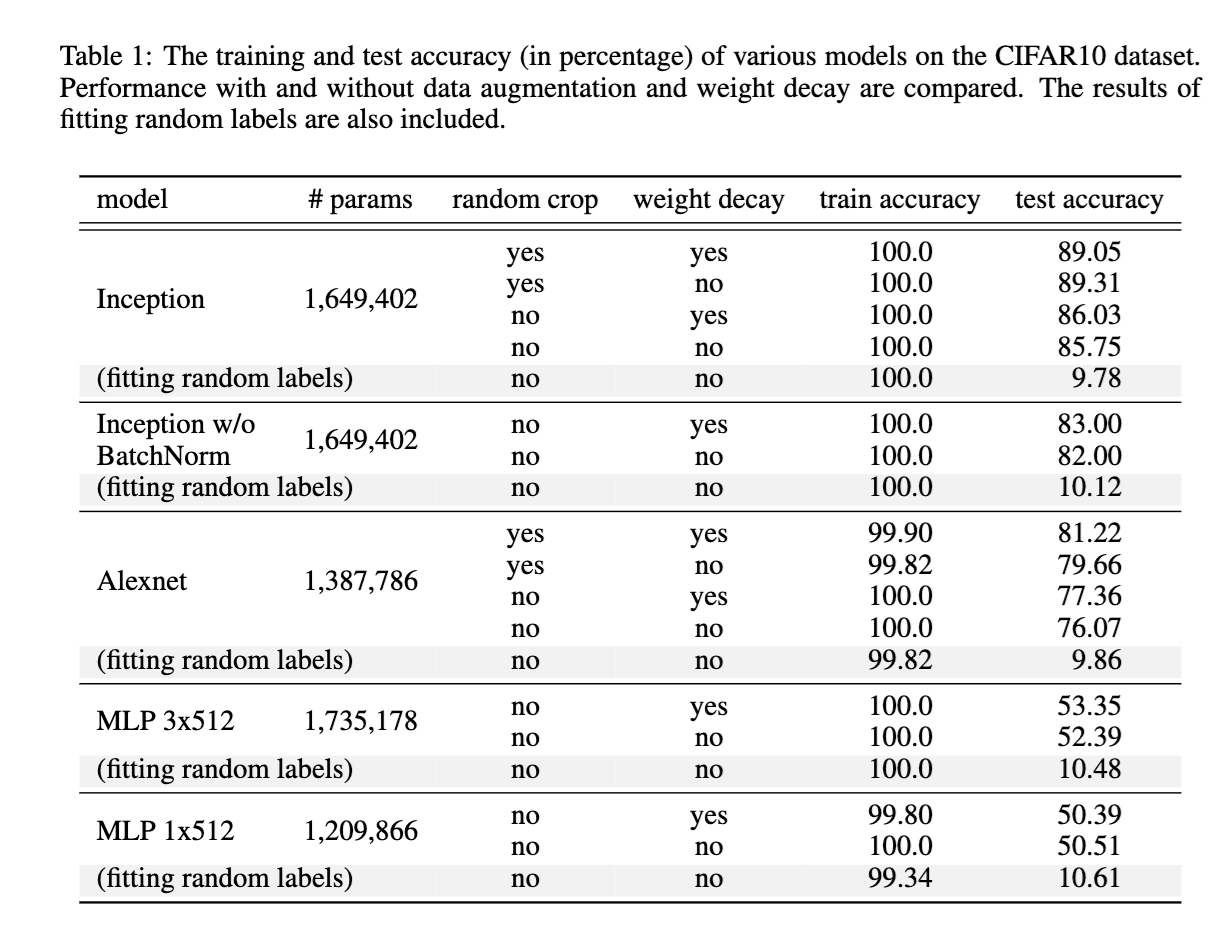
💡See table that rocked DL theory: NNs memorize junk data effortlessly
⚡ 30-Second TL;DR
What Changed
NNs overfit random labels using standard training, despite high complexity metrics.
Why It Matters
Shattered optimism in extending statistical learning to deep nets, pushing field toward new explanations for generalization.
What To Do Next
Replicate Zhang 2016 experiments on your NN to test overfitting risks.
Key Points
- •NNs overfit random labels using standard training, despite high complexity metrics.
- •Breaks data-independent generalization bounds like VC dimension and Rademacher.
- •Signals failure of classical theory to explain empirical DL success.
🧠 Deep Insight
AI-generated analysis for this event — not the original article.
🔑 Enhanced Key Takeaways
- •The paper, titled 'Understanding deep learning requires rethinking generalization,' introduced the 'random labeling experiment' which demonstrated that deep neural networks can achieve zero training error on completely randomized data, proving that the capacity of these models far exceeds the complexity of the underlying data distribution.
- •The findings catalyzed a shift in theoretical research toward 'implicit regularization,' suggesting that the optimization algorithm (SGD) itself, rather than just the model architecture, plays a critical role in selecting solutions that generalize well.
- •The paper's impact led to the development of new complexity measures, such as norm-based bounds and PAC-Bayesian frameworks, which attempt to explain generalization by accounting for the specific path taken by gradient descent during training.
🛠️ Technical Deep Dive
- •Experimental setup involved training standard architectures (Inception, AlexNet, MLP) on CIFAR-10 and ImageNet datasets.
- •Randomization tests included: (1) True labels, (2) Random labels, (3) Random pixels, and (4) Gaussian noise.
- •Observed that training time increased by only a small constant factor when labels were randomized, despite the loss function becoming significantly more difficult to optimize.
- •Demonstrated that weight decay (L2 regularization) and data augmentation, while helpful, were not strictly necessary to achieve zero training error on random labels, highlighting the inherent over-parameterization of the models.
🔮 Future ImplicationsAI analysis grounded in cited sources
⏳ Timeline
Weekly AI Recap
Read this week's curated digest of top AI events →
👉Related Updates
AI-curated news aggregator. All content rights belong to original publishers.
Original source: AI Alignment Forum ↗
This is a summary, not the original. Read the source, or get the weekly briefing.
The weekly digest
One email a week. Unsubscribe anytime.