Zero-Gravity Seats Face Safety Scrutiny and New Standards
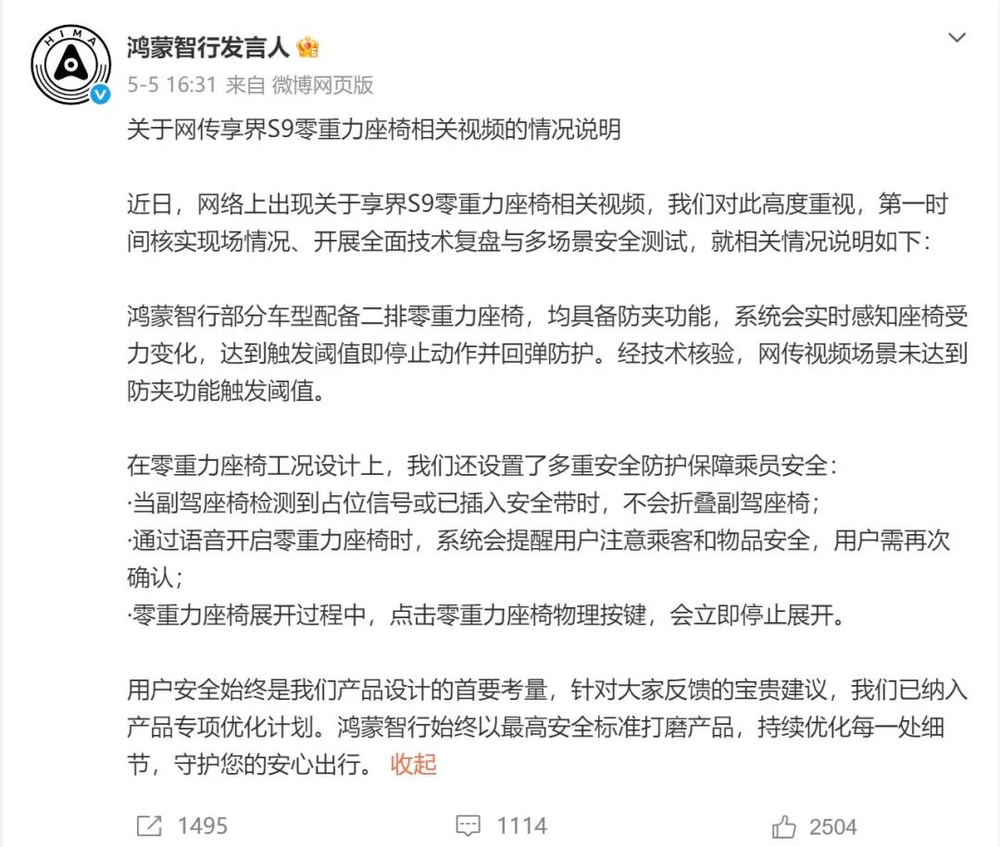
💡Critical safety warning on automotive interior design trends and the upcoming regulatory shift for smart cabins.
⚡ 30-Second TL;DR
What Changed
Zero-gravity seats lack unified safety standards, leading to inconsistent designs and significant injury risks during crashes.
Why It Matters
Automakers must pivot from marketing-driven comfort features to engineering-heavy integrated safety systems to comply with upcoming regulations.
What To Do Next
If building automotive AI or cabin monitoring systems, prioritize safety-critical sensor fusion to detect occupant posture and trigger real-time safety interventions.
Key Points
- •Zero-gravity seats lack unified safety standards, leading to inconsistent designs and significant injury risks during crashes.
- •Testing shows that in a 50km/h collision, occupants in a 'laid-back' position face spinal injury risks comparable to a 5-story fall.
- •New national standards (GB 15083-2019 revision) are in development to mandate safety requirements for large-angle reclining seats.
🧠 Deep Insight
Web-grounded analysis with 19 cited sources.
🔑 Enhanced Key Takeaways
- •The 'zero-gravity' seat concept originated from NASA's research into 'neutral body posture' (NBP) for astronauts in microgravity, aiming to minimize stress on the body during prolonged sitting.
- •Nissan pioneered the integration of this technology into automotive seats, first introducing their 'Zero Gravity' seats in the 2013 Nissan Altima.
- •The adoption of zero-gravity seats in China has seen rapid growth, with the number of equipped car models increasing from 32 in 2022 to 117 in 2024, and the feature expanding from luxury vehicles to mainstream models under CNY200,000.
- •Beyond collision risks, zero-gravity seats also present active safety concerns, notably the lack of unified anti-pinch standards for electric adjustment mechanisms, as highlighted by a public incident where a child was trapped in a showroom vehicle.
- •The current Chinese national standard, GB 15083-2019, primarily addresses structural strength and passive safety of seats but does not yet include specific requirements for anti-pinch functions, voice-controlled operations, or occupant protection in highly reclined positions.
🛠️ Technical Deep Dive
- Zero-gravity seats are designed to replicate a neutral body posture (NBP) by reclining the backrest to approximately 120–128 degrees and elevating the legs to reduce spinal pressure.
- Nissan's implementation utilizes a patented shape and 14 pressure points to provide continuous support from the hips to the shoulders, aiming to maximize blood flow and reduce muscle strain.
- The design often incorporates a two-piece backrest with a flexible joint and multi-density padding to distribute pressure evenly and support the natural curvature of the spine.
- Development involves extensive ergonomic analysis, including joint research with institutions like Yamazaki Laboratory at Keio University, utilizing seat simulators and musculoskeletal models.
- Advanced zero-gravity seats may feature 'Seat Sensing Posture ID' technology to detect a user's body size, sitting posture, and fatigue level for adaptive adjustments.
- Safety solutions for large-angle reclined seats, such as those developed by Yanfeng, can include a Pre-Crash Seat Rapid Return mechanism, Follow Up Seat, Hoodie Airbag, Buttock Airbag, and Seat Integrated Seat Belt (All Belt to Seat) to enhance protection during collisions.
- The complex coordinated movement of rails, backrests, and leg rests during seat folding makes it challenging to establish a fixed anti-pinch threshold.
🔮 Future ImplicationsAI analysis grounded in cited sources
⏳ Timeline
📎 Sources (19)
Factual claims are grounded in the sources below. Forward-looking analysis is AI-generated interpretation.
- Google Search Source
- Google Search Source
- Google Search Source
- Google Search Source
- Google Search Source
- Google Search Source
- Google Search Source
- Google Search Source
- Google Search Source
- Google Search Source
- Google Search Source
- Google Search Source
- Google Search Source
- Google Search Source
- Google Search Source
- Google Search Source
- Google Search Source
- Google Search Source
- Google Search Source
Weekly AI Recap
Read this week's curated digest of top AI events →
👉Related Updates


AI-curated news aggregator. All content rights belong to original publishers.
Original source: 虎嗅 ↗