๐ŸฏFreshcollected in 24m

Why your brain is hardwired for overeating
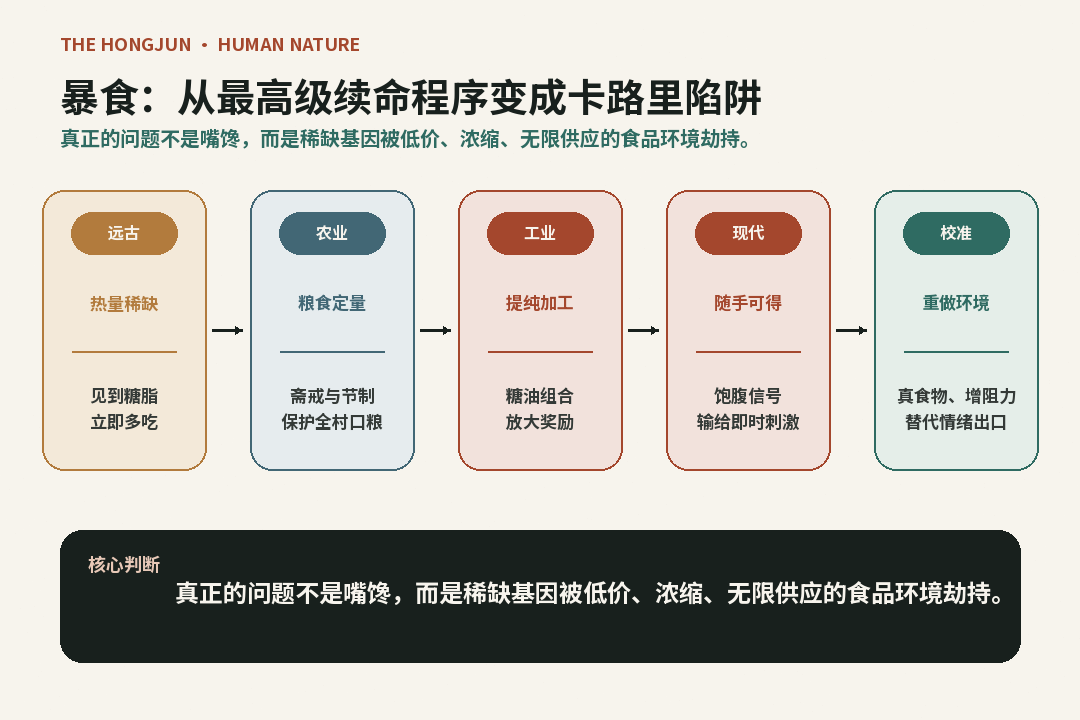
Why your brain is hardwired for overeating
PostLinkedIn
๐ŸฏRead original on ่™Žๅ—…

๐Ÿ’กLearn how evolutionary biology and modern algorithms conspire to override human willpower in food consumption.

โšก 30-Second TL;DR

What Changed

Evolutionary biology favored ancestors who consumed high-calorie foods to survive scarcity.

Why It Matters

Understanding these biological feedback loops is crucial for developers building health-tech or habit-tracking AI, as it highlights the limitations of willpower against algorithmic nudges.

What To Do Next

If building a health app, design features that increase the 'friction' of unhealthy choices rather than relying solely on user willpower.

Who should care:Developers & AI Engineers

Key Points

  • โ€ขEvolutionary biology favored ancestors who consumed high-calorie foods to survive scarcity.
  • โ€ขModern food processing 'hacks' the brain's reward system by removing fiber and concentrating sugar/fat.
  • โ€ขStrategies to combat overeating include removing temptation from the environment and choosing whole, unprocessed foods.

๐Ÿง  Deep Insight

AI-generated analysis for this event.

๐Ÿ”‘ Enhanced Key Takeaways

  • โ€ขThe 'thrifty gene hypothesis,' proposed by James Neel in 1962, suggests that certain genotypes predisposed humans to store fat efficiently, providing a survival advantage during periods of famine.
  • โ€ขDopamine signaling in the nucleus accumbens is specifically modulated by the 'bliss point'โ€”a precise concentration of sugar, salt, and fat engineered by food scientists to maximize palatability.
  • โ€ขRecent neuroimaging studies indicate that ultra-processed foods can trigger neurobiological responses similar to substance addiction, involving the downregulation of D2 dopamine receptors.
  • โ€ขThe gut-brain axis plays a critical role in satiety signaling; the rapid absorption of refined carbohydrates bypasses the slower, fiber-mediated release of GLP-1 and PYY hormones that signal fullness.
  • โ€ขEpigenetic research suggests that maternal nutrition and early-life exposure to high-calorie diets can program hypothalamic pathways, permanently altering an individual's set point for hunger and satiety.

๐Ÿ› ๏ธ Technical Deep Dive

  • Neurobiological Mechanism: Hyper-palatable foods trigger the mesolimbic dopamine system, specifically the ventral tegmental area (VTA) projecting to the nucleus accumbens.
  • Hormonal Regulation: Ghrelin (the hunger hormone) is secreted by the stomach, while Leptin (the satiety hormone) is secreted by adipose tissue; ultra-processed foods often induce leptin resistance, preventing the brain from registering energy sufficiency.
  • Sensory-Specific Satiety: This phenomenon, where the pleasure derived from a specific food decreases as it is consumed, is significantly blunted by the complex flavor profiles of ultra-processed foods, leading to increased total caloric intake.

๐Ÿ”ฎ Future ImplicationsAI analysis grounded in cited sources

Regulatory bodies will mandate 'ultra-processed' labeling on food packaging by 2030.
Growing scientific consensus on the addictive nature of processed foods is driving legislative pressure to treat them similarly to tobacco or alcohol.
Personalized nutrition based on gut microbiome analysis will become the primary intervention for obesity.
Advances in sequencing technology allow for tailored dietary plans that bypass generic 'hardwired' triggers by optimizing individual metabolic responses.

โณ Timeline

1962-01
James Neel proposes the Thrifty Gene Hypothesis.
2009-05
The NOVA classification system is introduced to categorize foods by degree of processing.
2018-02
Major studies link ultra-processed food consumption to increased cancer risk.
2023-11
Global health organizations formally recognize the link between food addiction and obesity.
๐Ÿ“ฐ

Weekly AI Recap

Read this week's curated digest of top AI events โ†’

๐Ÿ‘‰Related Updates

AI-curated news aggregator. All content rights belong to original publishers.
Original source: ่™Žๅ—… โ†—

Why your brain is hardwired for overeating | ่™Žๅ—… | SetupAI | SetupAI