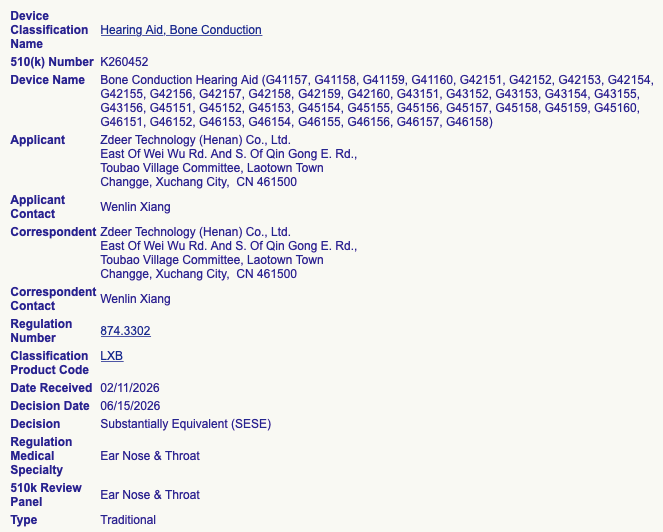
zdeer Secures FDA Approval for Global Hearing Aid Market
💡FDA-approved medical tech leveraging AI for audio processing is a growing sector for edge AI developers.
⚡ 30-Second TL;DR
What Changed
zdeer achieves FDA regulatory compliance
Why It Matters
The integration of AI-driven signal processing in modern hearing aids is a growing trend; FDA approval allows zdeer to compete with established global players.
What To Do Next
Research the integration of edge AI in medical devices to understand how small-form-factor hardware handles real-time audio processing.
Key Points
- •zdeer achieves FDA regulatory compliance
- •Expansion into the international hearing aid market
- •Increasing competitiveness of Chinese medical technology firms
🧠 Deep Insight
AI-generated analysis for this event — not the original article.
🔑 Enhanced Key Takeaways
- •zdeer (Zhidie) has historically focused on health and wellness hardware, such as smart moxibustion devices, marking this hearing aid approval as a significant diversification into medical-grade audiology equipment.
- •The FDA clearance specifically pertains to Over-the-Counter (OTC) hearing aid regulations, which were finalized in the U.S. to increase accessibility and lower costs for adults with perceived mild-to-moderate hearing impairment.
- •zdeer leverages advanced digital signal processing (DSP) algorithms to compete with established incumbents by offering high-fidelity sound amplification at a lower price point.
- •The company's strategy involves integrating AI-driven noise reduction technology to differentiate its products in the crowded OTC hearing aid market.
- •This regulatory milestone follows a broader trend of Chinese consumer electronics manufacturers pivoting toward high-margin, regulated medical device sectors to mitigate saturation in domestic markets.
📊 Competitor Analysis▸ Show
| Feature | zdeer (OTC) | Bose/Lexie (OTC) | Jabra Enhance (OTC) |
|---|---|---|---|
| Pricing | Competitive/Mid-range | Premium/Mid-range | Premium |
| DSP Technology | AI-Enhanced | Proprietary | Advanced Clinical-Grade |
| Target Market | Mild-to-Moderate | Mild-to-Moderate | Mild-to-Moderate |
| Distribution | Global E-commerce | Retail/Direct | Direct-to-Consumer |
🛠️ Technical Deep Dive
- Utilizes multi-channel Wide Dynamic Range Compression (WDRC) to manage varying sound input levels.
- Incorporates adaptive feedback cancellation algorithms to minimize whistling artifacts common in compact hearing aids.
- Features Bluetooth Low Energy (BLE) connectivity for direct audio streaming and smartphone app-based customization.
- Employs directional microphone arrays to improve speech intelligibility in noisy environments.
🔮 Future ImplicationsAI analysis grounded in cited sources
⏳ Timeline
Weekly AI Recap
Read this week's curated digest of top AI events →
👉Related Updates



AI-curated news aggregator. All content rights belong to original publishers.
Original source: 钛媒体 ↗
This is a summary, not the original. Read the source, or get the weekly briefing.
Weekly AI briefing
One email a week. Unsubscribe anytime.