YouTube introduces AI-powered playlist curation
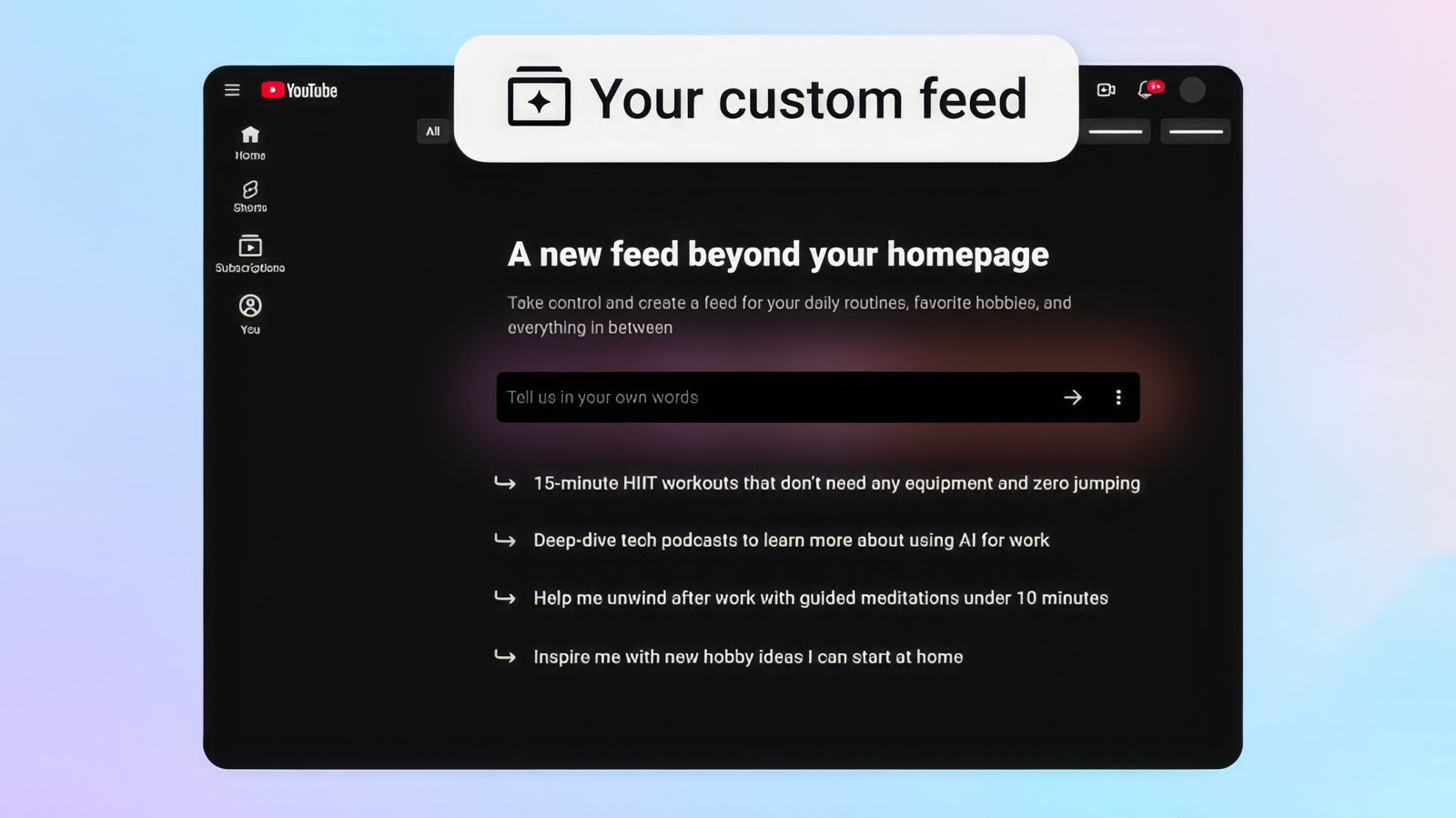
💡See how YouTube is shifting from manual to AI-assisted content curation to improve user engagement.
⚡ 30-Second TL;DR
What Changed
YouTube integrates AI to automate video playlist curation for users.
Why It Matters
This integration signals YouTube's broader strategy to embed generative AI into user-facing content management tools. It may change how creators and viewers interact with recommendation algorithms.
What To Do Next
Explore the YouTube Data API to see if playlist metadata or AI-curated tags become accessible for programmatic integration.
Key Points
- •YouTube integrates AI to automate video playlist curation for users.
- •The feature aims to simplify content organization and discovery within the platform.
- •This update follows YouTube's recent efforts to label AI-generated videos.
🧠 Deep Insight
AI-generated analysis for this event — not the original article.
🔑 Enhanced Key Takeaways
- •The new AI-powered video playlist curation feature, "Your custom feed," enables users to generate personalized video playlists by inputting text prompts, which can then be pinned to their YouTube homepage for quick access [6].
- •YouTube's AI content labeling system is shifting from voluntary creator disclosure to an automated detection model, with more prominent and permanent labels for photorealistic AI-generated content, especially for videos created with YouTube's own AI tools or those containing C2PA metadata/SynthID watermarks [1, 2, 5].
- •This video playlist curation feature for the main YouTube platform follows YouTube Music's earlier introduction of its "Ask Music" AI playlist generator in September 2024, which allows Premium subscribers to create music playlists using prompts and is likely powered by Gemini [3, 14, 15].
- •The automatic detection system for AI-generated content leverages internal signals and can identify Google's imperceptible SynthID watermarks, which are embedded directly into AI-generated content, as well as C2PA metadata [1, 2].
📊 Competitor Analysis▸ Show
| Feature/Platform | YouTube (Video) | YouTube Music | Spotify | Apple Music |
|---|---|---|---|---|
| Feature Name | Your custom feed [6] | Ask Music / AI Playlist [3, 11, 14, 15] | AI Playlist (formerly Prompted Playlist) [6, 13, 19] | Playlist Playground [10] |
| Target Content | Video playlists [6] | Music playlists [3, 11, 14, 15] | Music & Podcasts [13, 19] | Music playlists [10] |
| Input Method | Text prompts [6] | Text or voice prompts [11, 17] | Text prompts [13, 19] | Plain language prompts [10] |
| Availability | Signed-in users in US (mobile/desktop, English) [6] | Premium subscribers (iOS/Android, US, Canada, Australia, New Zealand) [3, 11, 14, 15] | Premium subscribers (Android/iOS, US, Canada, UK, Ireland, Australia, New Zealand, Sweden) [13, 19] | Active Apple Music subscription (iPhone, iPad, Mac) [10] |
| Key Differentiator | Focus on video content curation, pinning to homepage [6] | Gemini-powered, creates "radio stations" [3, 14] | Expansive prompt capabilities, covers music and podcasts, iterative refinement [13, 19] | AI-generated artwork, cohesive listening experience, collaboration support [10] |
🛠️ Technical Deep Dive
- YouTube's recommendation system is a complex, multi-stage pipeline that integrates AI, deep learning, collaborative filtering, and data science techniques [8, 20].
- The system employs AI for trend prediction and is designed to balance short-term user engagement with long-term satisfaction [8, 20].
- Google developed "Semantic ID," a system that tokenizes billions of videos into meaningful sequences, enabling its Gemini AI model to understand and reason about video content [22].
- Semantic ID utilizes RQ-VAE (Residual Quantized Variational AutoEncoder) to compress videos into hierarchical semantic tokens [22].
- YouTube's automatic AI content detection system for labeling uses internal signals, C2PA metadata, and Google's imperceptible SynthID watermarking technology [1, 2].
- SynthID embeds a signal directly into AI-generated content (images and videos) that is invisible to human viewers but detectable by automated systems [1].
- Google's Video Intelligence API can recognize over 20,000 objects, places, and actions in video, extracting rich metadata at the video, shot, or frame level to facilitate content discovery [27].
🔮 Future ImplicationsAI analysis grounded in cited sources
⏳ Timeline
Weekly AI Recap
Read this week's curated digest of top AI events →
👉Related Updates
AI-curated news aggregator. All content rights belong to original publishers.
Original source: Engadget ↗
This is a summary, not the original. Read the source, or get the weekly briefing.
The weekly digest
One email a week. Unsubscribe anytime.