Your selfies are becoming training data for AI
💡Understand the growing privacy risks and ethical backlash surrounding the use of public personal data in AI training.
⚡ 30-Second TL;DR
What Changed
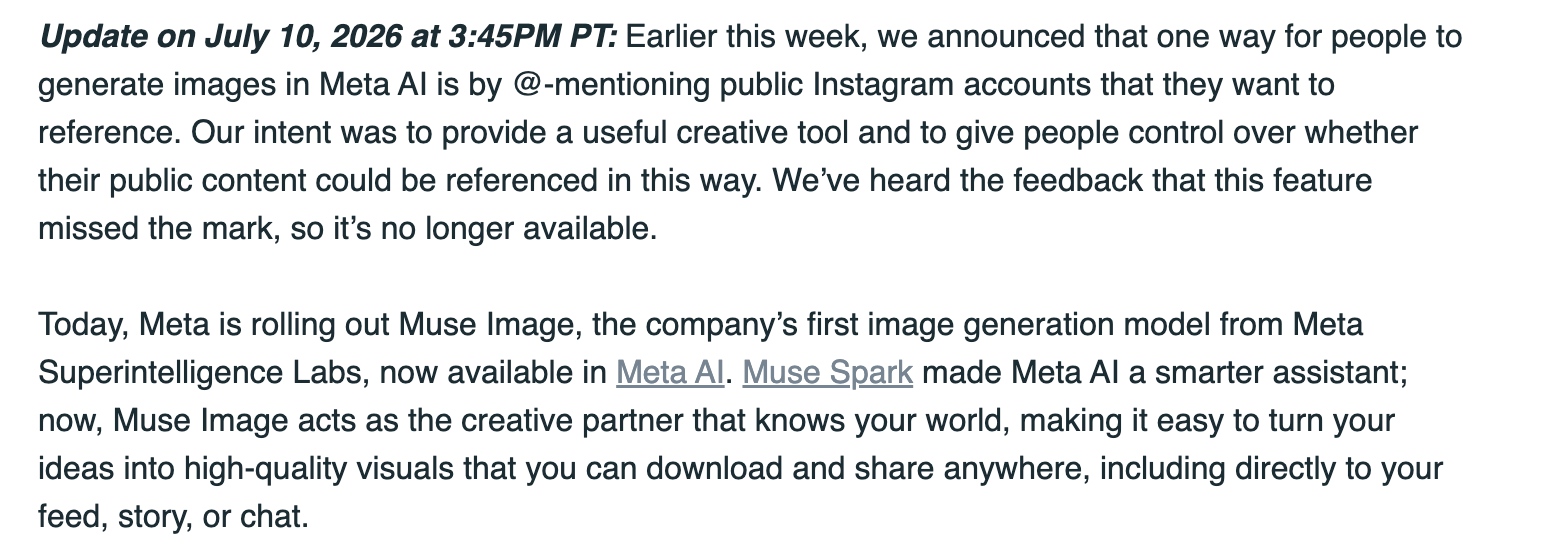
Publicly shared selfies are being repurposed as AI training datasets
Why It Matters
This highlights the growing tension between open data availability and individual privacy rights. Practitioners must consider the ethical implications of their training datasets.
What To Do Next
Implement strict data provenance tracking and opt-out mechanisms in your data ingestion pipelines.
Key Points
- •Publicly shared selfies are being repurposed as AI training datasets
- •Lack of consent in the data scraping process for generative models
- •The risk of personal identity being synthesized into AI-generated content
🧠 Deep Insight
AI-generated analysis for this event — not the original article.
🔑 Enhanced Key Takeaways
- •Major AI companies have faced class-action lawsuits alleging that scraping public social media photos violates biometric privacy laws, such as Illinois' BIPA.
- •The emergence of 'data poisoning' tools like Nightshade and Glaze allows users to add invisible perturbations to images, rendering them unusable for training generative AI models.
- •Regulatory bodies, including the EU's AI Act, have begun implementing stricter transparency requirements for AI developers regarding the provenance of training data.
- •Opt-out mechanisms provided by social media platforms are often criticized for being 'opt-out by default' or ineffective against third-party scrapers who have already harvested historical data.
- •Synthetic data generation is being explored by some AI labs as a potential alternative to scraping human likenesses, though it currently struggles to match the nuance of real-world human data.
🛠️ Technical Deep Dive
- Data Scraping Pipelines: Automated crawlers utilize headless browsers (e.g., Playwright, Selenium) to bypass basic bot detection and extract high-resolution image metadata (EXIF data) alongside visual content.
- Latent Diffusion Model Training: Models like Stable Diffusion utilize CLIP (Contrastive Language-Image Pre-training) to associate scraped image pixels with text captions, effectively mapping human faces to descriptive tags.
- Adversarial Perturbations: Tools like Glaze apply a style-mimicry defense by altering pixel values in a way that is imperceptible to humans but causes the model's feature extraction layer to misclassify the artistic style or facial features.
- Differential Privacy: Some researchers are implementing noise-injection techniques during the training phase to ensure that individual training samples cannot be reconstructed or 'memorized' by the model.
🔮 Future ImplicationsAI analysis grounded in cited sources
⏳ Timeline
Weekly AI Recap
Read this week's curated digest of top AI events →
👉Related Updates



AI-curated news aggregator. All content rights belong to original publishers.
Original source: 钛媒体 ↗
This is a summary, not the original. Read the source, or get the weekly briefing.
The weekly digest
One email a week. Unsubscribe anytime.