Xunsun Intelligence Unveils AI-Driven Software Factory
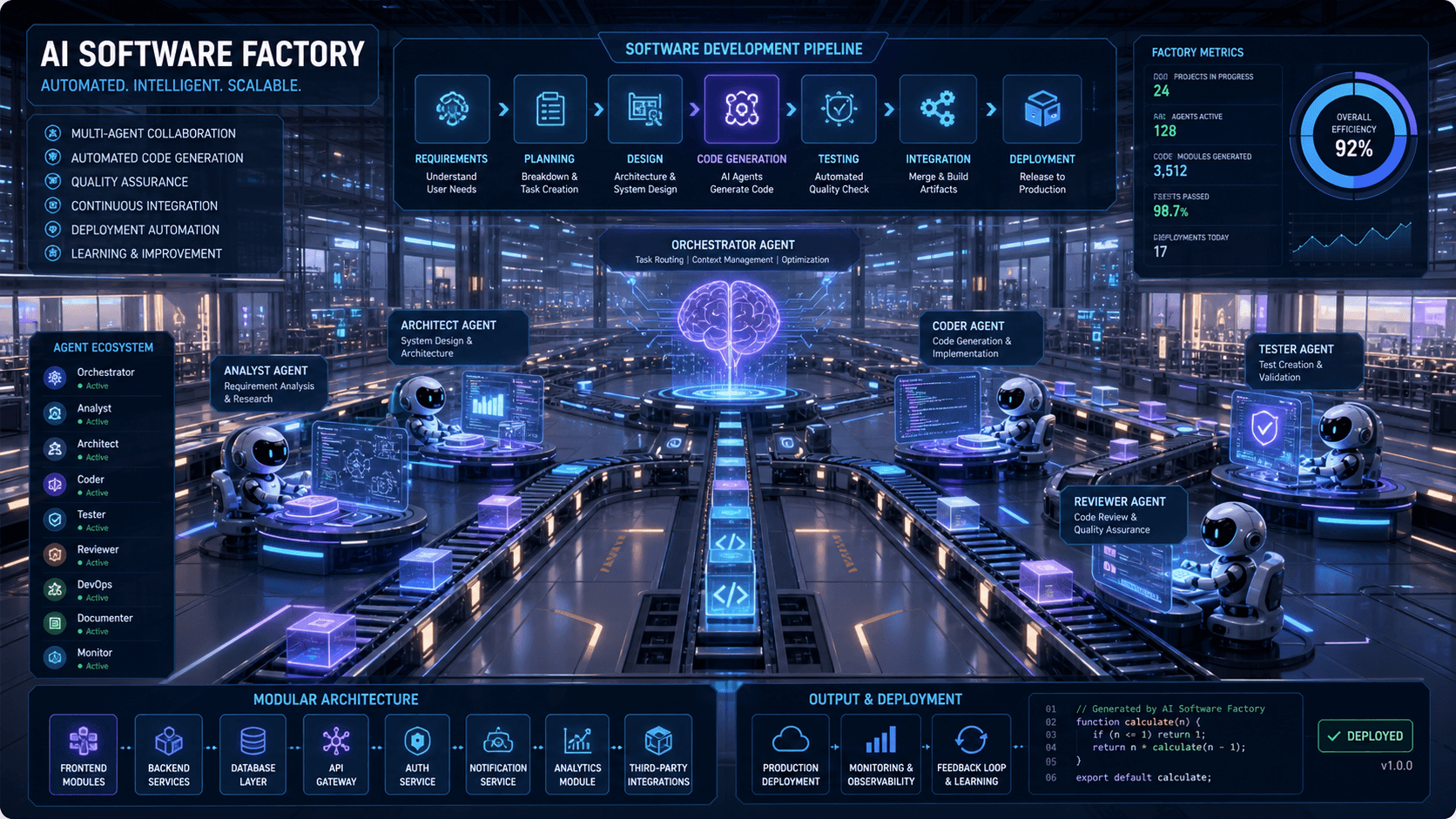
💡A major leap in agentic AI: moving from code generation to full system production via multi-agent collaboration.
⚡ 30-Second TL;DR
What Changed
Introduced AI-Ready requirements modeler for automated system design.
Why It Matters
This platform significantly lowers the barrier to software development by automating the lifecycle from requirements to deployment. It signals a shift toward agentic workflows in enterprise software production.
What To Do Next
Evaluate your current development pipeline to see where multi-agent orchestration can replace manual coding tasks.
Key Points
- •Introduced AI-Ready requirements modeler for automated system design.
- •Utilizes multi-agent collaboration to bridge the gap between requirements and code.
- •Enables full system generation directly from natural language inputs.
🧠 Deep Insight
AI-generated analysis for this event.
🔑 Enhanced Key Takeaways
- •Xunsun Intelligence's platform integrates a proprietary 'Context-Aware Knowledge Graph' that maps natural language business requirements to specific architectural patterns before code generation begins.
- •The multi-agent architecture utilizes a hierarchical structure where 'Architect Agents' define system boundaries, while 'Worker Agents' specialize in specific language stacks and database schemas.
- •The software factory includes a built-in automated testing and self-healing loop that runs continuous integration checks during the generation process to minimize technical debt.
- •Xiong Jibin announced that the platform is designed to support hybrid-cloud deployments, allowing enterprises to keep sensitive code generation processes within private infrastructure.
- •The system features a 'Human-in-the-Loop' (HITL) interface that allows developers to intervene at the requirements modeling stage to adjust constraints before the multi-agent swarm executes the build.
📊 Competitor Analysis▸ Show
| Feature | Xunsun Intelligence | GitHub Copilot Workspace | Devin (Cognition AI) |
|---|---|---|---|
| Core Focus | Enterprise System Factory | Developer Productivity | Autonomous Software Engineer |
| Requirements Modeling | AI-Ready Modeler (Graph-based) | Natural Language Prompting | Task-based Planning |
| Deployment | Hybrid-Cloud/On-Prem | Cloud-Native | Cloud-Native |
| Agent Architecture | Hierarchical Multi-Agent | Single/Paired Agent | Autonomous Agent Swarm |
🛠️ Technical Deep Dive
- Architecture: Utilizes a proprietary Large Language Model (LLM) fine-tuned on enterprise-grade software architecture patterns and design documents.
- Modeler: Employs a graph-based requirements engine that converts unstructured natural language into structured JSON-LD schemas for system design.
- Agent Framework: Implements a custom orchestration layer that manages state synchronization between specialized agents (Architect, Coder, Tester, DevOps).
- Self-Healing: Features a feedback loop where failed unit tests trigger an automated re-prompting of the Coder Agent with the error stack trace.
🔮 Future ImplicationsAI analysis grounded in cited sources
⏳ Timeline
Weekly AI Recap
Read this week's curated digest of top AI events →
👉Related Updates

AI-curated news aggregator. All content rights belong to original publishers.
Original source: Pandaily ↗