XtalPi Hits First Profit on 201% Revenue Surge
💡First HK-listed AI for Science co profitable—validates sector's business potential
⚡ 30-Second TL;DR
What Changed
First annual profit reported in 2025
Why It Matters
Demonstrates viability of AI for Science business models. May spur investments in AI-driven drug discovery and materials science. Signals maturing profitability in HK AI listings.
What To Do Next
Review XtalPi's investor filings for AI platform integration opportunities.
Key Points
- •First annual profit reported in 2025
- •Revenue growth of 201% to $112 million
- •Pioneering profitable HK-listed AI for Science firm
🧠 Deep Insight
AI-generated analysis for this event — not the original article.
🔑 Enhanced Key Takeaways
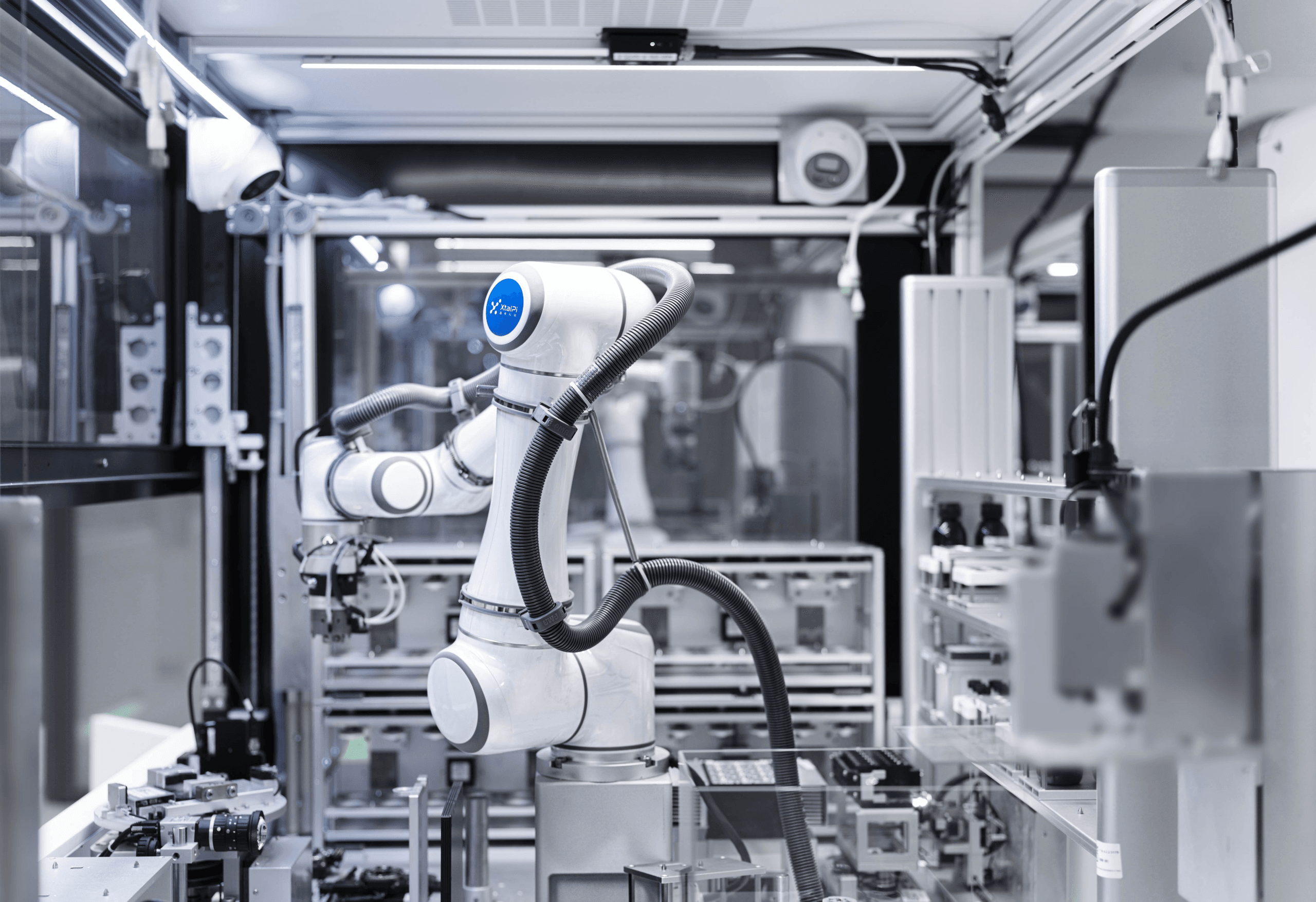
- •The revenue growth was primarily driven by the expansion of XtalPi's 'AI + Robotics' automation platform, which integrates high-throughput experimental data with generative AI models to accelerate drug discovery cycles.
- •XtalPi's profitability is attributed to a strategic shift toward high-margin integrated drug discovery service contracts, moving away from pure-play software licensing models.
- •The company successfully leveraged its '18A' listing status on the Hong Kong Stock Exchange, utilizing capital raised to scale its proprietary wet-lab infrastructure, which serves as a critical data feedback loop for its AI algorithms.
📊 Competitor Analysis▸ Show
| Competitor | Core Focus | Business Model | Key Differentiator |
|---|---|---|---|
| Schrödinger | Physics-based computational chemistry | Software licensing & collaborative drug discovery | Long-standing industry standard in molecular modeling |
| Insilico Medicine | Generative AI for drug discovery | End-to-end drug discovery pipeline | Strong focus on novel target identification & clinical-stage assets |
| Recursion Pharmaceuticals | AI-enabled biology | Data-driven drug discovery platform | Massive proprietary biological dataset via automated microscopy |
🛠️ Technical Deep Dive
- Hybrid AI-Physics Engine: Combines quantum mechanics-based simulations with deep learning models to predict molecular properties with high accuracy.
- Automated Wet-Lab Integration: Utilizes a closed-loop system where AI-generated molecular designs are automatically synthesized and tested in robotic labs, with results fed back into the model for iterative improvement.
- Generative Chemistry Models: Employs proprietary generative architectures specifically optimized for small molecule drug design, focusing on optimizing ADMET (Absorption, Distribution, Metabolism, Excretion, and Toxicity) profiles early in the pipeline.
🔮 Future ImplicationsAI analysis grounded in cited sources
⏳ Timeline
Weekly AI Recap
Read this week's curated digest of top AI events →
👉Related Updates


AI-curated news aggregator. All content rights belong to original publishers.
Original source: Pandaily ↗
This is a summary, not the original. Read the source, or get the weekly briefing.
The weekly digest
One email a week. Unsubscribe anytime.