XPENG Robotics Raises $900M for Humanoid Production
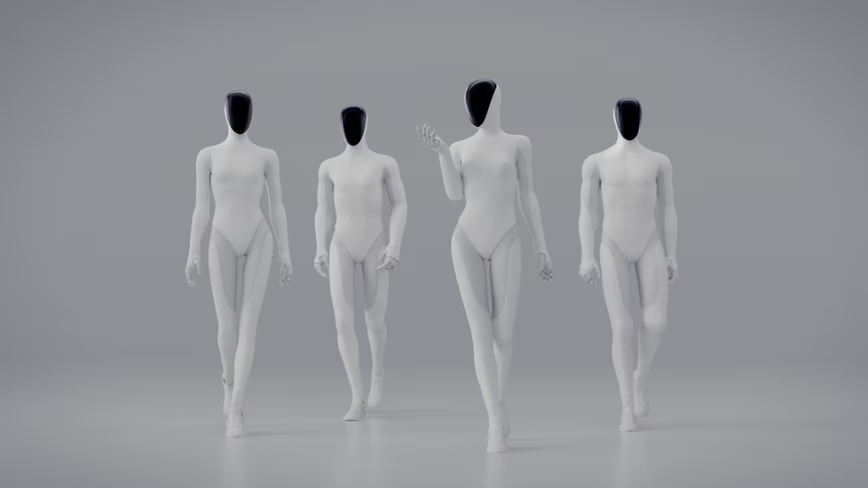
💡XPENG is putting $900M behind a humanoid robot before its first commercial sale.
⚡ 30-Second TL;DR
What Changed
XPENG’s robotics business raised more than $900 million in its first funding round.
Why It Matters
The financing could accelerate XPENG’s move from automotive AI into commercial embodied AI and robotics. For the broader sector, it signals that investors are willing to fund humanoid production before proven revenue, increasing competitive pressure on other robot makers.
What To Do Next
Track XPENG’s IRON production updates and look for a public developer SDK or pilot-program access before planning integrations.
Key Points
- •XPENG’s robotics business raised more than $900 million in its first funding round.
- •The funding was announced ahead of the planned mass production of the IRON humanoid robot.
- •The robotics unit has not yet sold a robot commercially, highlighting investor confidence in embodied AI.
🧠 Deep Insight
Background and context from public sources — not the original article. 10 sources cited.
🔑 Enhanced Key Takeaways
- •The robotics division, operating under the brand name Dogotix, achieved a post-money valuation of over US$6.3 billion following this funding round.
- •The financing round was led by IDG Capital, with significant strategic participation from major tech conglomerates Tencent and Alibaba.
- •XPENG retains a controlling interest of approximately 68.41% in the robotics unit, ensuring the business remains consolidated within the group's financial reporting.
- •The company is pivoting its strategic focus from the quadruped robotics research conducted in 2022 toward the mass production of bipedal humanoid systems.
- •Initial deployment of the IRON units is scheduled to occur internally within XPENG's own retail stores and corporate campuses before external commercial availability.
📊 Competitor Analysis▸ Show
| Feature | XPENG IRON | Tesla Optimus | Unitree G1 |
|---|---|---|---|
| Height | 1.72m | ~1.73m | ~1.32m |
| Degrees of Freedom | 82 | ~28-40 | 23-43 |
| Battery Tech | Solid-state | Lithium-ion | Lithium-ion |
| Primary Compute | 3x Turing AI chips | FSD Computer | Integrated SoC |
🛠️ Technical Deep Dive
- Height: 1.72 meters
- Weight: 70 kilograms
- Degrees of Freedom: 82 total, with 22 DoF in the hands
- Actuation: Utilizes industry-smallest harmonic joints for high-precision manipulation
- Compute: Powered by three in-house Turing AI chips delivering 2,250 TOPS
- Software Architecture: Employs a proprietary Physical World Large Model integrating VLT (Vision-Language-Task), VLA (Vision-Language-Action), and VLM (Vision-Language-Model) frameworks
- Energy Storage: First humanoid to implement full solid-state battery technology, yielding a 30% increase in power density and 30% reduction in weight
🔮 Future ImplicationsAI analysis grounded in cited sources
⏳ Timeline
📎 Sources (10)
Factual claims are grounded in the sources below. Forward-looking analysis is AI-generated interpretation.
Weekly AI Recap
Read this week's curated digest of top AI events →
👉Related Updates

AI-curated news aggregator. All content rights belong to original publishers.
Original source: The Next Web (TNW) ↗
This is a summary, not the original. Read the source, or get the weekly briefing.
Weekly AI briefing
One email a week. Unsubscribe anytime.