Xiaomi's Strategic Shift Beyond Market Trends
💡Understand the strategic challenges facing a major tech giant as it integrates AI and hardware ecosystems.
⚡ 30-Second TL;DR
What Changed
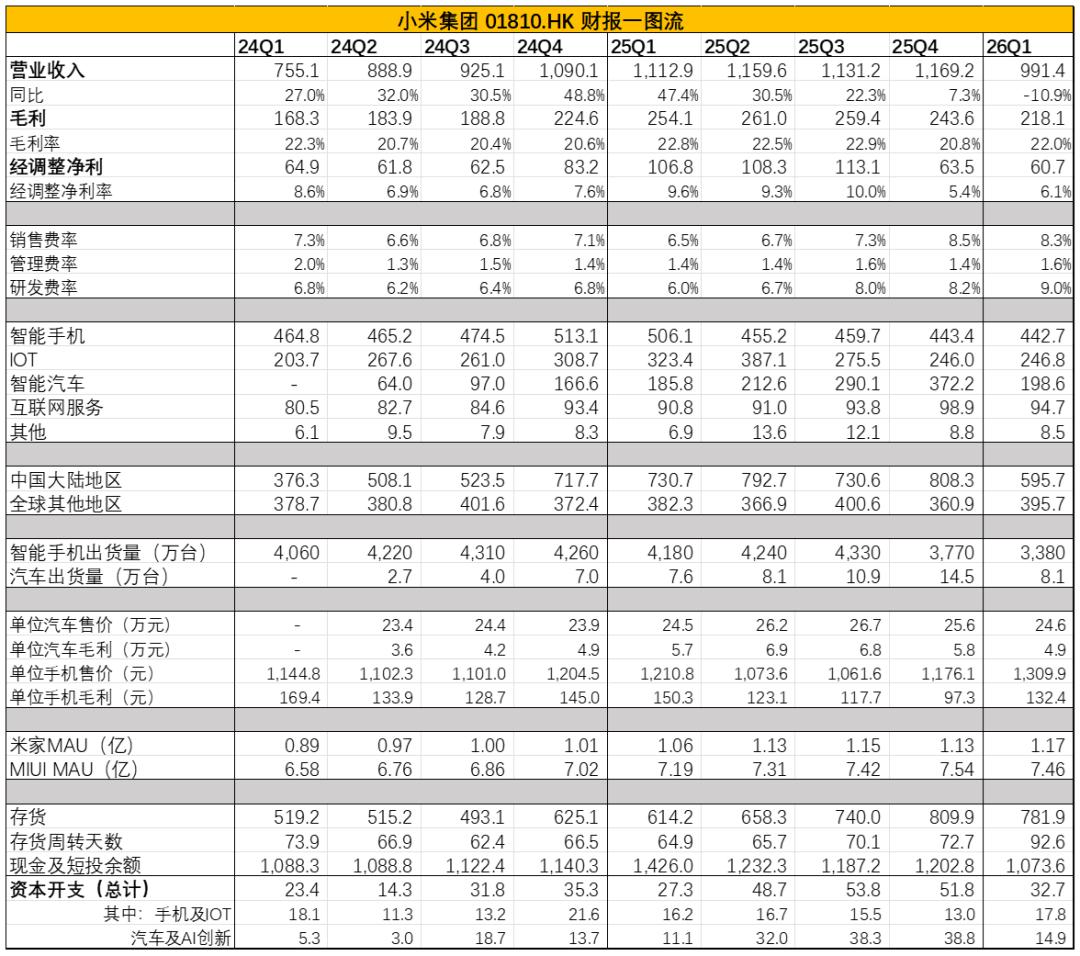
Analysis of Xiaomi's current financial health and revenue structure
Why It Matters
The analysis suggests that Xiaomi must pivot its business model to maintain long-term competitiveness in the evolving AI and EV landscape.
What To Do Next
Review Xiaomi's R&D expenditure in AI and IoT to assess their long-term technical moat.
Key Points
- •Analysis of Xiaomi's current financial health and revenue structure
- •Evaluation of the company's dependency on market trends
- •Strategic outlook for Xiaomi's transition in the tech sector
🧠 Deep Insight
Web-grounded analysis with 25 cited sources.
🔑 Enhanced Key Takeaways
- •Xiaomi's Smart EV, AI, and other new initiatives segment achieved positive full-year income from operations for the first time in 2025, with revenue surging 223.8% year-over-year to RMB106.1 billion, establishing itself as a primary growth engine for the company.
- •Despite a 19.2% decline in global smartphone shipments in Q1 2026, Xiaomi successfully increased its global smartphone Average Selling Price (ASP) by 8.2% year-over-year to a record high of RMB1,310, indicating a strategic shift towards premium devices and higher profitability.
- •The company's 'Human × Car × Home' smart ecosystem strategy, introduced in October 2023, aims to seamlessly integrate personal devices, smart home products, and electric vehicles, supported by significant R&D investment in AI, including the development of a proprietary large language model.
- •The Xiaomi SU7 EV outsold the Tesla Model 3 in China in 2025, delivering 258,164 units, and the company has set an ambitious target of 550,000 EV deliveries for the entire year of 2026, demonstrating rapid market penetration in the automotive sector.
📊 Competitor Analysis▸ Show
Xiaomi EV vs. Key Competitors in China (2025-2026)
| Feature/Metric | Xiaomi SU7 (Mainstream Sedan) | Tesla Model 3 (Sedan) | Xiaomi YU7 (SUV) | Tesla Model Y (SUV) | Geely Xingyuan (Sedan) |
|---|---|---|---|---|---|
| Market Segment | Mid-to-large luxury sedan | Mid-size luxury sedan | Mid-to-large SUV | Mid-size SUV | Sedan |
| 2025 Sales (China) | 258,164 units (outsold Model 3) | 200,361 units | N/A (launched June 2025) | N/A | N/A |
| Q1 2026 Deliveries | 9,233 units (SU7 series) | N/A | 71,623 units (YU7 series) | N/A | N/A |
| April 2026 Sales (China) | 26,826 units (SU7) | N/A | N/A (YU7 series) | 22,990 units (Model Y, 42% MoM plunge) | 34,727 units |
| Pricing (Standard) | From 219,900 yuan (New-Gen SU7) | N/A | From 233,500 yuan (New Standard YU7) | Approx. 30,000 yuan higher than YU7 standard | N/A |
| Key Advantage | "Human-Car-Home" ecosystem integration | Established brand, charging network | Cost advantage, configuration, driving range | Established brand, charging network | High sales volume |
| 2026 Target | 550,000 EV deliveries (total for Xiaomi Auto) | N/A | N/A | N/A | N/A |
Note: Xiaomi also competes in the smartphone market with global players like Samsung, Apple, Oppo, Vivo, and Huawei, maintaining a top-three global shipment ranking for the 5th consecutive year in 2025.
🛠️ Technical Deep Dive
- Xiaomi HyperOS: This operating system, which debuted in October 2023, is a successor to MIUI and is built on Android, integrating the Linux kernel and Xiaomi's proprietary Vela OS for IoT devices.
- Ecosystem Integration: HyperOS is designed to create a seamless 'Human × Car × Home' smart ecosystem, connecting smartphones, smart home products, and electric vehicles.
- HyperCore Architecture: At its core, HyperOS features 'HyperCore,' a redesigned engine that efficiently manages CPU, memory, and background tasks, resulting in faster app loading, reduced installation times, and improved battery life.
- Lightweight Design: The system firmware on smartphones occupies only 8.75GB, achieved through file deduplication and compression of the underlying IO stack.
- Performance Optimization: It boasts refined scheduling capabilities, including dynamic thread priority adjustment and dynamic task cycle evaluation, to ensure optimal performance and power efficiency across diverse scenarios.
- AI Integration: HyperOS leverages large foundation models to enhance system applications, enabling advanced AI Assistant features such as text generation, speech generation, article summarization, real-time subtitles, AI photo search, AI portrait, and AI expansion.
- Security: The OS incorporates a self-developed TEE (Trusted Execution Environment) security system, providing hardware-level protection for sensitive data like passwords and biometrics.
- Cross-Device Connectivity: It facilitates seamless interconnectivity, allowing users to switch camera sources during video conferencing, access car cameras from their phones, and connect tablets to the internet via smartphones.
🔮 Future ImplicationsAI analysis grounded in cited sources
⏳ Timeline
📎 Sources (25)
Factual claims are grounded in the sources below. Forward-looking analysis is AI-generated interpretation.
Weekly AI Recap
Read this week's curated digest of top AI events →
👉Related Updates


AI-curated news aggregator. All content rights belong to original publishers.
Original source: 钛媒体 ↗