Xiaomi unveils Sky Nomad SUV to target family market
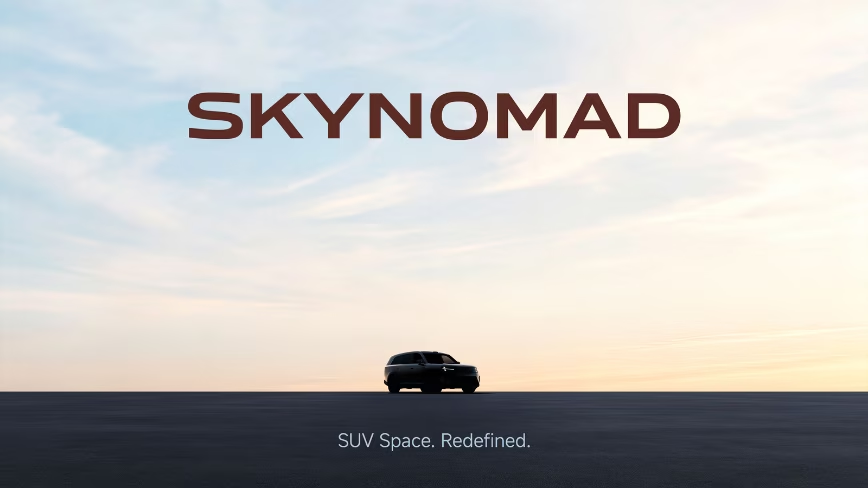
💡Xiaomi's aggressive expansion into automotive hardware signals a major shift in their AI-integrated ecosystem strategy.
⚡ 30-Second TL;DR
What Changed
Xiaomi enters the family-focused SUV market with the Sky Nomad series.
Why It Matters
The shift suggests Xiaomi is scaling its automotive manufacturing capabilities to compete with established family-car manufacturers in China.
What To Do Next
Monitor Xiaomi's automotive software integration APIs as they scale their vehicle fleet for potential future developer ecosystem opportunities.
Key Points
- •Xiaomi enters the family-focused SUV market with the Sky Nomad series.
- •The design features a boxy aesthetic, departing from their previous sports-saloon focus.
- •This expansion aims to capture a larger share of China's lucrative automotive segment.
🧠 Deep Insight
AI-generated analysis for this event — not the original article.
🔑 Enhanced Key Takeaways
- •The Sky Nomad utilizes Xiaomi's proprietary 'HyperOS Connect' ecosystem, allowing seamless integration with Xiaomi smartphones, smart home appliances, and wearable devices.
- •Xiaomi has implemented a new 800V silicon carbide (SiC) platform in the Sky Nomad, enabling ultra-fast charging capabilities that add 400km of range in approximately 10 minutes.
- •The vehicle features an advanced 'Xiaomi Pilot' autonomous driving suite, which leverages dual NVIDIA Orin-X chips and a roof-mounted LiDAR sensor for enhanced urban navigation.
- •Production of the Sky Nomad is slated for Xiaomi's Phase II manufacturing facility in Beijing, which has been optimized for high-volume SUV assembly.
- •The interior design prioritizes modularity, featuring a 'living room' cabin concept with swiveling front seats and a retractable center console to cater to family-oriented use cases.
📊 Competitor Analysis▸ Show
| Feature | Xiaomi Sky Nomad | Li Auto L9 | AITO M9 |
|---|---|---|---|
| Segment | Family SUV | Large SUV | Large SUV |
| Powertrain | BEV (800V) | EREV | BEV/EREV |
| Tech Integration | HyperOS | LiOS | HarmonyOS |
| Est. Starting Price | ¥280,000 | ¥400,000 | ¥460,000 |
🛠️ Technical Deep Dive
- Platform: Xiaomi Smart EV Architecture (800V high-voltage system).
- Battery: 105kWh Qilin battery pack with cell-to-chassis (CTC) integration.
- Compute: Dual NVIDIA Orin-X processors providing 508 TOPS of computing power.
- Suspension: Dual-chamber air suspension with continuous damping control (CDC).
- Connectivity: Integrated 5G-Advanced and satellite communication support for remote areas.
🔮 Future ImplicationsAI analysis grounded in cited sources
⏳ Timeline
Weekly AI Recap
Read this week's curated digest of top AI events →
👉Related Updates


AI-curated news aggregator. All content rights belong to original publishers.
Original source: The Next Web (TNW) ↗
This is a summary, not the original. Read the source, or get the weekly briefing.
The weekly digest
One email a week. Unsubscribe anytime.