World’s First Space AI Controls Ground Robots
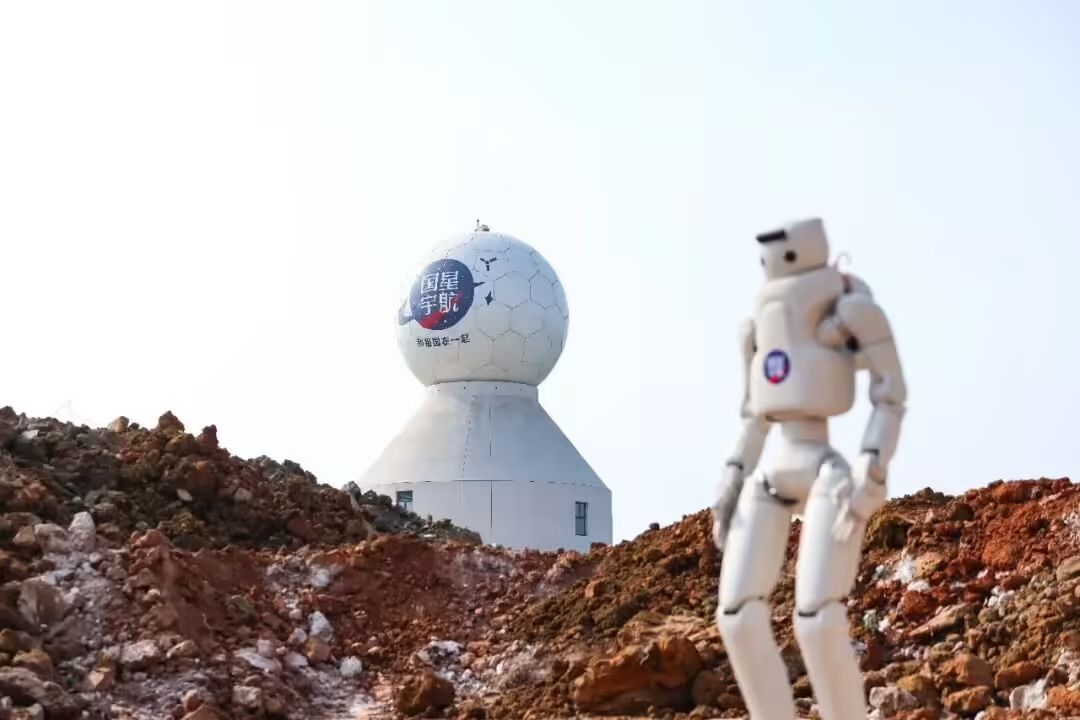
💡First space AI directly controls Earth robots via NLP—game-changer for remote embodied AI.
⚡ 30-Second TL;DR
What Changed
ADASPACE conducted world's first OpenClaw-powered space computing experiment
Why It Matters
This advances embodied AI for remote operations in harsh environments like disasters or exploration. It could reduce latency issues in satellite-robot systems, opening new applications in global robotics infrastructure.
What To Do Next
Download OpenClaw framework and test natural language control on a ground robot simulator.
Key Points
- •ADASPACE conducted world's first OpenClaw-powered space computing experiment
- •Direct control of ground robots from space using natural language
- •Demonstrates space-based AI for real-time Earth robotics
- •Pioneers integration of orbital computing with terrestrial hardware
🧠 Deep Insight
Background and context from public sources — not the original article. 12 sources cited.
🔑 Enhanced Key Takeaways
- •The experiment achieved a record-breaking 180ms round-trip latency, with 90ms dedicated to on-orbit inference and 90ms for communication links, enabling near-real-time control of a 32-DOF bipedal humanoid robot.
- •The system utilized Alibaba's Qwen3 large language model, which was uplinked to the 'Star Compute' constellation in January 2026 to serve as the primary reasoning engine for orbital-to-terrestrial commands.
- •The 'Star Compute' network architecture employs 100 Gbps laser inter-satellite links, allowing the AI to distribute computational loads across a constellation that aims for 2.1 exaFLOPS of total capacity by 2035.
- •OpenClaw functions as a hardware-agnostic AI operating system, using a Virtual Device Interface (VDI) to translate high-level space-based tokens into specific kinematic system calls for diverse ground hardware like the Unitree G1.
- •The demonstration validated 'Space Computing as a Service' (SCaaS), proving that orbital nodes can provide AI cognitive services to 'silicon-based agents' on Earth even when terrestrial grids or networks are unavailable.
📊 Competitor Analysis▸ Show
| Competitor | Primary Focus | Key Technology/Benchmark | Pricing/Model |
|---|---|---|---|
| Starcloud (formerly Lumen Orbit) | Orbital Public Cloud | NVIDIA H100-based orbital training; backed by NVIDIA | Commercial Multi-tenant Cloud |
| SpaceX / xAI | Vertically Integrated AI | Starlink-integrated data centers for xAI workloads | Proprietary/Internal Use |
| Google (Project Suncatcher) | Satellite-based TPUs | Partnership with Planet Labs for orbital AI infrastructure | Hyperscale Extension |
| Loft Orbital | Space Infrastructure | 'YAM' (Yet Another Mission) shared satellite bus | Infrastructure-as-a-Service |
| Axiom Space | Orbital Data Centers | ISS-based data center nodes planned for 2027 | Research & Gov Contracts |
🛠️ Technical Deep Dive
Detailed technical specifications of the ADASPACE and OpenClaw integration:
- Onboard Hardware: The 'Three-Body' constellation satellites feature AI processors delivering 5 POPS (Peta Operations Per Second) per unit, with 30TB of shared orbital storage.
- Model Architecture: Utilizes a quantized version of the Qwen3 MLLM (Multimodal Large Language Model) optimized for the 'Star Computing' Group 01 space center.
- OpenClaw Gateway: A WebSocket-first control plane (default port 18789) that manages sessions, memory persistence, and tool sandboxing via Docker-based isolation.
- Communication Protocol: Employs a 'Live-Link' token-based service invocation that compresses LLM output into actionable control frames to minimize bandwidth consumption.
- Robotic Interface: The ground-side OpenClaw agent uses a ProtocolAdapter to drive 32 degrees of freedom (DOF) with harmonic drive actuators and tendon-driven hand systems.
🔮 Future ImplicationsAI analysis grounded in cited sources
⏳ Timeline
📎 Sources (12)
Factual claims are grounded in the sources below. Forward-looking analysis is AI-generated interpretation.
Weekly AI Recap
Read this week's curated digest of top AI events →
👉Related Updates
AI-curated news aggregator. All content rights belong to original publishers.
Original source: Pandaily ↗
This is a summary, not the original. Read the source, or get the weekly briefing.
Weekly AI briefing
One email a week. Unsubscribe anytime.