Wispr Flow addresses user feedback with UI improvements
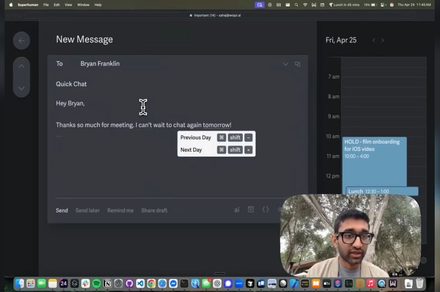
Learn how to effectively leverage community feedback to iterate on AI product UI and improve user retention.
30-Second TL;DR
What Changed
Collected feedback from over 700 users regarding product pain points
Why It Matters
This highlights the importance of community-driven development in AI-powered productivity tools. Rapid iteration based on user friction is essential for maintaining retention in a competitive market.
What To Do Next
Analyze your own product's user feedback loop to identify the top 3 friction points and prioritize them in your next sprint.
Key Points
- •Collected feedback from over 700 users regarding product pain points
- •Prioritized UI adjustments based on direct community criticism
- •Moving the desktop Flow Bar as the first visible improvement
- •Focusing on long-term reliability and performance stability
Deep Insight
AI-generated analysis for this event — not the original article.
Enhanced Key Takeaways
- •Wispr Flow utilizes a proprietary neural interface technology designed to translate subvocalized speech into text, distinguishing it from traditional voice-to-text dictation software.
- •The product is marketed as a 'thought-to-text' solution, aiming to achieve speeds significantly faster than standard typing or conventional voice dictation by bypassing the need for audible speech.
- •The company, Wispr AI, was founded by former Meta and Google engineers with a focus on human-computer interaction (HCI) and non-invasive neural sensing.
- •The Flow Bar UI update is part of a broader initiative to reduce cognitive load, as early adopters reported that the original interface placement interfered with standard workflow multitasking.
- •Wispr Flow integrates with major operating systems via a dedicated hardware wearable that captures electromyography (EMG) signals from the user's neck/jaw area.
Competitor Analysis
- Wispr Flow
- Subvocal/EMG Neural Sensing
- Nuance Dragon
- Audible Voice Dictation
- Otter.ai
- Audio Recording/Transcription
- Wispr Flow
- Localized Signal Processing
- Nuance Dragon
- Cloud-Based Processing
- Otter.ai
- Cloud-Based Processing
- Wispr Flow
- Near-Instant (Neural)
- Nuance Dragon
- Moderate (Audio Processing)
- Otter.ai
- High (Post-Processing)
- Wispr Flow
- Premium Hardware + Subscription
- Nuance Dragon
- Enterprise/Perpetual License
- Otter.ai
- Freemium/Subscription
| Feature | Wispr Flow | Nuance Dragon | Otter.ai |
|---|---|---|---|
| Input Method | Subvocal/EMG Neural Sensing | Audible Voice Dictation | Audio Recording/Transcription |
| Privacy | Localized Signal Processing | Cloud-Based Processing | Cloud-Based Processing |
| Latency | Near-Instant (Neural) | Moderate (Audio Processing) | High (Post-Processing) |
| Pricing | Premium Hardware + Subscription | Enterprise/Perpetual License | Freemium/Subscription |
Technical Deep Dive
- Utilizes surface electromyography (sEMG) sensors to detect neuromuscular signals associated with speech articulation.
- Employs a transformer-based machine learning architecture to decode silent speech patterns into natural language text.
- Implements real-time signal filtering to isolate speech-related EMG data from background muscle noise or movement artifacts.
- The desktop application acts as a HID (Human Interface Device) bridge, allowing the neural input to be injected into any text field across the OS.
Future ImplicationsAI analysis grounded in cited sources
Timeline
- 2023-05Wispr AI emerges from stealth mode with a focus on neural interfaces.
- 2024-02Wispr AI secures significant Series A funding to scale production of their wearable device.
- 2025-09Official commercial launch of Wispr Flow to early access users.
- 2026-06Wispr AI initiates a large-scale feedback collection campaign involving 700+ users.
Weekly AI Recap
Read this week's curated digest of top AI events →
AI-curated news aggregator. All content rights belong to original publishers.
Original source: Digital Trends ↗
This is a summary, not the original. Read the source, or get the weekly briefing.
The weekly digest
One email a week. Unsubscribe anytime.