Why Tesla FSD Still Leads
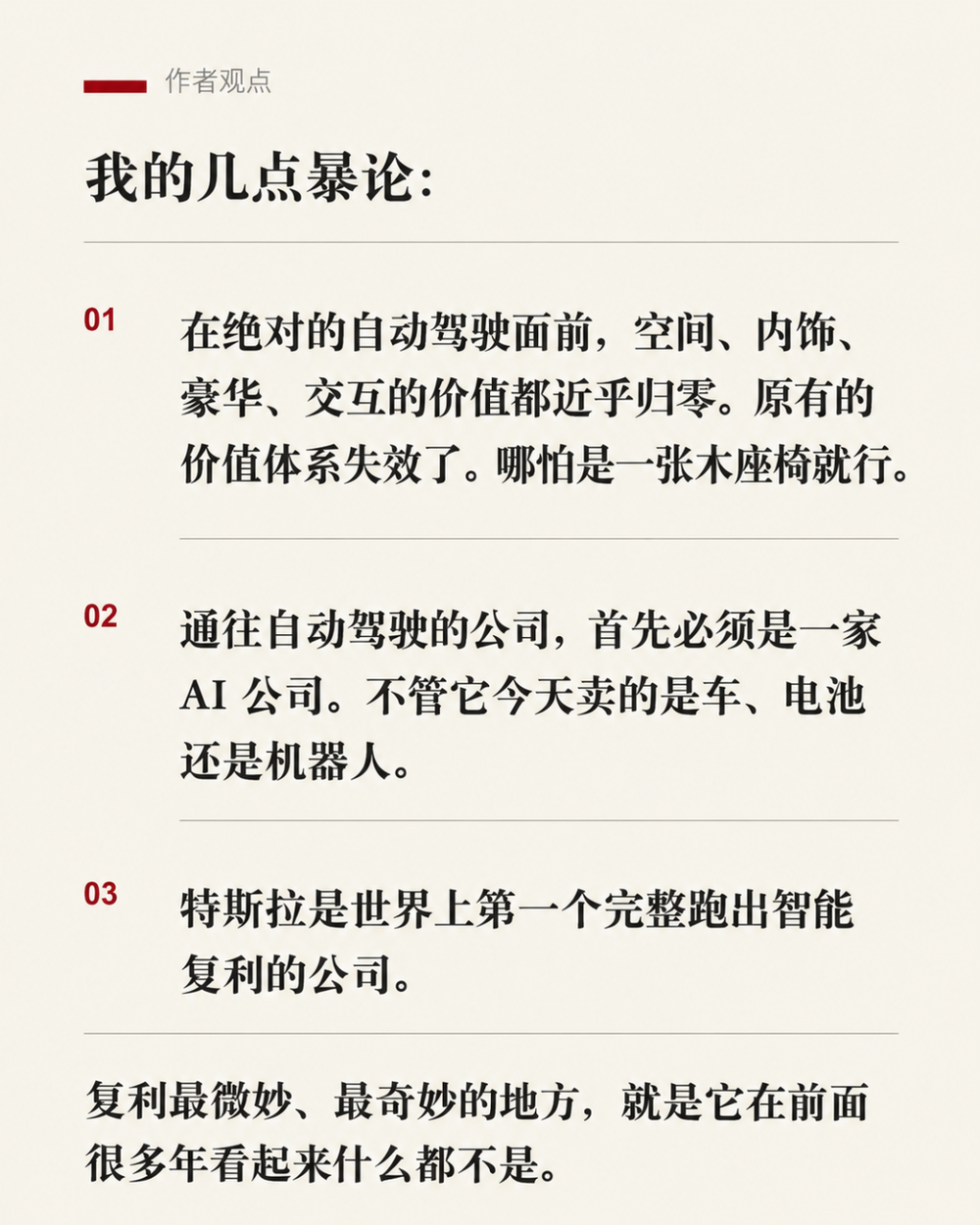
💡Tesla’s FSD edge may come from cloud-scale training and software optimization—not the biggest in-car chip.
⚡ 30-Second TL;DR
What Changed
FSD V12 replaced much of the rule-based urban-driving stack with an end-to-end neural network trained on human driving trajectories.
Why It Matters
For autonomous-driving developers, the article reinforces that model quality depends on the full training and deployment stack, not headline vehicle-side TOPS. It also suggests that companies without comparable data, simulation, and cloud-training capacity may struggle to close the performance gap.
What To Do Next
Benchmark your autonomous-driving model on end-to-end latency, difficult-case recovery, and compiler efficiency instead of comparing vehicle-side TOPS alone.
Key Points
- •FSD V12 replaced much of the rule-based urban-driving stack with an end-to-end neural network trained on human driving trajectories.
- •V13 expanded the system from driving assistance to end-to-end trips, including starting from a parked state, reversing out, and autonomous parking.
- •V14.3 reportedly cut reaction time by 20% through a rewritten AI compiler and runtime, while improving perception and difficult-case behavior.
- •Tesla relies primarily on cameras and embeds safety behavior through reinforcement learning rather than extensive runtime rule-based safeguards.
- •The article argues that Tesla’s major moat is cloud-scale training infrastructure, estimated at about 280,000 H100-equivalent GPUs by June 2026.
Weekly AI Recap
Read this week's curated digest of top AI events →
👉Related Updates



AI-curated news aggregator. All content rights belong to original publishers.
Original source: 虎嗅 ↗
This is a summary, not the original. Read the source, or get the weekly briefing.
Weekly AI briefing
One email a week. Unsubscribe anytime.