Why Still Betting Big on Humanoids in 2026?
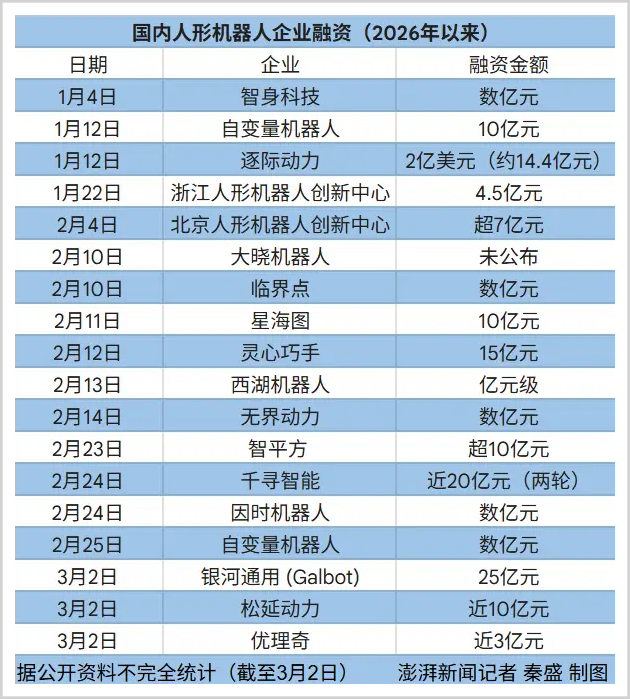
💡2026 humanoid inflection: commercialization or bust? Essential for embodied AI roadmaps.
⚡ 30-Second TL;DR
What Changed
Ongoing aggressive funding in humanoid robot sector.
Why It Matters
Signals maturing humanoid robotics market with high stakes, potentially consolidating leaders while weeding out weaker players. Impacts AI practitioners eyeing embodied AI applications.
What To Do Next
Scout 2026 commercialization timelines from Unitree or Figure for prototype integrations.
Key Points
- •Ongoing aggressive funding in humanoid robot sector.
- •2026 as pivotal 'commercialization first year'.
- •2026 also 'elimination race first year' for firms.
- •Dual opportunity and risk in embodied AI robotics.
🧠 Deep Insight
Background and context from public sources — not the original article. 6 sources cited.
🔑 Enhanced Key Takeaways
- •CES 2026 showcased production-ready humanoids like Boston Dynamics' Atlas deploying in Hyundai factories, Tesla's Optimus Gen 3 operating autonomously, and 1X's NEO accepting $20,000 pre-orders.[1]
- •Several humanoid robotics firms including China's Unitree and Singapore's Otsaw announced IPOs in 2025, with more expected in 2026 amid surging investor interest.[2]
- •Global industrial robot installations hit a record US$16.7 billion in value, with humanoids advancing toward proving reliability, efficiency, and human-level dexterity to compete in factories.[5]
- •Key supply chain bottlenecks for scaling humanoids include vision systems (Ambarella), actuators (Harmonic Drive), edge AI (Qualcomm), and rare earths (MP Materials), offering high-margin investment plays.[1]
🛠️ Technical Deep Dive
- •XPeng’s Next-Gen IRON humanoid features 82 degrees of freedom (22 in hands), lifelike movement, three Turing AI chips for brain processing, and a solid-state battery.[4]
- •Tesla Optimus faces challenges in developing human-capable robotic hands/forearms and a supply chain for over 10,000 unique components, requiring vertical integration.[4]
- •Humanoids rely on NVIDIA’s Isaac Sim for virtual training, Vision Language Models (VLMs) for perceiving unstructured environments, and integrated 'Digital Nervous Systems' to process terabytes of hourly data.[3]
🔮 Future ImplicationsAI analysis grounded in cited sources
⏳ Timeline
📎 Sources (6)
Factual claims are grounded in the sources below. Forward-looking analysis is AI-generated interpretation.
- investorplace.com — Humanoid Robot Stocks Ces 2026 Reveals Commercial Breakout
- nasdaq.com — Humanoid Robotics Key Trends Watch and Investment Insights
- dbr77.com — Industrial Robotics Trends 2026
- themesetfs.com — 3 Exciting Humanoid Robot Stocks to Watch in 2026
- ifr.org — Top 5 Global Robotics Trends 2026
- therobotreport.com — Therobotreport2026 Outlook
Weekly AI Recap
Read this week's curated digest of top AI events →
👉Related Updates



AI-curated news aggregator. All content rights belong to original publishers.
Original source: 钛媒体 ↗
This is a summary, not the original. Read the source, or get the weekly briefing.
Weekly AI briefing
One email a week. Unsubscribe anytime.