Why Standalone AI Browsers Are Losing
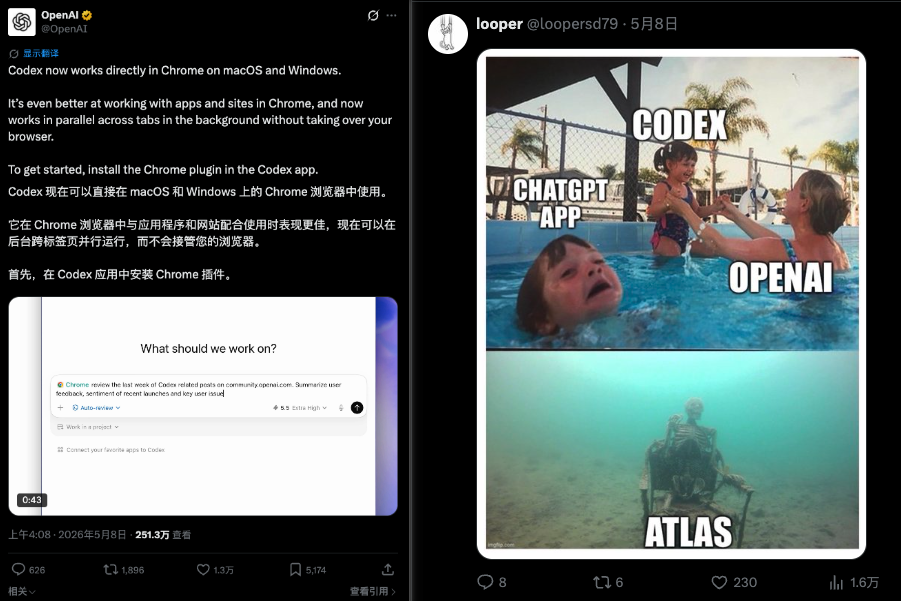
Atlas’s reported shutdown reveals why AI agents may live inside Chrome instead of asking users to switch browsers.
30-Second TL;DR
What Changed
Atlas was launched in October 2025 as a ChatGPT-centered browser intended to make AI a persistent assistant across web tasks.
Why It Matters
For AI builders, the browser may be a distribution surface rather than the product itself. Winning products will likely minimize migration friction while differentiating through trusted context access, agent permissions, enterprise controls, and workflow integration.
What To Do Next
Prototype your agent as a Chrome extension or side panel first, and measure task completion, permission requirements, and retention against a standalone-browser workflow.
Key Points
- •Atlas was launched in October 2025 as a ChatGPT-centered browser intended to make AI a persistent assistant across web tasks.
- •OpenAI's reported retreat reflects the high switching cost of moving bookmarks, accounts, history, extensions, and learned browser habits.
- •Google has integrated Gemini into Chrome, while Anthropic is testing Claude for Chrome and OpenAI is extending Codex and ChatGPT into existing Chrome environments.
- •Perplexity's Comet and Dia are narrowing toward enterprise, knowledge-worker, security, and workflow-specific use cases instead of competing directly with Chrome.
Deep Insight
AI-generated analysis for this event — not the original article.
Enhanced Key Takeaways
- •OpenAI's pivot away from Atlas is part of a broader 'Agentic Web' strategy that prioritizes cross-platform interoperability over proprietary browser environments.
- •User retention data for standalone AI browsers indicated that users were unwilling to abandon Chrome's ecosystem, specifically citing the lack of support for legacy enterprise plugins and password managers.
- •The shift toward 'browser-as-a-service' models allows AI companies to bypass the high customer acquisition costs (CAC) associated with convincing users to switch default browsers.
- •Internal reports suggest that the maintenance overhead of keeping a Chromium-forked browser compliant with rapid security patches was a significant factor in the decision to sunset Atlas.
- •Enterprise adoption of AI agents is currently favoring 'in-context' execution, where AI operates within the user's existing browser session to maintain compliance with corporate data loss prevention (DLP) policies.
Competitor Analysis
- OpenAI (ChatGPT/Codex)
- Extension/Sidebar
- Google (Gemini/Chrome)
- Native Integration
- Anthropic (Claude)
- Extension/API
- Perplexity (Comet/Dia)
- Enterprise Agent
- OpenAI (ChatGPT/Codex)
- Freemium/Plus
- Google (Gemini/Chrome)
- Free/Advanced
- Anthropic (Claude)
- Freemium/Pro
- Perplexity (Comet/Dia)
- Enterprise/Pro
- OpenAI (ChatGPT/Codex)
- Coding/General
- Google (Gemini/Chrome)
- Productivity/Search
- Anthropic (Claude)
- Writing/Analysis
- Perplexity (Comet/Dia)
- Knowledge/Research
| Feature | OpenAI (ChatGPT/Codex) | Google (Gemini/Chrome) | Anthropic (Claude) | Perplexity (Comet/Dia) |
|---|---|---|---|---|
| Primary Strategy | Extension/Sidebar | Native Integration | Extension/API | Enterprise Agent |
| Pricing | Freemium/Plus | Free/Advanced | Freemium/Pro | Enterprise/Pro |
| Workflow Focus | Coding/General | Productivity/Search | Writing/Analysis | Knowledge/Research |
Technical Deep Dive
- Atlas was built on a Chromium-based architecture, requiring continuous upstream merging to maintain security parity with standard Chrome releases.
- The transition to ChatGPT/Codex extensions utilizes the Chrome Extensions API (Manifest V3) to inject context-aware AI overlays directly into the DOM of active web pages.
- Agentic workflows in Perplexity's Comet utilize a specialized RAG (Retrieval-Augmented Generation) pipeline that indexes enterprise-specific knowledge bases rather than relying solely on public web crawls.
- Integration of Gemini into Chrome leverages local model execution for low-latency tasks, reducing the need for constant server-side round trips for simple UI interactions.
Future ImplicationsAI analysis grounded in cited sources
Timeline
- 2025-10OpenAI launches Atlas, a standalone AI-native browser.
- 2026-01OpenAI begins internal evaluation of Atlas user retention and engagement metrics.
- 2026-05OpenAI shifts development resources from Atlas to browser-integrated AI agents.
- 2026-07Reports emerge regarding the impending shutdown of the Atlas project.
Weekly AI Recap
Read this week's curated digest of top AI events →
AI-curated news aggregator. All content rights belong to original publishers.
Original source: 虎嗅 ↗
This is a summary, not the original. Read the source, or get the weekly briefing.
The weekly digest
One email a week. Unsubscribe anytime.