Why Avatr's Sales Suddenly Slumped
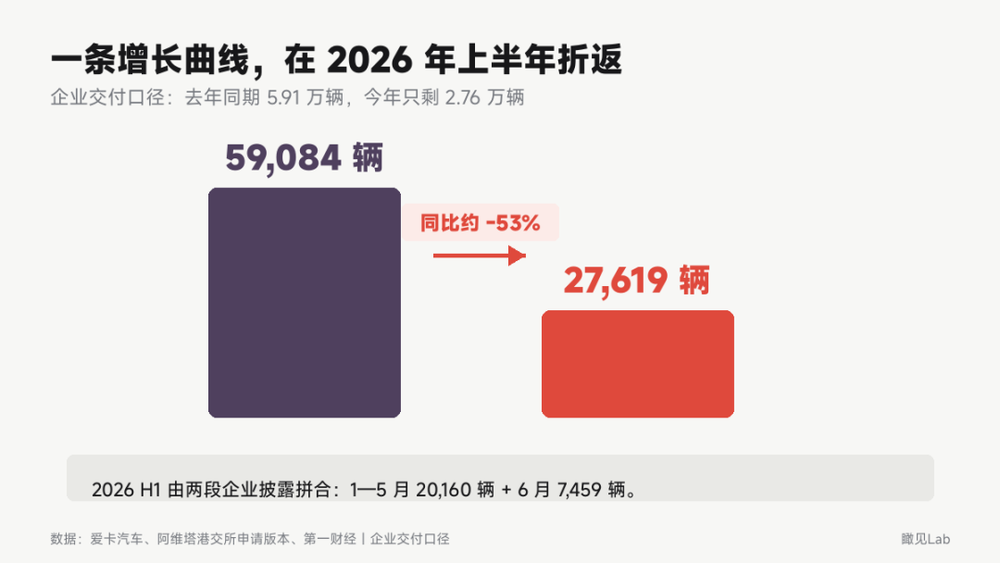
💡Avatr shows why buying the same AI stack as rivals is not enough to win users or build a durable automotive moat.
⚡ 30-Second TL;DR
What Changed
Avatr delivered about 27,600 vehicles in the first half of 2026, compared with roughly 59,100 in the same period of 2025.
Why It Matters
For AI-enabled vehicle builders, the case shows that access to a strong driving stack is becoming table stakes rather than a durable moat. Differentiation will increasingly depend on proprietary data, user experience, scenario-specific autonomy, service quality, and a clearly defined customer segment.
What To Do Next
Benchmark Huawei Qiankun's assisted-driving scenarios against competing stacks on your target routes, focusing on actual intervention rates and user retention rather than feature checklists.
Key Points
- •Avatr delivered about 27,600 vehicles in the first half of 2026, compared with roughly 59,100 in the same period of 2025.
- •Huawei's Qiankun solution has expanded to more than 25 brands and over 50 vehicle models, reducing Avatr's technology differentiation.
- •Avatr's futuristic styling creates brand recognition but may limit appeal among mainstream family-car buyers.
- •The 06, 07, 11, and 12 models appear to lack a sharply defined target customer and usage scenario.
- •The company must clarify whether to prioritize mainstream family utility, youth-oriented luxury, or a distinctive premium identity.
🧠 Deep Insight
AI-generated analysis for this event.
🔑 Enhanced Key Takeaways
- •Avatr's internal restructuring in early 2026 included a shift toward a 'multi-energy' strategy, introducing extended-range electric vehicle (EREV) variants to compete with Li Auto, which diluted the brand's original pure-EV premium positioning.
- •The company faced significant channel conflict as it attempted to integrate its sales network with Changan's broader dealership ecosystem, leading to inconsistent customer service experiences and brand dilution.
- •Avatr's reliance on Huawei's 'HI' (Huawei Inside) model, which grants the automaker full control over vehicle integration, has proven more costly and slower to market compared to the 'Harmony Intelligent Mobility Alliance' (HIMA) model used by partners like Seres.
- •Financial reports from early 2026 indicate that Avatr's marketing expenditure per vehicle sold spiked significantly as the brand struggled to maintain premium pricing against aggressive discounting from competitors like Zeekr and Nio.
- •Supply chain bottlenecks related to the production of the Avatr 07's unique chassis components caused delivery delays in Q1 2026, further exacerbating the year-over-year decline in sales volume.
📊 Competitor Analysis▸ Show
| Feature | Avatr 12 | Zeekr 001 | Nio ET7 |
|---|---|---|---|
| Driving Tech | Huawei Qiankun | Zeekr AD (In-house) | Nio Adam (In-house) |
| Powertrain | Pure EV / EREV | Pure EV | Pure EV / Swap-ready |
| Design Language | Futuristic/Avant-garde | Shooting Brake | Executive Sedan |
| Price Range | Mid-to-High | Mid-to-High | Premium |
🛠️ Technical Deep Dive
- Avatr utilizes the CHN platform, a joint architecture developed by Changan, Huawei, and CATL specifically for high-end intelligent EVs.
- The Qiankun ADS 3.0 system integrates LiDAR, millimeter-wave radar, and high-definition cameras to enable end-to-end autonomous driving capabilities.
- The 07 model introduced the 'Kunlun' range-extender engine, a 1.5T high-efficiency unit designed to bridge the gap between pure EV performance and long-range utility.
- Battery technology features CATL's CTP (Cell-to-Pack) and Qilin battery architectures, supporting 800V high-voltage fast charging platforms.
🔮 Future ImplicationsAI analysis grounded in cited sources
⏳ Timeline
Weekly AI Recap
Read this week's curated digest of top AI events →
👉Related Updates

AI-curated news aggregator. All content rights belong to original publishers.
Original source: 虎嗅 ↗