White House launches Gold Eagle for machine-speed cyber defense
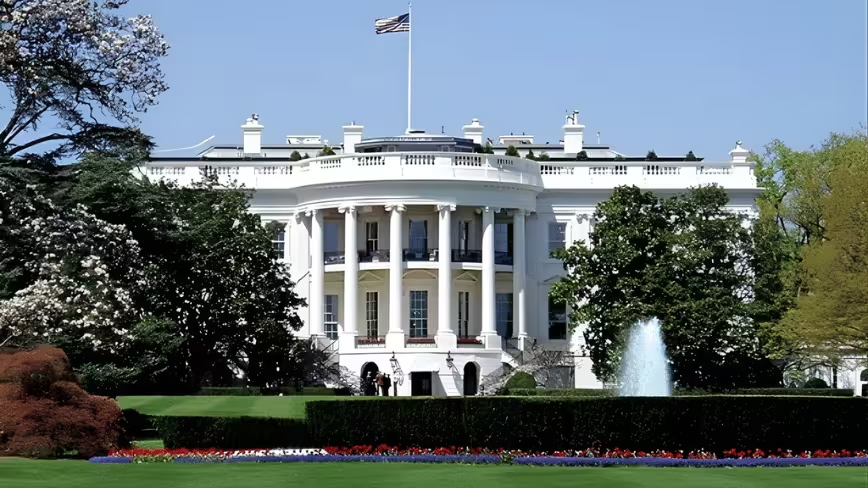
💡Learn how the new Gold Eagle clearinghouse will automate vulnerability patching for critical US infrastructure.
⚡ 30-Second TL;DR
What Changed
Gold Eagle pools vulnerability findings from government and private sectors.
Why It Matters
This marks a major shift toward automated, AI-driven national security. For developers, this means faster vulnerability disclosure cycles and potentially more standardized security requirements for critical infrastructure software.
What To Do Next
Monitor the Gold Eagle initiative for new vulnerability reporting standards that may soon apply to your software supply chain.
Key Points
- •Gold Eagle pools vulnerability findings from government and private sectors.
- •System ranks threats and automates coordination of security patches.
- •Designed to counter the speed of AI-driven cyberattacks.
🧠 Deep Insight
AI-generated analysis for this event.
🔑 Enhanced Key Takeaways
- •Gold Eagle operates under the jurisdiction of the Office of the National Cyber Director (ONCD) in collaboration with CISA's Joint Cyber Defense Collaborative (JCDC).
- •The platform utilizes a federated learning architecture, allowing private sector partners to train threat detection models on local data without exposing proprietary source code or sensitive network telemetry.
- •Gold Eagle integrates directly with the Vulnerability Disclosure Program (VDP) and utilizes the Common Security Advisory Framework (CSAF) to standardize machine-readable patch instructions.
- •The initiative includes a 'Red-Teaming Sandbox' where AI agents simulate adversarial attacks against critical infrastructure digital twins to validate patch efficacy before deployment.
- •Funding for the project was authorized under the 2026 National Defense Authorization Act (NDAA), specifically earmarking resources for 'Automated Defensive Cyber Operations' (ADCO).
📊 Competitor Analysis▸ Show
| Feature | Gold Eagle (US Gov) | Mandiant/Google Cloud Threat Intel | Microsoft Security Copilot |
|---|---|---|---|
| Primary Focus | Critical Infrastructure Protection | Enterprise Threat Intelligence | Enterprise Security Operations |
| Data Source | Gov/Private Sector Aggregation | Proprietary Global Telemetry | Microsoft Ecosystem Telemetry |
| Deployment | Public-Private Partnership | Commercial SaaS | Commercial SaaS |
| Patch Automation | High (Coordinated) | Low (Advisory-based) | Medium (Script-based) |
🛠️ Technical Deep Dive
- Architecture: Employs a decentralized federated learning model to maintain data privacy across participating critical infrastructure entities.
- Data Standardization: Utilizes CSAF (Common Security Advisory Framework) 2.0 for machine-to-machine communication of vulnerability data.
- Integration: Connects via API to existing SIEM/SOAR platforms used by utility providers to trigger automated patch testing.
- AI Engine: Leverages a fine-tuned Large Language Model (LLM) specialized in code analysis and vulnerability remediation pathing, hosted on a secure government cloud environment.
- Validation: Incorporates a digital twin simulation layer to test patch stability before automated deployment to production environments.
🔮 Future ImplicationsAI analysis grounded in cited sources
⏳ Timeline
Weekly AI Recap
Read this week's curated digest of top AI events →
👉Related Updates
Same topic
Explore #cybersecurity
Same product
More on gold-eagle-ai-clearinghouse
Same source
Latest from The Next Web (TNW)
Zipline partners with Cleveland Clinic for drone delivery
Anthropic’s safety hiring signals a focus on existential threats
Apple wins dismissal of iCloud child abuse imagery lawsuit
ASML’s $400M machine prints first laptop processors
AI-curated news aggregator. All content rights belong to original publishers.
Original source: The Next Web (TNW) ↗